
“Morals are for men, not gods.”
Tonight I watched “Where No Man Has Gone Before”. This is the second pilot for TOS but it was the third episode released, airing first on September 22, 1966. It was written by Samuel A. Peeples who would later go on to write an episode of Star Trek: The Animated Series as well.
Story
Is it a coherent story?
There are a couple of plot holes but they don’t really detract much from the story for me. For one, Spock is a telepath. One might have assumed that the Galactic Barrier would have affected him similarly to Mitchell and Dehner, but it doesn’t. For another, it doesn’t seem like stranding Mitchell on Delta Vega would really stop him for long. If his powers continued to progress, surely he’d have been able to construct a ship or lure a ship to him before long. 4/5
Is it enjoyable to watch?
I enjoy this episode. I appreciate the cerebral bits more than the action scenes. Particularly the fight between Kirk and Mitchell on Delta Vega seems like it was shoehorned in. 4/5
Is the dialogue strong and/or memorable?
Yes, Mitchell in particular, gets some very memorable lines. He describes Kirk at the Academy as a stack of books with legs. That description seems to be very memorable with Trekkies. He also gets to refer to himself as a god a few times – he can do things like maybe a god could do, and “soon I’ll squash you like insects!” On Delta Vega, his line, “Can you hear me, James?” always sticks with me, too. 4/5
Does it serve the main cast well?
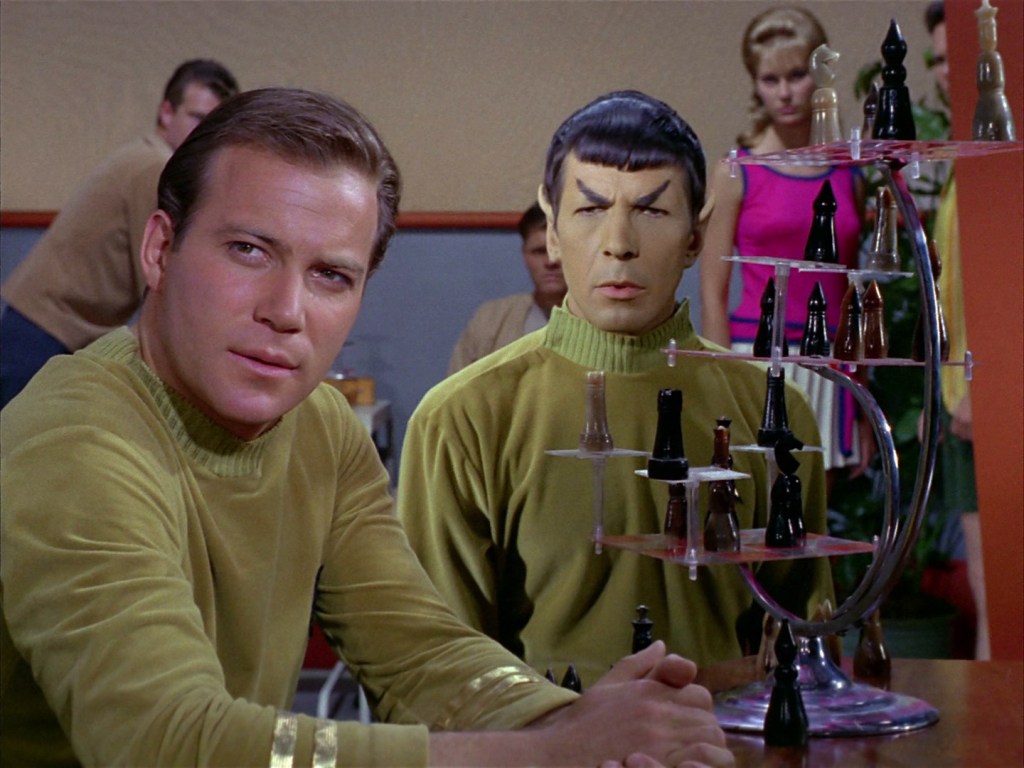
As usual, Kirk and Spock are best-served. The episode opens with them playing tridimensional chess. This would have been the first episode filmed with that prop, though we have already seen it in “Charlie X” at this point. They have a brief exchange about Spock playing an irritating game, and Spock noting that irritation is a Human emotion (yet he smirks while saying it). Spock also gets an important line at the end of the episode. He tells Kirk of Mitchell, “I felt for him, too” which tells us that Spock is not emotionless. He feels, but suppresses his emotions.
Kirk is a man of action, torn between loyalty to his old friend, Gary Mitchell, and ensuring the safety of his ship and crew. In the fight on Delta Vega, Kirk’s uniform tunic is torn – something that will happen many times again. But, as much as Kirk is down for fisticuffs, he also displays thoughtful intelligence. He asks Dehner whether Gary will acquire the wisdom he needs to be a god, saying that above all else, a god needs compassion. 4/5
If there are guest or recurring characters, are they memorable or interesting?
Paul Carr appears as Lt. Lee Kelso. Unfortunately, he dies in this episode (the 10th death after 9 crewmembers die in the passage through the Galactic Barrier). He does a good job with what he’s given. It’s a shame we lost him. He might have become an interesting recurring character.
Instead of Dr. Boyce from “The Cage”, here we get another older doctor: Dr. Piper, played by Paul Fix. He doesn’t get a lot to do in this episode. He’s overshone by Sally Kellerman as Dr. Elizabeth Dehner. I really enjoy her. Like Kelso and Mitchell, she would have been an interesting recurring character. Alas, this is her only appearance.
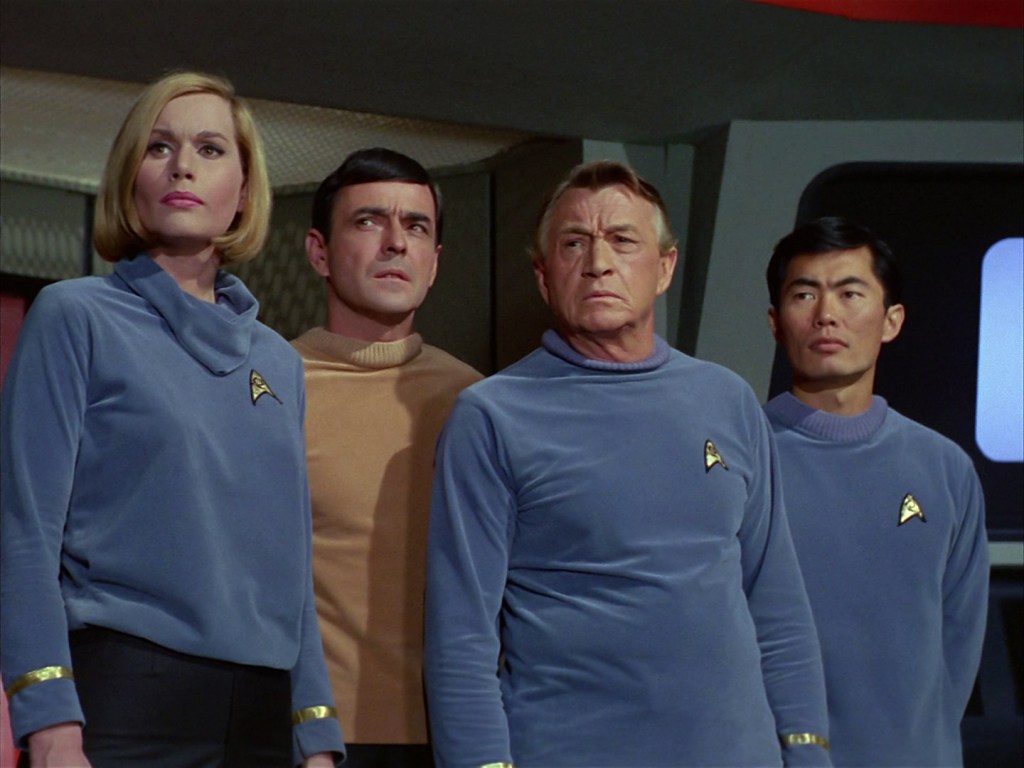
Gary Lockwood plays Gary Mitchell, two years before he would be immortalized as a sci-fi legend in 2001: A Space Odyssey. Mitchell really serves to tell us about Kirk. They’ve known one another for 15 years, so Mitchell is in a perfect position to share some backstory about the captain and to provide him with an emotional arc in the story.
We see Scotty in the transporter room, where he belongs, and he has some dialogue about engineering always being ready. 4/5
World-building
Does it contribute positively to the Trek Universe?
I think this episode is the first time we’ve heard mention of an Academy. This will, of course, later become Starfleet Academy, and be an important part of the Trek universe. There is a mention of the Aldebaron Colony. We will go on to hear about many products and creatures from Aldebaron in future episodes. We learn about a missing vessel called the SS Valiant, which has left behind an “old-style ship recorder”. It’s always fun to get references to other ships. 3/5
Is it consistent with the rest of canon?
There is a Delta Vega in the 2009 Star Trek film, which would seem to be a different celestial body than the one visited here.
The bridge viewscreen is the same one we saw in “The Cage”. It will soon be swapped out for the familiar design that will stay with the ship for the remainder of the series. The briefing room set is also the one from “The Cage” but with a fresh paint job and red accents.
Sickbay is referred to as both “sickbay” and the “dispensary”. Its walls are painted really green! The same colour is used on the beds and computer monitors. It’s quite distracting if you’re familiar with the look of the set for the rest of the series.
The largest anachronism is that when Mitchell creates a tombstone for Kirk, it reads “JAMES R. KIRK”. The R would become a T for Tiberius elsewhere. 3/5
Is there something new and unique?
This is the third of the three episodes aired that includes some kind of telepathy (the fourth if you include “The Cage”). That’s becoming a bit of a trope. 2/5
Does the science seem plausible?
We know that there is no Galactic Barrier at the edge of our galaxy and I think they must have known that at the time. However, it remains established in the Trek universe and we’ll see it again. It’s at least internally consistent. However, when we encounter it later, it doesn’t have the same effect on our crewmembers. They must have developed a defense against it. 2/5
Production
Production design (sets, props)
As mentioned above, the standing sets are in the process of transition from their appearance in “The Cage” to what their regular appearance would be. There’s a wall with a window on Delta Vega that we’ll see re-used several times on the series.
The planet set is the same as that used in “The Cage”. There is a section that is built up off the floor so that Mitchell can conjure a small fountain and pool. The little area that he re-develops with a variety of colourful plants is quite lovely.
The communicators we see are the ones from “The Cage” and Spock also carries one of the original laser pistols. What’s new in this episode is the glorious phaser rifle which is a beautiful prop.
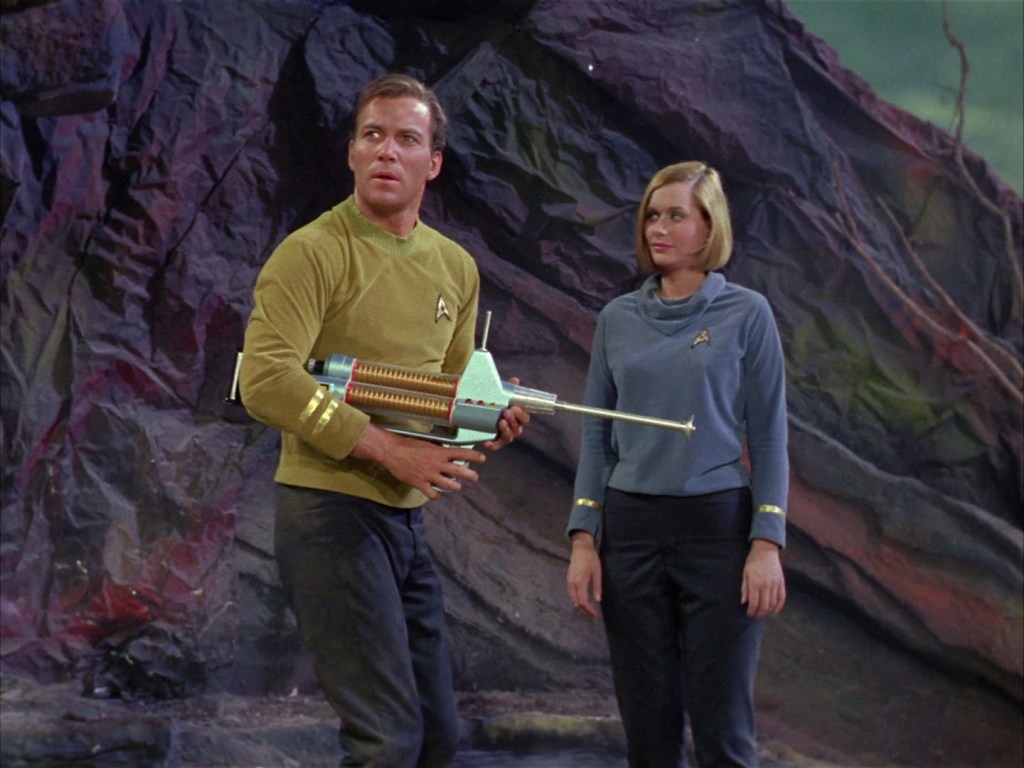
Kelso takes a coffee break at one point. We see Mitchell using what would become a very familiar grey, branded coffee cup.
We see Piper give Kirk a pill to help rouse him after Mitchell attacks him. Pills are very uncommon on Trek, but we will see them again. There’s the infamous kidney pill in Star Trek IV: The Voyage Home, for example. 4/5
Costumes
Our crew is wearing the uniforms from “The Cage”. Dr. Dehner is especially flattered by the blue velour cowl-neck tunic. We still see women wearing uniform pants in this episode. The only other notable pieces of costuming are some heavy duty belts the landing party wears, and a blue smock that Dr. Piper wears at one point. 3/5
Make-up and Hair
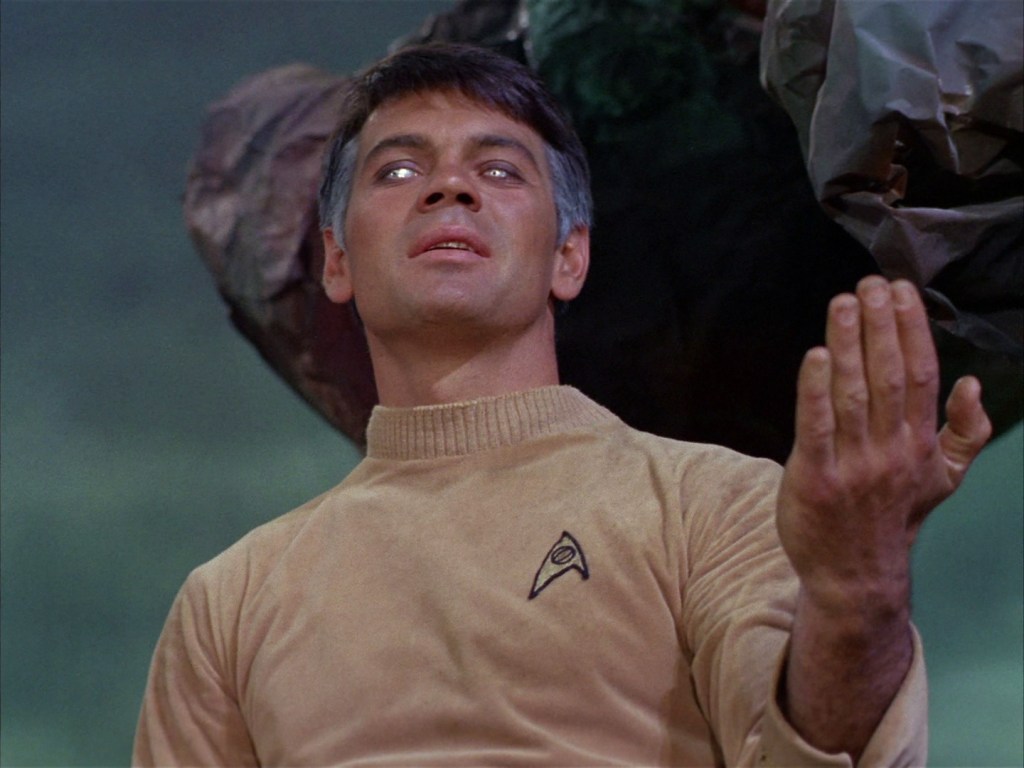
The most notable thing here is the silver contact lenses that Kellerman and Lockwood wear. These were apparently solid but for a tiny pin hole, so they had to tilt their heads back in order to see anything. This ended up working well. It gave them a haughty look.
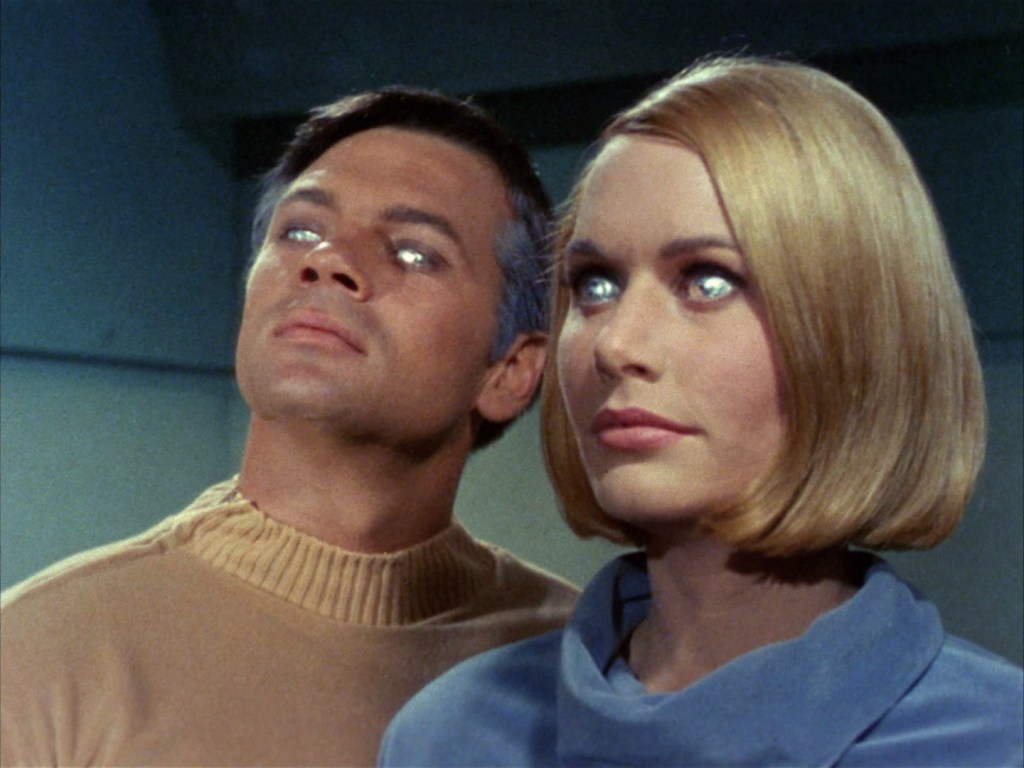
Kirk doesn’t yet have his customary pointed sideburns in this episode.
Mitchell’s temples get progressively greyer throughout the episode. 3/5
Visual Effects
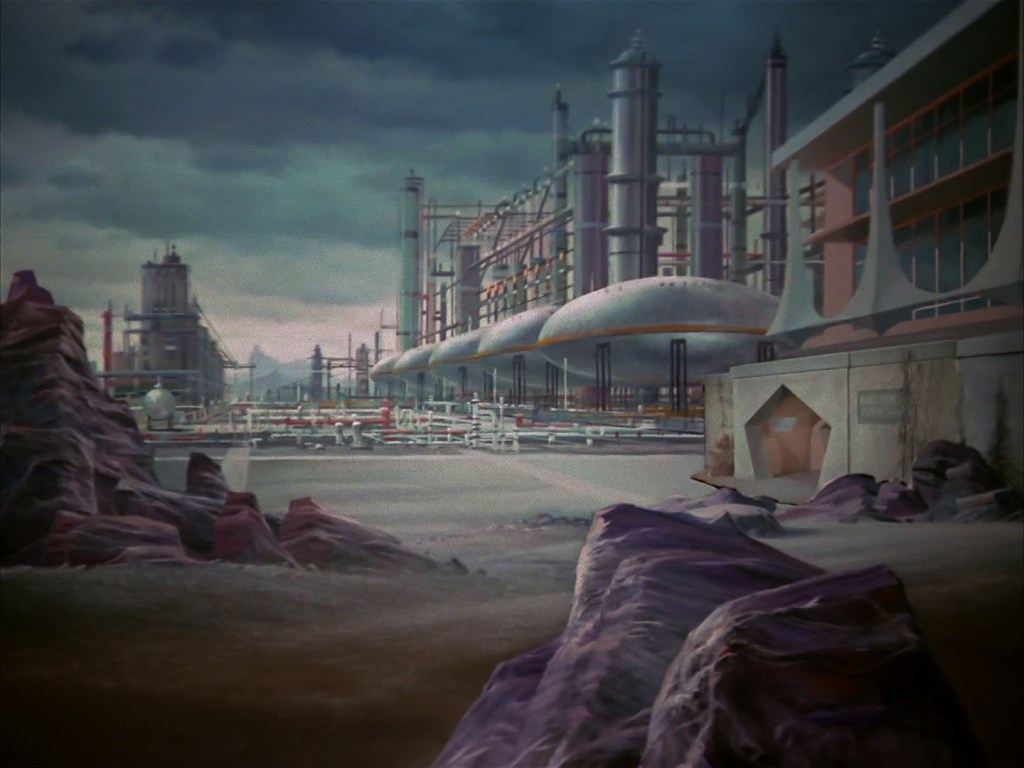
There’s a great matte painting representing Delta Vega. There seems to be differences of opinion about who created it; either Albert Whitlock or Garson Citron.
The effects representing the Galactic Barrier in the remastered edition of the episode are quite lovely. There are some beautiful shots of the Enterprise moving through it.
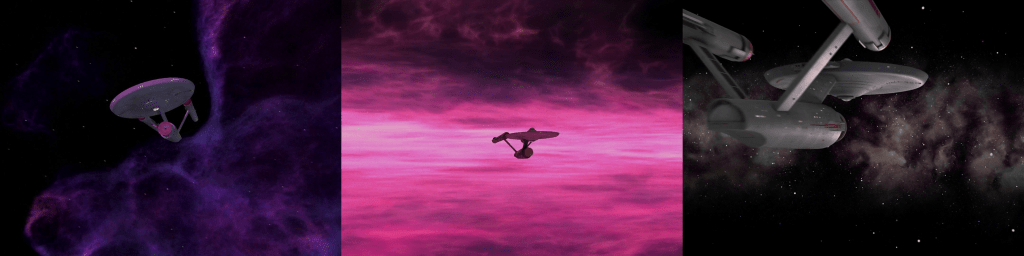
There are some lightning animation effects when Mitchell and Dehner attack people. There’s also an animated effect of the phaser rifle beam hitting Mitchell. 4/5
Music
The music was written by Alexander Courage. I have to confess that I didn’t really notice it. 3/5
Acting (series regulars and guests)
All the performances are quite strong in this episode. There are a few great two-handers; one for Kirk and Spock, one for Mitchell and Dehner, and one for Dehner and Kirk. Mitchell and Dehner start out fairly antagonistic towards each other. Mitchell refers to her as a “walking freezer unit” which is definitely not professional behaviour for the bridge! He later apologizes and quotes a sonnet that was written by Gene Roddenberry. It’s called “Nightingale Woman” and is quite beautiful.
There are moments on the bridge where Spock is yelling commands as he did in “The Cage”. I would categorize that as a performance issue, but he just hadn’t figured out the character entirely yet.
Dehner has a few moments where she becomes quite impassioned in defence of espers and of Mitchell’s transformation. She has a line about how a mutated superior man could be a wonderful thing, which must have been a challenge to deliver with a straight face. 4/5
Direction (coherent, memorable)
This episode was directed by James Gladstone. He would go on to direct one other episode in the first season of TOS. There’s not too much that stood out to me in this area. He does an interesting zoom-in to Mitchell’s silver eyes on the bridge, and a lot of up-the-nose close-ups of Mitchell in sickbay. I’d say the direction is generally fine. 3/5
Philosophy
Is it thought-provoking?
This episode asks the question, can a man handle the power of a god? It seems to answer that absolute power corrupts absolutely. A god driven by Human frailty cannot live successfully amongst regular Humans. They will always have the tendency to abuse their power. 4/5
Does it deal with a moral or ethical issue?
Should Kirk kill his friend of 15 years in order to protect his crew? Of course, he can’t. Kirk can’t punish a man for crimes he’s yet to commit. Instead, he chooses to strand Mitchell on a remote planet. This fails, and Kelso is killed. Kirk would have saved Kelso’s life if he had ended Mitchell’s but Star Trek rarely settles for that kind of scale balancing. 4/5
Is it consistent with Trek’s optimism and Humanism?
I think it is. I think Trek’s Humanism says that we are amazing as we are, and that we have the potential to learn and grow. When an evolution is forced upon us by accident, we don’t have the maturity to deal with it. Maybe if we arrived at that state naturally, we would have the skill to manage it properly. The notion that Kirk won’t impose a death sentence on someone (given the option) also speaks to Trek’s philosophy. 4/5
IDEA (Inclusion, Diversity, Equity, Accessibility)
Here, we’re talking mainly about gender again. The only substantial part for a woman in this episode is Dehner. She’s portrayed as cold, and calculating but she is a doctor and they do consult her for her expertise. In the scene I mentioned above where Mitchell apologizes to her, she sort of minimizes the situation by saying that “women professionals do tend to overcompensate.”
Dehner eventually helps Kirk to defeat Mitchell, but it happens at the expense of her own life. 3/5
Conclusion
My ratings for this episode add up to 69/100 – the lowest so far. Of the two pilots, I think “The Cage” is stronger.


2 comments