
“No other specimen has shown your adaptability. You were our last hope.”
The format and content of these reviews may evolve over time, but here’s a first attempt!
Tonight I watched “The Cage”. This is the original pilot for Star Trek, written by Gene Roddenberry and directed by Robert Butler. The episode was filmed November 27 – December 18, 1964 at Desilu – Culver and the budget is estimated to be over $500,000.
Story
Is it a coherent story?
The short answer is “yes”. In fact, it’s a great story – if a little predictable today. 4/5
Is it enjoyable to watch?
Yes, again. The run-time is about 63 minutes and it zips along quickly. 4/5
Is the dialogue strong and/or memorable?
Yes, there are some really memorable lines. For example, one favourite is from the Talosian Keeper: “Wrong thinking is punishable. Right thinking will be as quickly rewarded.” This is, of course, reminiscent of “crimethink” from Orwell’s 1984. It demonstrates that Roddenberry was reading and borrowing from the classics of science fiction. 4/5
Does it serve the main cast well?
Yes, the main cast are all served well with this story. The focus is on Jeffrey Hunter’s Christopher Pike. We meet him as a man who is tired, burnt out, and considering retiring from Starfleet. Throughout the course of the episode, we see him find his way back to being a confident leader. This would have set him up well had he continued in the series.
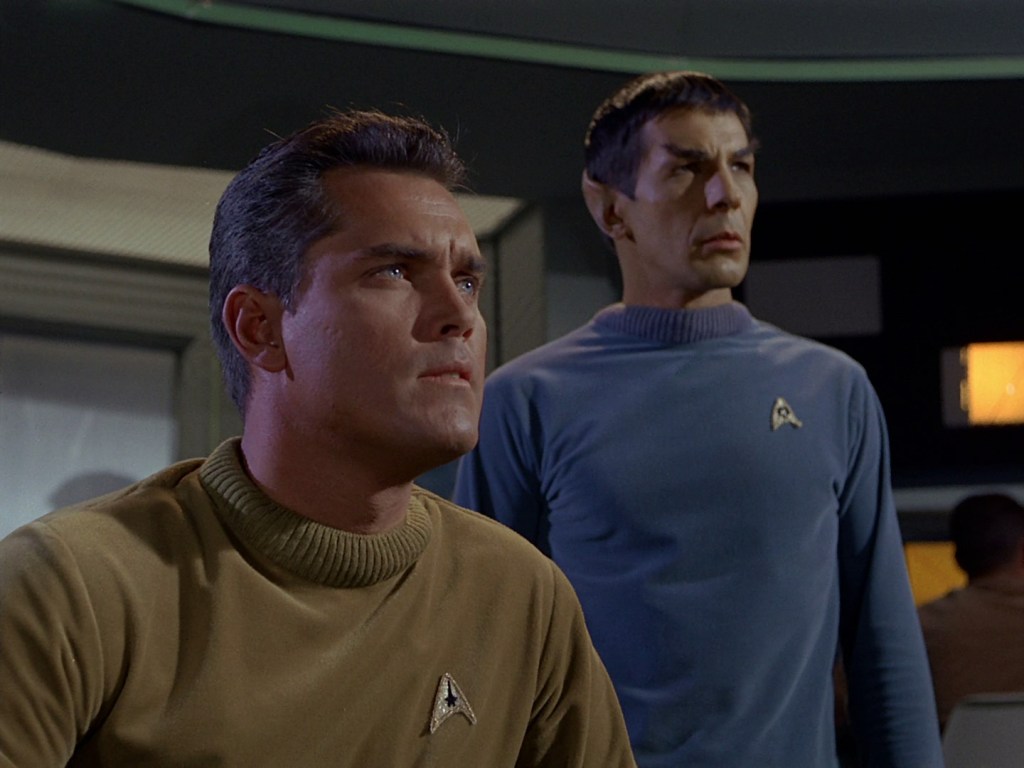
Leonard Nimoy’s Spock is not quite the Vulcan we will come to know and love. He is shown as being intelligent and efficient, but quite emotional. When the landing party first beams down to Talos IV, Spock smiles at the behaviour of a plant that stops making sound upon being touched, and his somewhat laughable cry of “the women!” when Number One and Yeoman Colt are taken by the Talosians stands out like a sore thumb.
Majel Barrett is great as Number One. In 1964 it would have been quite something to have a woman in second command. Pike says that she’s the ship’s most experienced officer and we see her take decisive action more than once. This episode gives her a strong introduction and it would have been quite interesting to see what the series would look like had she been retained.
John Hoyt as Phil Boyce is very memorable. As a doctor who dispenses drinks and life advice more than medicine, he provides some comic relief but his advice is also at the heart of the story. He helps Pike understand how important Starfleet is to him and it’s easy to see how he evolved into Dr. McCoy later on.
Peter Duryea as José Tyler was clearly being positioned as a young man of action. His eager enthusiasm is tempered by Spock and Number One’s more measured responses to situations. I think he would have made a strong regular cast member.
Finally, Laurel Goodwin as JM Colt is a spunky young yeoman. I can imagine her having become a mentee to Number One and an ongoing source of comic relief and sexual frustration for Pike. An actor called Mahé Thaissa would step into the role for OTOY and the Roddenberry Archive in 2022. It was a lot of fun to see the character again in that project. 5/5
If there are guest or recurring characters, are they memorable or interesting?
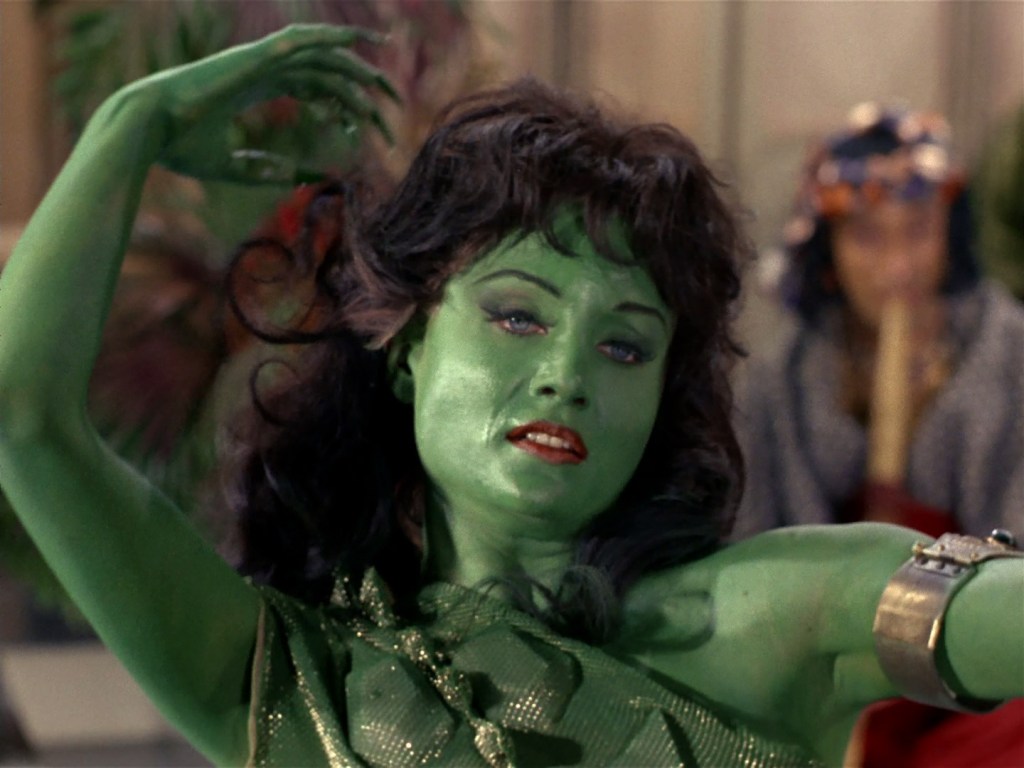
The most prominent guest star is Susan Oliver as Vina. We get to see her in a variety of costumes and guises and she does a great job with the part. She carries a lot of the exposition in the episode and is quite memorable, especially as the green Orion dancer. In 2014, a documentary called The Green Girl explored Susan Oliver’s work and life. I highly recommend it. 4/5
World-building
Does it contribute positively to the Trek Universe?
Yes, it really couldn’t contribute more! It establishes so much that would become familiar, and yet many of the details are not quite finalized. For example, it establishes that Class-M planets have an oxygen atmosphere. The basic types of characters, ship design, and storytelling format are all established here. 4/5
Is it consistent with the rest of canon?
Largely. There is some terminology that would change with time. For example, the “time warp, factor 7” feels clunky to anyone who knows the rest of Trek. When the Talosians cut the Enterprise’s power, Spock says “switch to rockets” which seems much more 1964 than 2254. They use lasers rather than phasers, etc. Famously, when this pilot was not picked up by the network, Roddenberry cleverly integrated much of the footage into a two-part episode which saved the show’s budget and schedule. For that reason, the characters and story are canon. 3/5
Is there something new and unique?
Since this is the first episode, it’s entirely new and unique (although one can see the influence of films like Forbidden Planet). The idea of an alien race maintaining a zoo of creatures from across the galaxy has been done before, but I found it interesting that alongside the pig-gorilla, and humanoid bird, there is also a flowering plant in one of the cells in the menagerie. I’m intrigued by the idea that it might be an intelligent species. 4/5
Does the science seem plausible?
Most of the science seems plausible to me. The idea that a species could devastate the surface of their world and be forced underground seems all too close to reality. The notion that, once underground, that species would focus on developing their mental capacities to the point of having brains three times the size of the human brain, with telepathic abilities and the ability to project illusions seems logical within the Trek universe. The idea that this ability would become addictive, like a narcotic, also seems logical.
In the opening scene, Tyler mentions that radio waves travel at the speed of light, which is correct. However, there are a few anachronisms. For example, in the opening scene, Tyler uses “meteoroid” and “meteorite” interchangeably. A meteoroid is correct for a body travelling through space. A meteorite is a body that survives its passage through a planetary atmosphere.
The Talosians provide Pike with a “nourishing protein complex” to drink. It reminds me of something like Ensure (which wouldn’t be released until nearly a decade later). 3/5
Production
Production design (sets, props)
I mentioned above that the budget is estimated at $500,000 and I think it all shows up on screen. Later TOS episodes would cost about $185,000 each. Here, they had the initial investment in the Enterprise bridge (all grey) and corridor sets, as well as a briefing room that I think was re-dressed as Pike’s quarters. They also had to create the Enterprise miniature.
In addition, they also had a planet set with various “rock” formations that is extremely memorable. It struck me as I was watching that the cyclorama in the background of the planet set is very similar to the AR wall that’s used on modern Trek series. The underground zoo set is quite large. The corridor extends a-ways into the distance and the massive transparency that keeps Pike in his cell must have been quite pricey at the time.
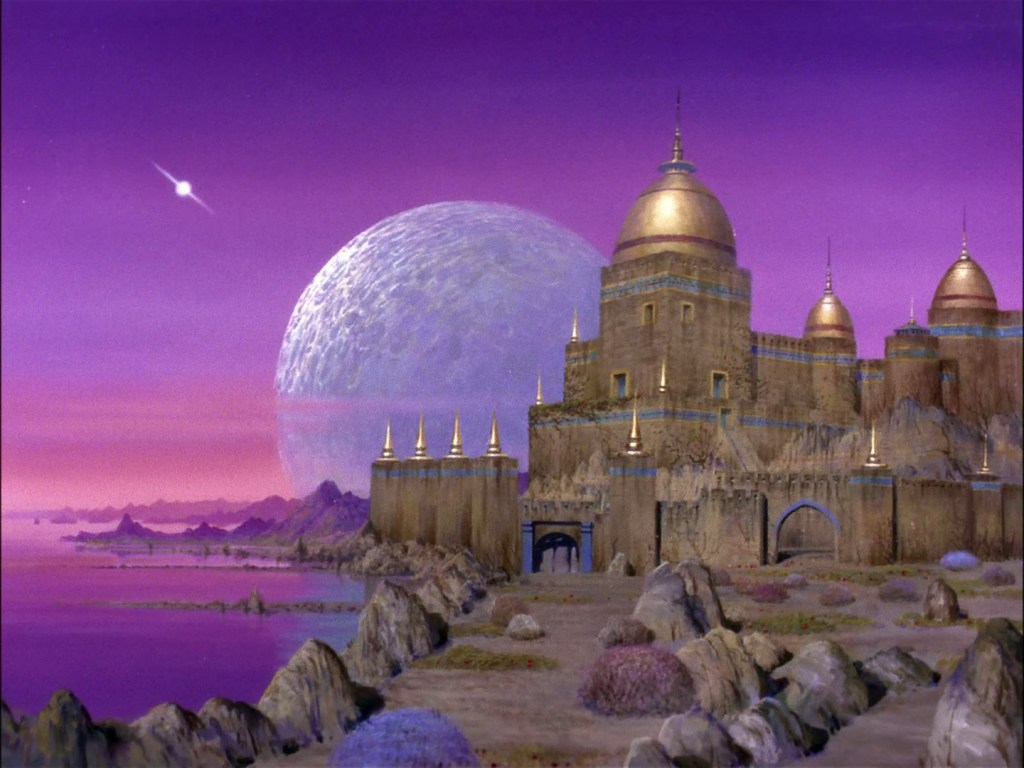
Albert Whitlock did a tremendous job on the matte painting to represent Rigel VII. That image is so memorable!
In terms of props, the original transparent communicator is pretty neat. It reads well on camera and the actors seemed comfortable handling it. The laser pistols also worked well. The paper print-outs and Pike’s clipboard for reports always stand out to me as anachronistic. 5/5
Costumes
I don’t love the Starfleet uniforms in this pilot. It took them quite a while into the series to get the collars to work decently. However, I love the glittery landing party jackets! I wish they had used those again on the series. It’s interesting that the women wear uniform pants, the same as the men. That would change soon.
I’m not a fan of the other costumes Pike wears in this episode. He has this two-piece denim number in the Mojave illusion sequence which is quite hideous (Vina’s pink ruffled shirt in this sequence is also terrible). Later, he’s got the metallic space pimp robes which are memorable, but not in a good way.
I like the Talosian metallic robes and Vina’s matching mini-dress. I noticed the unnamed transporter technician is initially wearing glasses when he appears. In the next shot they’re gone. I’m not sure if that was an error or not. 3/5
Make-up and Hair
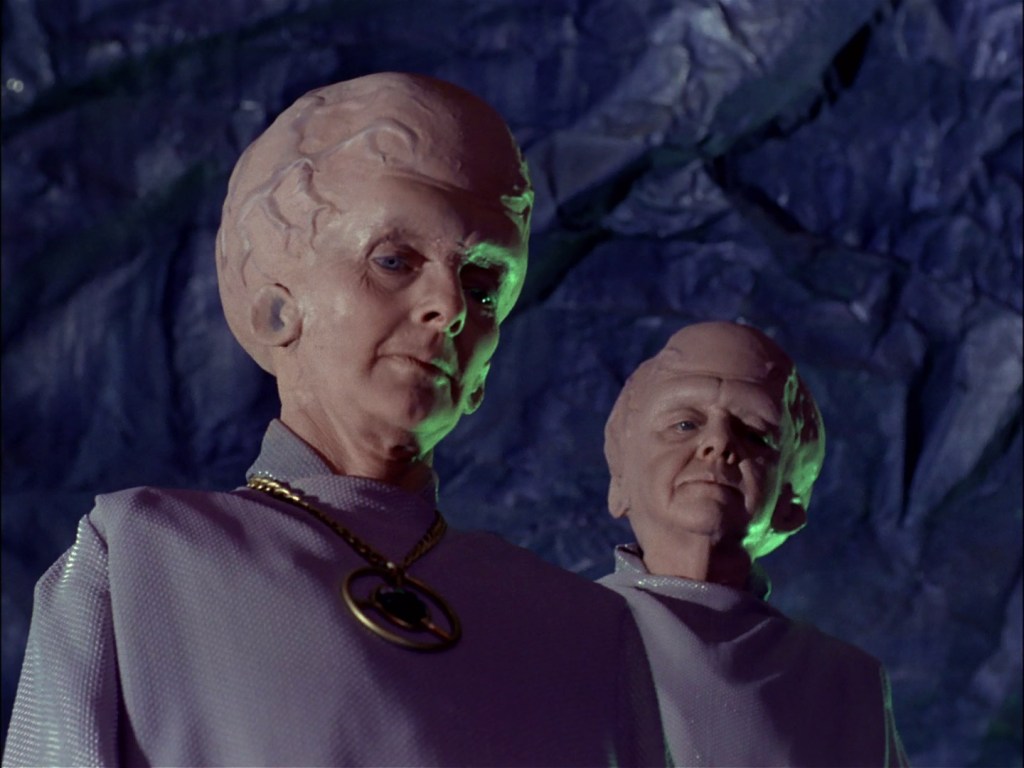
The make-up is great in this episode. Just figuring out Spock’s ears was an enormous challenge and they look terrific. I also love the Talosian design – they’re one of Trek’s most memorable aliens. The bladder system to get the veins on their heads to pulse is fun. The Kaylar (Mike Dugan) has some very questionable dentition.
The hair is less great. Number One’s hair looks terrific and Yeoman Colt’s is cute, but the wigs that Vina wears are pretty obvious. 4/5
Visual Effects
The episode opens with the really memorable shot of pushing in to the Enterprise miniature, through the dome on the saucer section, into live action footage on the bridge set. They did a great job of cleaning this up in the remastered edition but even in the original it’s fairly impressive. It’s a clever way of helping the audience understand the geography of the ship and it looks cool.
The freeze frames for the transporter effect are pretty noticeable (they get smoother in the series). The animation for the lasers firing looks good. I especially like when the laser canon fires. The animation sort of sprays sparks that are reminiscent of the Monster from the Id in Forbidden Planet.
There’s also the aforementioned matte painting of Rigel VII, and there are some decent dissolves for transitions between illusions and Vina’s transformation at the end. There are also some really good “burn ins” for the view screens, both on the Enterprise and the Talosian version. 5/5
Music
Alexander Courage does a great job with the score. The main theme is a slightly different version than what would become the regular theme. The difference is probably negligible to most people. There is an odd warp travel montage sequence where the theme is revisited. I can see why they did it for the pilot but it’s a bit awkward and I’m glad they didn’t do it again. The Star Trek theme has become one of the most memorable television themes ever recorded.
I’ll also mention sound effects here. They did a great job creating a soundscape for the surface of Talos IV. The lasers and communicator sounds are strong. There are some fun chimes that signify the opening of the Talosian elevator doors, and there’s a great boing sound when Pike throws himself against the transparency of his cell. 3/5
Acting (series regulars and guests)
I think the acting is largely strong. All the main cast members are good. Nimoy feels a bit off but I think it’s just because the characterization of Spock wasn’t quite nailed down. The weakest link for me might be Susan Oliver as Vina. She mostly does a good job, but she is hampered by exposition.
I made a note of Jon Lormer who makes the first of three Trek appearances here as one of the illusory survivors. I find him very memorable so he always kind of sticks out for me.
The actors playing the Talosians did a great job. It must have been extremely uncomfortable in that make-up. 4/5
Direction (coherent, memorable)
I think Robert Butler did an admirable job setting the stage for the 60 years of Trek that was to come. He had to deal with a lot of visual effects, complex sets, make-up-ridden actors, physical effects, etc. and he knew he was setting things up for a series which is a lot of pressure. 4/5
Philosophy
Is it thought-provoking?
Yes, the idea of telepathy and the ability to create illusions as a trap, a narcotic, is interesting. One wonders how one would respond to Vina’s invitation that “you can have whatever dream you want.” Certainly a tempting idea. It’s an important character point that Pike insists on reality even though it might be less pleasant. 3/5
Does it deal with a moral or ethical issue?
Yes, the idea of the Talosians wanting to create a new race of humans to learn their culture and replace them is interesting. Number One has a great line near the end of the episode about how it’s wrong to create a race of humans to serve as slaves – something that likely would have hit hard during the civil rights struggles of the 60s. 4/5
Is it consistent with Trek’s optimism and Humanism?
Yes, the idea that humans are more adaptable and unique than other species the Talosians have experimented with is in line with Gene’s love of humanity and faith in our ability to be great. Pike exemplifies this by choosing reality when he has the option of more comfortable fantasies. 5/5
IDEA (Inclusion, Diversity, Equity, Accessibility)
What was most noticeable for me in this area is the treatment of women. Early in the episode, when we meet Yeoman Colt, Pike says he can’t get used to having a woman on the bridge. He quickly then says to Number One, “No offense, lieutenant. You’re different, of course.” Roddenberry goes out of his way to point out that there are women officers, in fact that the second in command is a woman, even if it seems they’re not completely accepted. I think Majel Barrett as Number One gets the best treatment.
The cringiest part is the illusion where Pike is an Orion slaver. There are two seriously creepy guys leering at the dancing Vina. One says, “Funny how they are on this planet – actually like being taken advantage of!” which is super-gross. That scene is uncomfortably long for me. I guess that’s the point. Pike is also uncomfortable which is why he rushes out.
There is at least one Asian crewman (the aforementioned transporter technician) though most of the rest of the crew is white, and the technician has no lines.
The other thing that stood out to me here is just the lack of agency Pike has. There’s nothing like consent happening. He’s kidnapped, forced into various situations where it’s hoped he’ll couple with Vina. After he resists and escapes, the Talosians restore Vina’s illusion of beauty and create an illusion of Pike to live with her – this without asking for Pike’s permission to use his image. 4/5
Conclusion
In conclusion, I think this is a strong pilot and it could easily have gone to series as-is if the network had a little more courage (but perhaps it would not have been accepted by so much of the public). My ratings add up to 79/100 – a strong start.


8 comments