
“Tell me how your planet Vulcan looks on a lazy evening when the moon is full.”
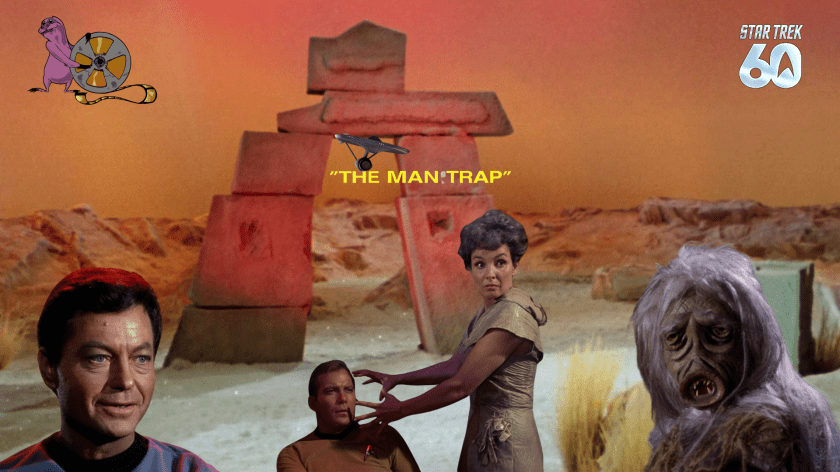
Today I watched “The Man Trap.” This was the sixth episode produced, but the first released. It premiered September 8, 1966 (or a day earlier here in Canada).
Story
Is it a coherent story?
Written by George Clayton Johnson, the story of a strange, dangerous creature on a planet of ruins is quite engaging. 5/5
Is it enjoyable to watch?
Yes, it moves along nicely, with a few exceptions. There is some unnecessary time spent on Kirk and Spock searching for Dr. Crater, playing cat and mouse in the ruins. It feels like those scenes were tacked on in order to find some action. 4/5
Is the dialogue strong and/or memorable?
I didn’t notice anything particularly strong in terms of dialogue. I did note the Captain’s Log voiceover which is a clever way to provide some exposition. This, of course, continues as a device for the next 60 years of the franchise. 3/5
Does it serve the main cast well?
Yes, this was a smart choice for the first episode to air because it reveals a lot about the main cast.
Kirk is introduced as a captain who is friendly with Dr. McCoy, but who can turn on a dime to address the needs of his ship and crew. There are conversations McCoy and Kirk have about Nancy Crater being McCoy’s lost love, but when another crew member is killed, Kirk snaps McCoy out of his romantic revelry and back to business. Kirk refers to McCoy as “Bones” and Nancy shares that an old nickname of McCoy’s is “Plum”.
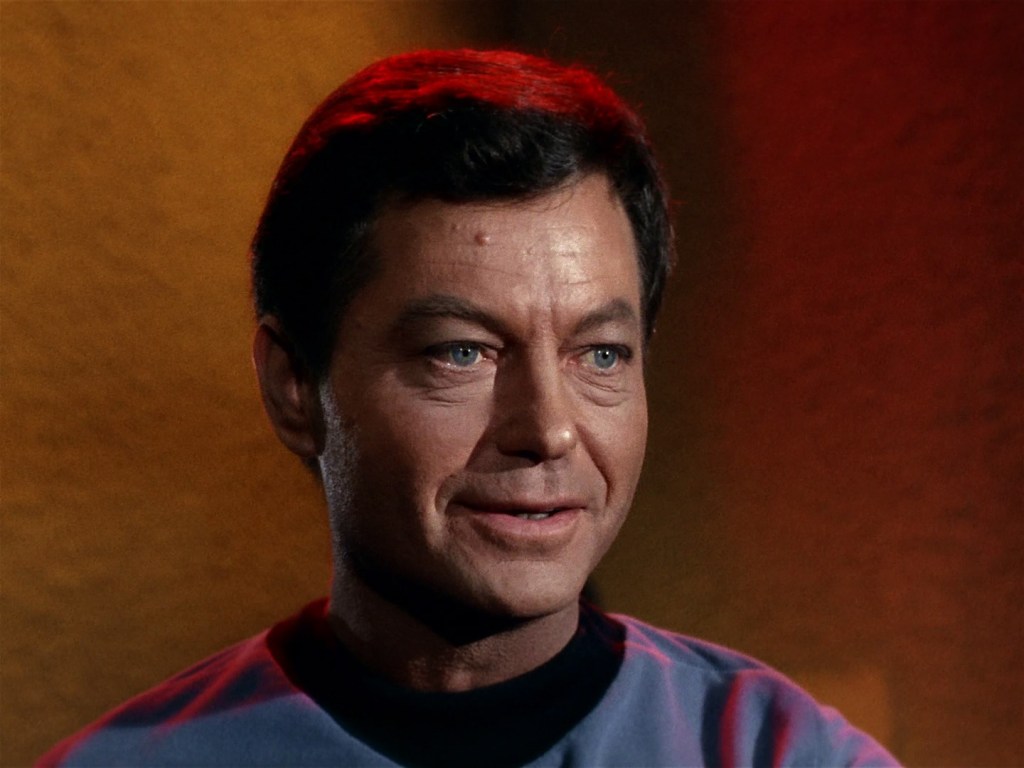
My favourite scene in the episode takes place on the bridge, early on. Spock is in the captain’s chair and Uhura comes down from her station to talk with them. She briefly flirts with him and the conversation reveals that she is the ship’s communications officer. It also reveals that Spock is dedicated to dispassionate logic. It also tells us that he comes from the planet Vulcan, and that Vulcan has no moon. It’s a nice moment that serves them both well. Later, we see Uhura speaking Swahili which is also a nice moment for her.
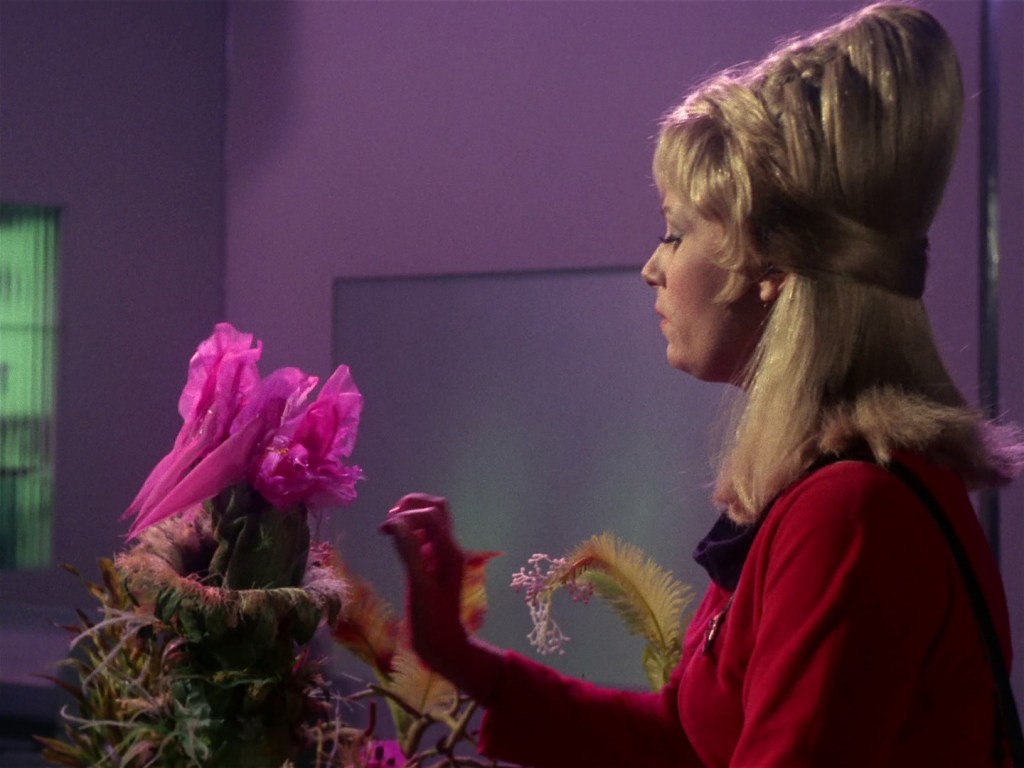
We’re also introduced to Yeoman Janice Rand, munching on some celery while bringing a lunch tray to Sulu in a botany lab. Why she’s serving Sulu lunch is not quite clear. We get to see Sulu as a botanist and we see him later on the bridge, communicating announcements to the entire ship. 5/5
If there are guest or recurring characters, are they memorable or interesting?
The most notable guest stars are Jeanne Bal as Nancy Crater and Alfred Ryder as Bob Crater. Bob Crater fills a role that will become a bit of a trope; that of a curmudgeonly and eccentric scientist. He’s been on planet M-113 for five years, studying the ancient civilization that once lived there and he’s gone a bit space-happy since his wife was killed by the single remaining native inhabitant. As an aside, xenoarchaeology is my favourite Star Trek science. If I were in Starfleet, that would be what I’d do.
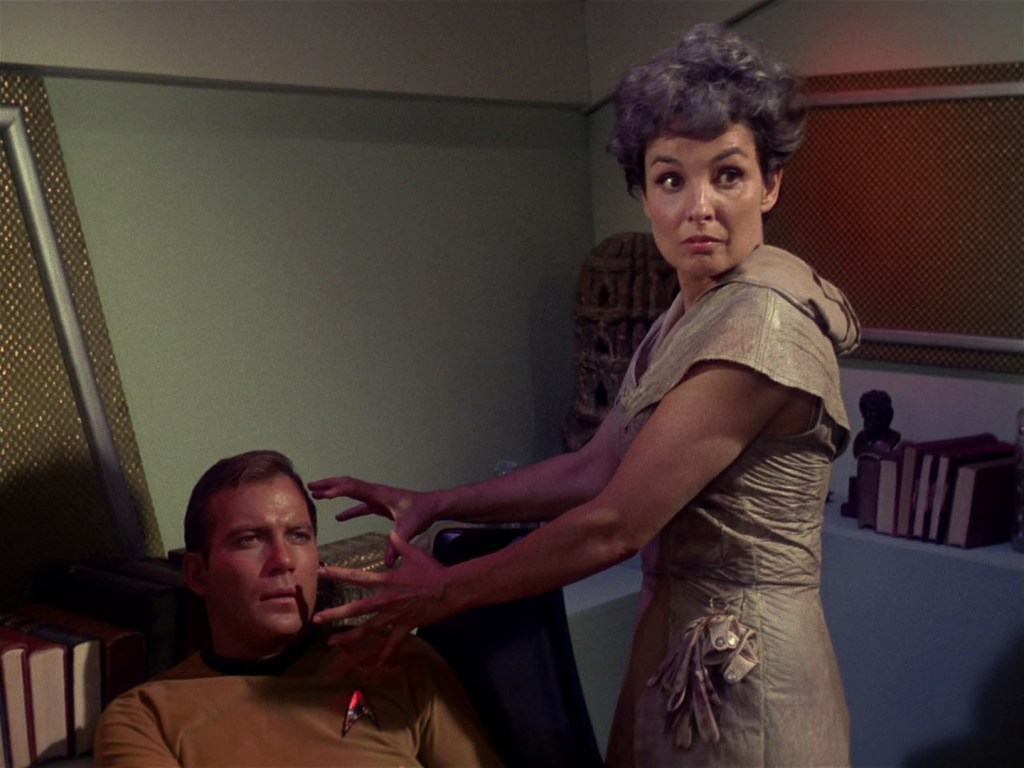
Bal does a good job playing Nancy. There are multiple versions of her to play because she appears differently to different people. She has the biggest arc in the episode because we see her true form revealed over the course of the show. 3/5
World-building
Does it contribute positively to the Trek Universe?
“The Man Trap” starts to build the idea of Starfleet (without using that word). We know there are regulations that scientists on alien planets must be visited annually for medical exams. We also learn that there are “starship bases” because Uhura receives a communication from Space Commander Dominguez. Kirk’s reply to Dominguez about picking up peppers for him lets us know that these are real people who have relationships outside of their duties.
When Rand brings Sulu his meal, Sulu says “may the Great Bird of the Galaxy bless your planet!” Trekkies would later dub Gene Roddenberry the Great Bird of the Galaxy.
Rand mentions Saurian Brandy, a beverage that will continue to be featured throughout the franchise.
We see signage for “turbo lift 2”, officially giving the Enterprise elevators a name. 4/5
Is it consistent with the rest of canon?
I’d say yes, because it establishes some things that would become canon. The only anachronism I caught was that everyone refers to the ship’s “dispensary” rather than “sickbay”. Pieces of information like Vulcan having no moon are carried throughout Trek. 4/5
Is there something new and unique?
The shapeshifting, telepathic M-113 Creature, which is often referred to by fans as a Salt Vampire, is certainly unique. There’s also the animate, carnivorous plant called Beauregard and/or Gertrude in Sulu’s botany lab. Since we’re so early in the run of the series, this story isn’t building on any previous ones. It’s all new and unique. 5/5
Does the science seem plausible?
Salt is at the heart of this episode’s science! We learn that planet M-113 is a hot and arid planet. Humans living there require salt tablets to replenish their electrolytes. It does seem odd to me that a Salt Vampire would evolve on a planet where salt was difficult to come by. Dr. Crater says that there were once millions of these creatures. They must have been driven to extinction by the planet’s lack of salt. Crater draws a parallel to Earth’s buffalo. More specifically, I think he’s talking about the American or Plains Bison, because he says there were once herds that covered three states. Apparently, by the 23rd century this species is extinct.
The other science that gets some discussion is alkaloid poison. At one point, Nancy makes it appear that a crewman might have died from eating a poisonous Borgia plant. McCoy says he knows what alkaloid poison looks like and this isn’t it.
Finally, when the M-113 Creature injures Spock, we see he has green blood. This is a biological trait of Vulcans that is maintained in the franchise. Spock mentions that his “blood salts” are different from Humans to explain why the creature didn’t kill him. 3/5
Production
Production design (sets, props)
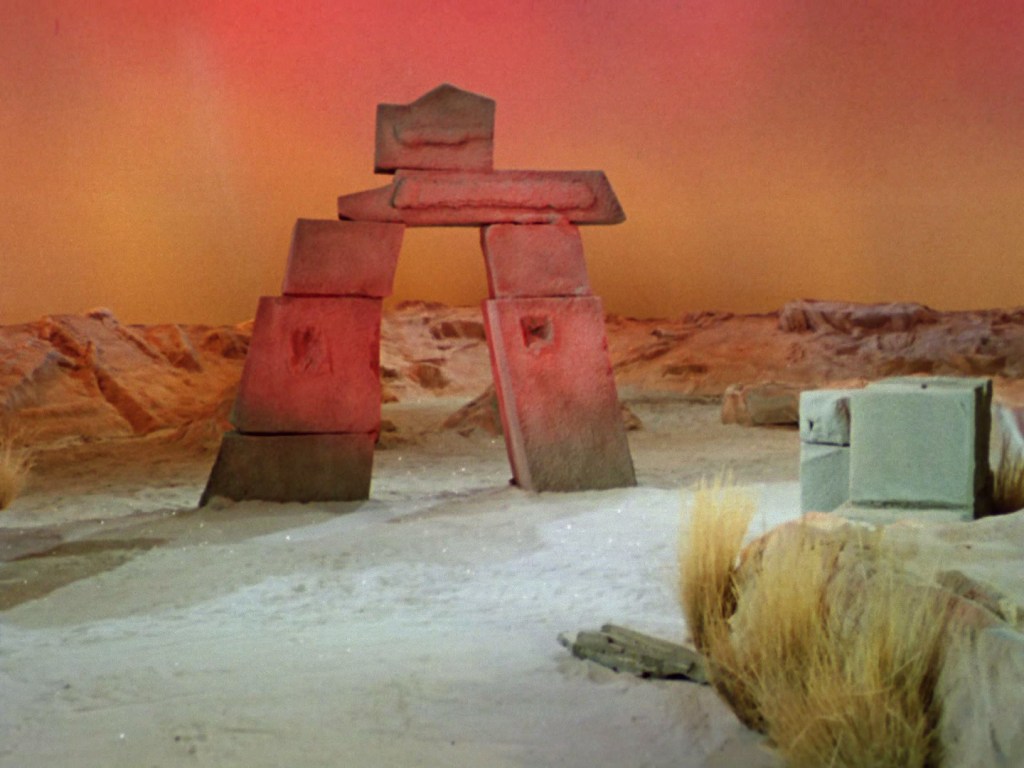
At the beginning of the episode, we see that Matt Jeffries has created ruins on the planet set. As always, he does a great job with very little. In the remastered version of the episode, there is a shot where the fields of ruins are digitally extended.
The Enterprise sets have been revamped since “The Cage”. The bridge is much brighter now that it has red accents. We also see the briefing room set in its recognizable form. There’s a great shot of the triangular computer monitor on the briefing table with a burn-in of Sulu speaking from the bridge.
In terms of props, we see Kirk and Spock carrying phasers rather than Pike’s laser pistol. The phasers have white handles in this episode. I’m going to watch to notice when that changes. Dr. Crater does make use of one of the laser pistols from “the Cage”. We learn that the phasers have a stun setting. The communicator is also in its familiar form here. One odd prop is used by McCoy; a wooden tongue depressor.
We see the infamous coloured food cubes and both Sulu and Kirk eat them. In a close-up of Sulu’s tray, it seems like they’re probably pieces of fruit that have been dyed. The tray’s contents also include a set of Wilhelm Wagenfeld Bauhaus salt and pepper shakers. 5/5
Costumes
We see the standard Starfleet uniforms here, and by the time this episode was produced, Theiss had nailed the collars. They produced quite a number of them because we see many extras wearing them. We also see extras wearing a variety of coverall-type uniforms.
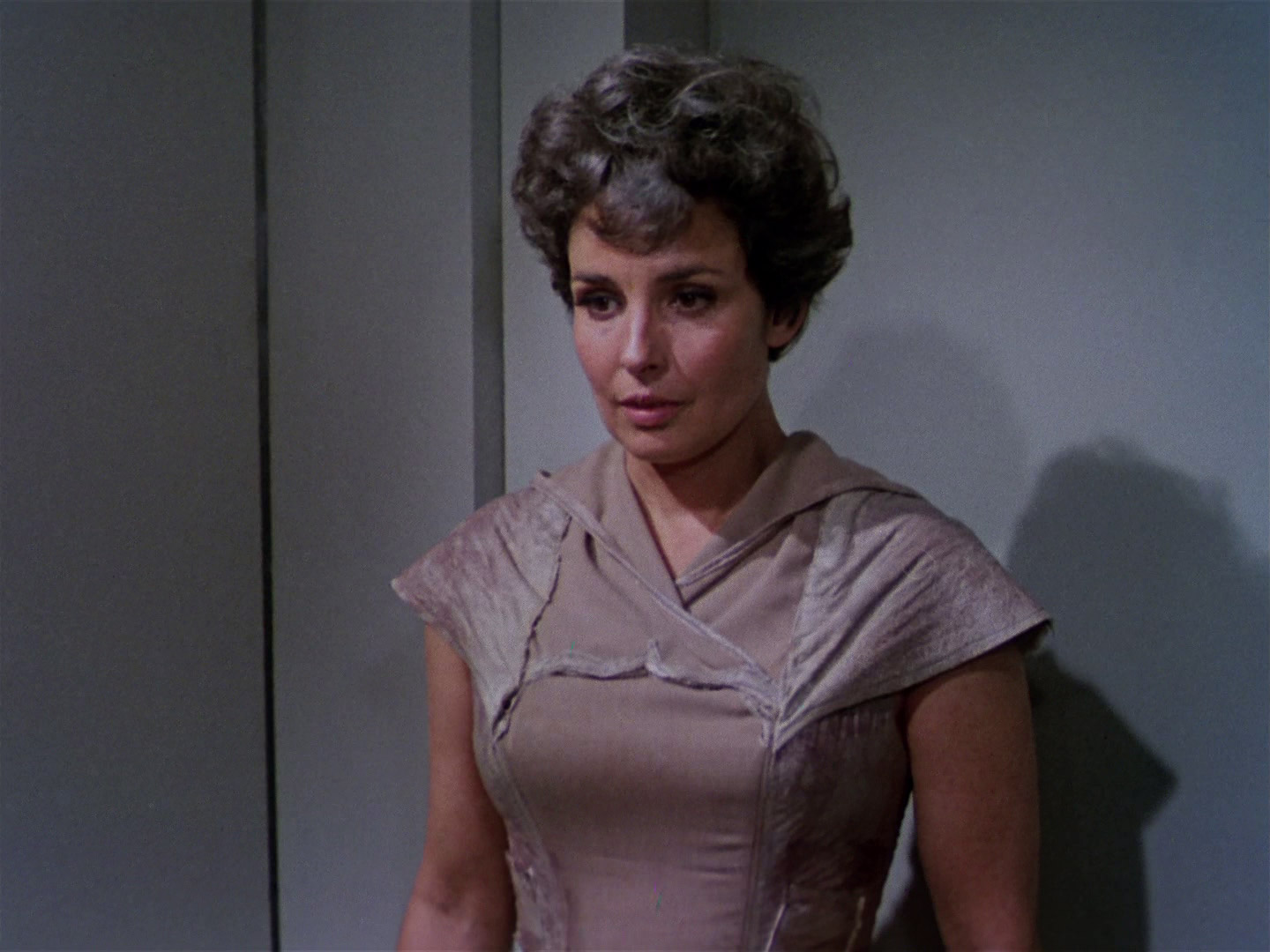
Dr. Crater’s shapeless coverall costume is nothing to write home about, but Nancy’s dress is quite interesting. It’s got a lot of texture.
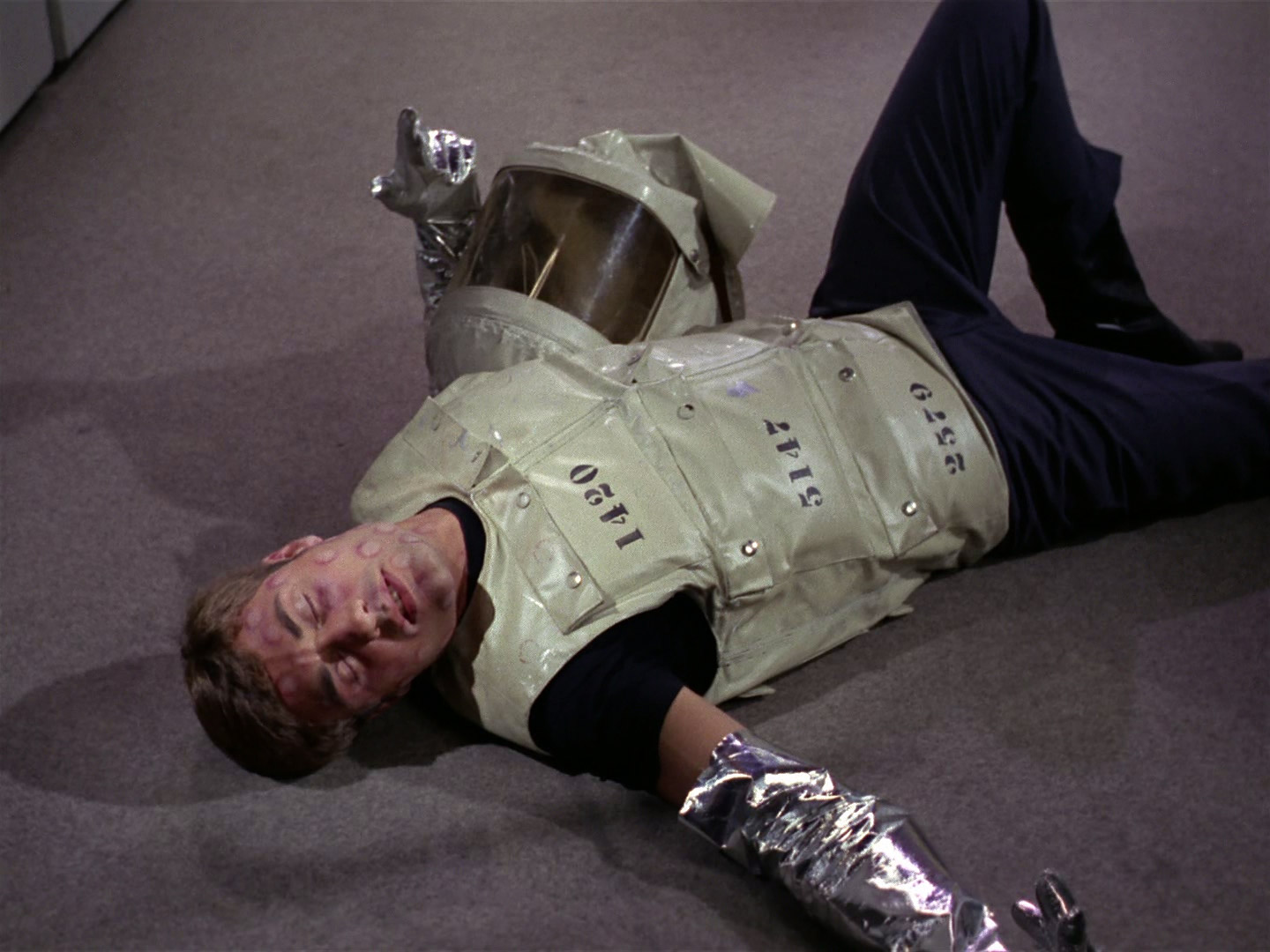
There’s an interesting costume re-used from The Outer Limits. Possibly it’s supposed to be some kind of radiation suit? The variety of costumes seen on the Enterprise feels correct.
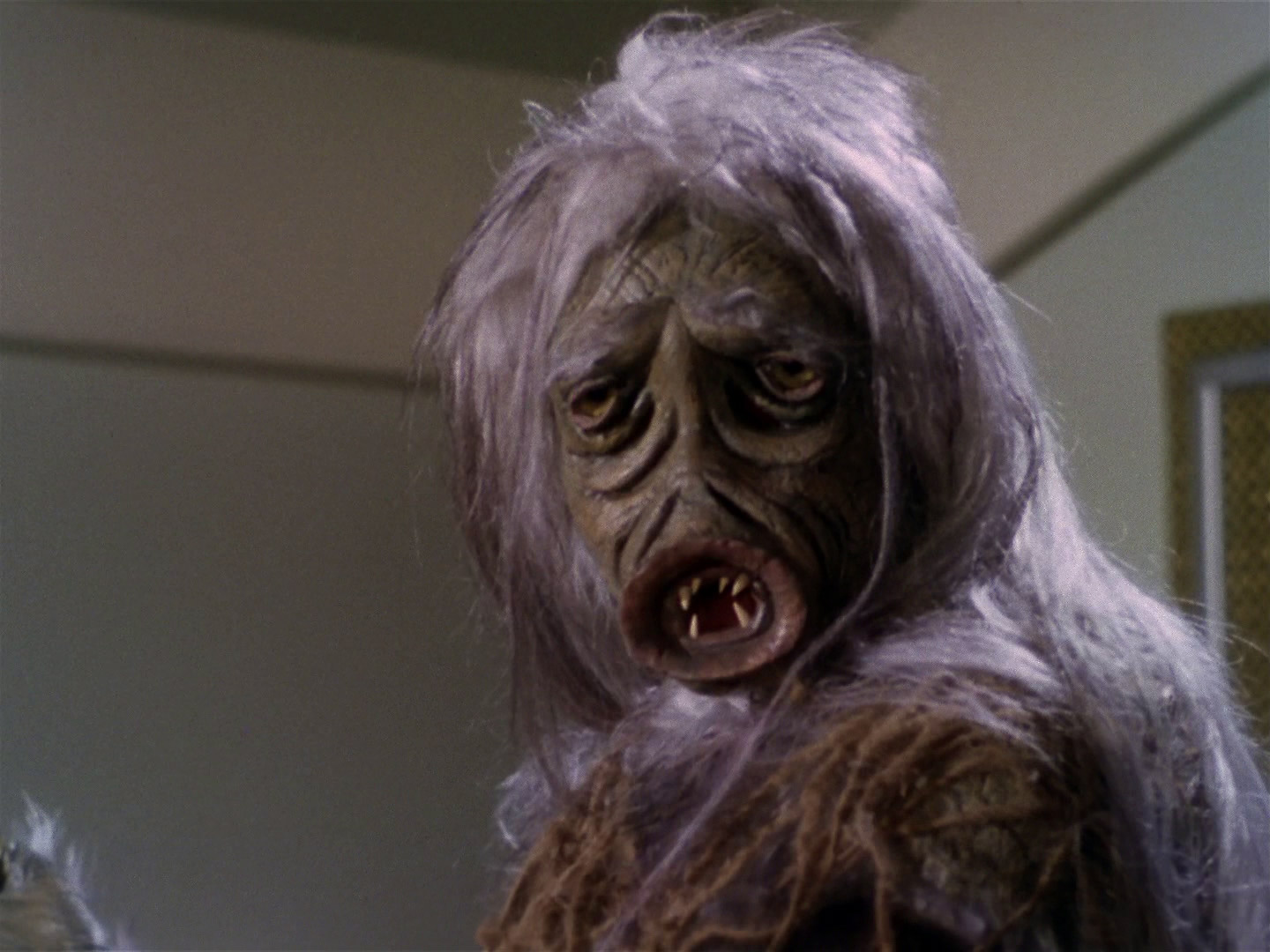
The Salt Vampire costume was created by Wah Chang (who also created the communicator, amongst other memorable items). It’s very memorable and would be seen again in animation in The Animated Series, and Lower Decks. 4/5
Make-up and Hair
When people are on the surface of M-113, there’s a lot of sweat so we never forget it’s a hot place. Nancy is the only one who gets extensive make-up. The version of her that is seen by most people is aged. She has grey in her hair and it looks like latex stippling for some wrinkles. There’s standard beauty make-up for Janice Rand, Uhura, and the blonde version of Nancy. Spock’s ears look good and we see some of his green blood. 3/5
Visual Effects
The visual effects are easy to take for granted in this episode. Things like the screen burn-in of Sulu that I mentioned above were extremely labour-intensive. There are also transporter and phaser beams. There are some dissolves for Nancy and the Creature changing shape which work fairly well. 3/5
Music
Alexander Courage wrote the score for this episode. We also get the more familiar form of his main title theme. I didn’t really notice the music in this episode. 3/5
Acting (series regulars and guests)
The acting is strong. Shatner, DeForest Kelley, and Nichelle Nichols are particularly good in this episode. They’re given good material to work with and they come across as fully realized characters. 4/5
Direction (coherent, memorable)
This episode was directed by Marc Daniels who is tied with Joseph Pevney for directing the most number of TOS episodes. There was one shot in particular that I noticed. It’s a handheld shot that tracks Kirk down the corridor and into the turbolift. The camera follows him into the turbolift and it’s a bit shaky but an interesting shot to attempt. 4/5
Philosophy
Is it thought-provoking?
I think this episode wants to be thought-provoking. The idea of a creature being the last of its species is quite sad. The fact that it’s an intelligent creature multiplies those feelings. There’s a briefing room scene where the team discusses the situation and learns more about the creature from Dr. Crater. I’m a sucker for briefing room scenes. I love that a group of very smart people get together and talk out a problem. Ultimately, I think the Salt Vampire is too monstrous to illicit too much empathy. It kills four Enterprise crewmembers, plus Dr. Crater, and comes close to killing others. 3/5
Does it deal with a moral or ethical issue?
I suppose the moral issue is how to deal with a creature that won’t stop killing. It’s only trying to survive, but we obviously can’t let it kill our Starfleet heroes. The way the episode climaxes there really isn’t enough time for anyone to think about how to handle the situation in a different way. It sort of has to go the way it goes. 3/5
Is it consistent with Trek’s optimism and Humanism?
Towards the end of the episode, when McCoy is forced to fire on the creature, he says, “Lord, forgive me.” Nothing bothers me more than religion in Star Trek but it’s definitely part of McCoy’s southern American culture.
It’s clear the crew is disturbed by having to kill the creature. Kirk’s final line to Spock is that “I was thinking about the buffalo, Mr. Spock.” That speaks to our humanity. 3/5
IDEA (Inclusion, Diversity, Equity, Accessibility)
I mentioned in my review of “The Cage” that the women crewmembers wore uniform pants. By this episode, most of the women are wearing the familiar miniskirt uniform, but there is one woman in the corridor wearing pants.
There’s some uncomfortable objectification of Rand by a couple of crewmen in the corridor. Nothing would be lost by losing that scene.
This episode introduces both Uhura, a Black woman on the bridge, and Sulu, an Asian man on the bridge. They’re both depicted as respected parts of the command structure. There’s also that scene where Uhura speaks Swahili with the creature in disguise. I can’t imagine there was much of that on American television in the 60s.
Overall, I think “The Man Trap” does well in this department. 4/5
Conclusion
My ratings for “The Man Trap” add up to 75/100. I think it was a strong choice for the first aired episode. Clearly it hooked a lot of folks!


4 comments