
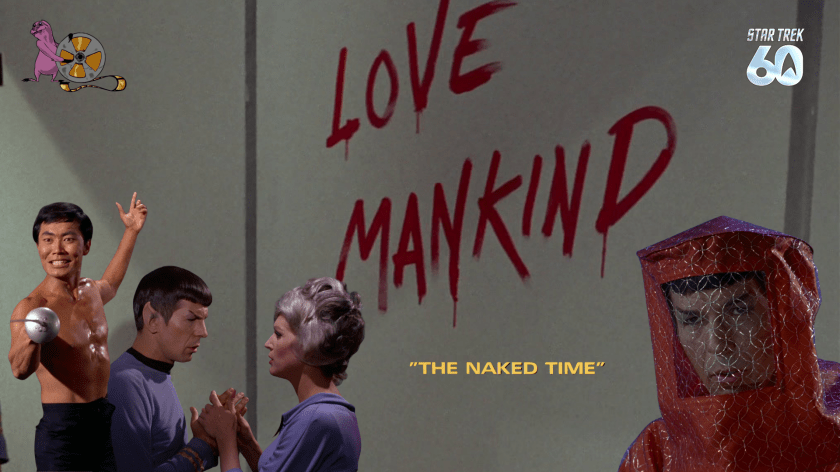
“It’s like nothing we’ve dealt with before.”
Tonight I watched “The Naked Time”. This was the seventh TOS episode produced, but the fourth aired. It was written by John DF Black and first aired on September 29, 1966. George Takei has named this his favourite episode of the series.
Story
Is it a coherent story?
The Enterprise is orbiting Psi 2000, a dying planet. They are present to evacuate a scientific team and then observe the planet’s disintegration. One needs to pay attention to this context – the information in the captain’s log entries and exposition in dialogue early in the episode – in order to really understand what’s happening. I love that Black trusted his audience to be engaged enough to do this. In our current landscape of dumbed-down second-screen “content” this kind of intelligent writing is a breath of fresh air. I enjoy when I actually have to engage with what I’m watching. 4/5
Is it enjoyable to watch?
Yes, the disintegrating planet provides a countdown that generates suspense, and the mysterious contamination provides excellent opportunities for important character moments for Spock, Sulu, and Riley.
It turns out all the scientists on the surface have died (six of them). The body counts are quite high in these early episodes, though most of the deaths happen off screen. There are a few mentions of one of them having died while showering with his clothes on. This will be important 25 years later in the TNG episode “The Naked Now.” 5/5
Is the dialogue strong and/or memorable?
This episode is where we hear Scotty say the immortal line, “I can’t change the laws of physics!” This episode also gives us some more Spock-McCoy sparring. After a medical exam, Spock says “As for my anatomy being different from yours, I’m delighted.” There are also some memorable moments in the scene with Spock and Nurse Chapel which I’ll talk about below. 5/5
Does it serve the main cast well?
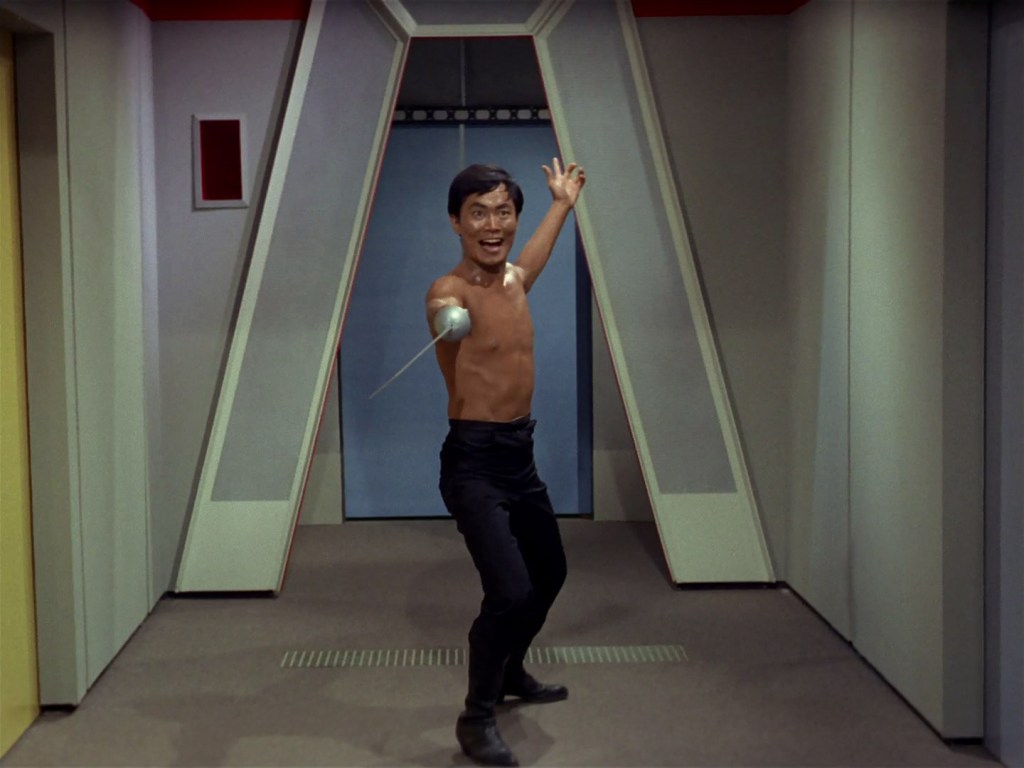
As I mentioned, Spock and Sulu are particularly well-served by this episode. The “polywater intoxication” removes inhibitions, giving us rare looks at some core pieces of our heroes’ characters. With Sulu, it brings to the surface a love of fencing. He mentions fencing to Riley, and then we see him shirtless in the corridor with a rapier. This is one of the most memorable images from TOS. Spock says that Sulu is, at heart, a swashbuckler, and Sulu as a fencer will come up again.
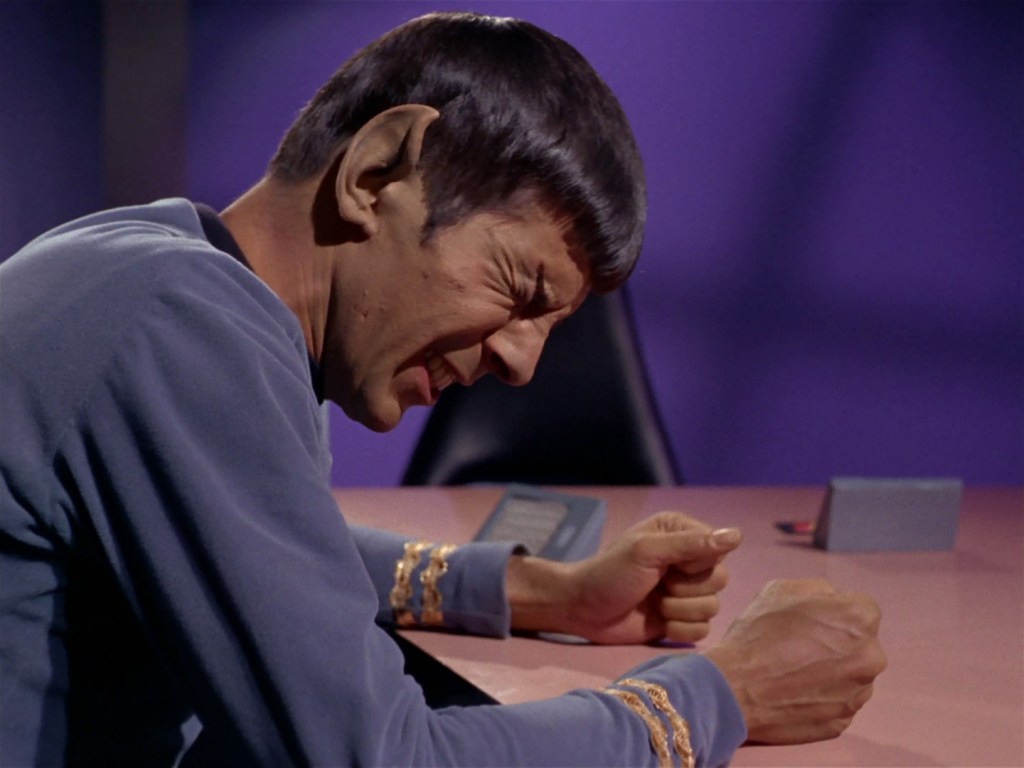
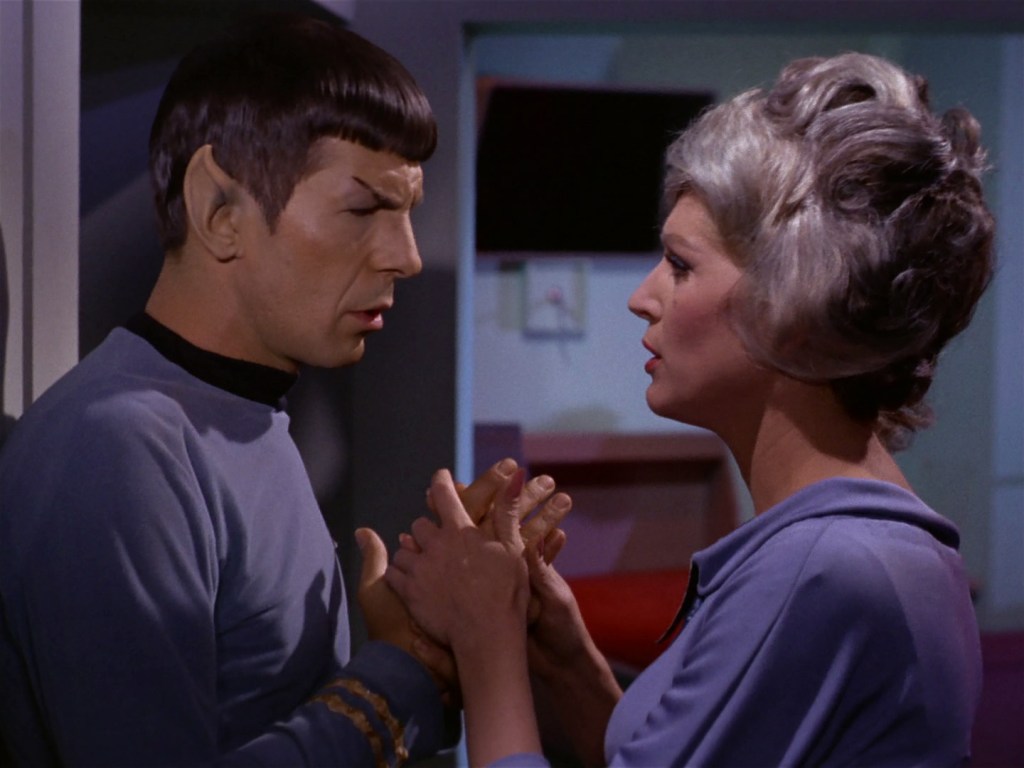
With Spock, it disrupts his ability to suppress his emotions. There is a scene in sickbay where Christine Chapel confesses her love to Spock and he is visibly shaken. She says, “The men from Vulcan treat their women strangely – at least, people say that… but you’re part Human, too… I’m in love with you, Mr. Spock.” She goes on to note how difficult it must be for Spock to live amongst emotional Humans. She says they must torture him. Spock apologizes to Christine for not being able to return her affections.
Spock then moves into the corridor and he is clearly not himself. He seems unstable on his feet and he moves haltingly rather than with the purpose he usually demonstrates. He eventually finds himself in the briefing room where he can be alone. There’s a very moving scene where we see him break down and cry. When Kirk finds him later, Spock shares that he’s upset that he could never tell his mother he loved her. He also says that he is ashamed when he feels friendship for Kirk. This all gives us great insight into the battle that Spock must fight within himself every day.
With Kirk, the intoxication lets him mention his beautiful yeoman. He would seem to have feelings for her but is unable to act upon them as her captain. He mentions having to live for the ship rather than himself.
There are also two good moments for Uhura. When Sulu comes to the bridge with his rapier, he briefly grabs Uhura, as if to take her hostage. He refers to her as a “fair maiden” to which Uhura replies, “sorry, neither”. That she’s not fair-skinned is obvious, but admitting that she’s not a maiden must have been a bit risque for 60s television. Later, when Kirk is frustrated by Riley’s antics with the intercom, he snaps at Uhura who’s unable to turn off Riley’s broadcast. He then apologizes to her. I’m imagining that audiences of the time hadn’t seen many examples of white men in positions of authority apologizing to Black women. 5/5
If there are guest or recurring characters, are they memorable or interesting?
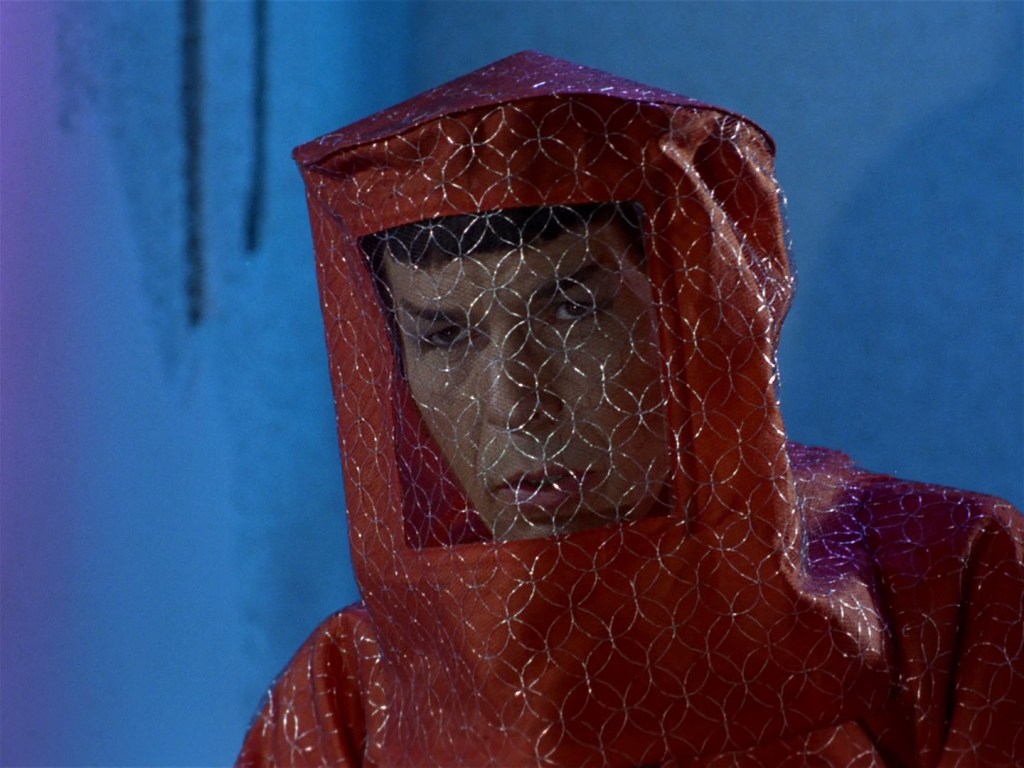
Stewart Moss plays Joe Tormolen, a crewman who should probably never have gone into Starfleet. In the opening scenes, Tormolen accompanies Spock to the surface of Psi 2000. They are wearing some kind of hazard or environmental suits to protect themselves but Joe casually removes a glove and scratches his nose. Later, when “intoxicated” he seems to be terrified of space. He doesn’t think Humans have any business being out there.
This is the first time we see Majel Barrett as Nurse Christine Chapel (though we saw Barrett as Number One in “The Cage”). After Tormolen injures himself, Chapel assists McCoy with a surgery. This is the first time we really get a sense of the medical technology of the 23rd century. We see McCoy using a variety of instruments that don’t require directly touching the patient. The lifesigns monitor adds some great suspense.
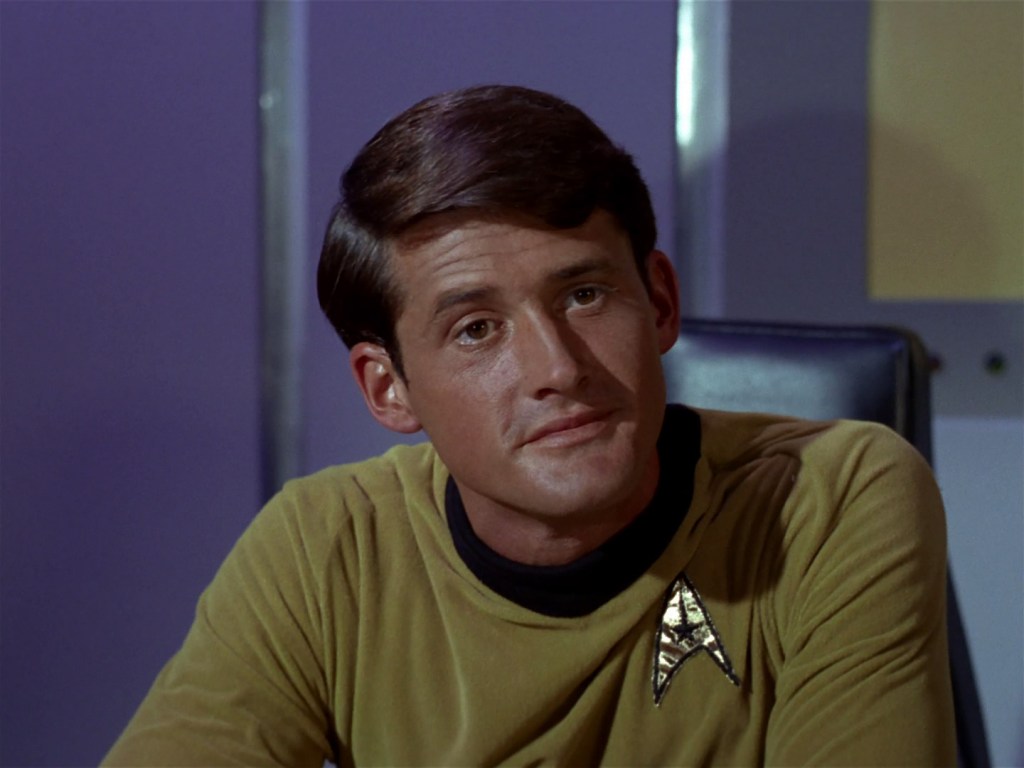
Finally, we have Bruce Hyde as Lt. Kevin Thomas Riley. Riley is one of my Trek boyfriends. Though he only appears in two episodes, both appearances are memorable. In this episode, the “intoxication” reveals that Riley secretly views himself as the ancestor of Irish kings. He locks himself in the engine room and repeatedly sings “I’ll Take You Home Again, Kathleen”. Between renditions, he makes orders about when ice cream will be served, and that women should wear their hair loosely about the shoulders and use restraint with make-up. 4/5
World-building
Does it contribute positively to the Trek Universe?
“The Naked Time” establishes that the Enterprise engines run on some kind of matter-antimatter reaction. We don’t get a lot of details, but this key piece of engineering information will inform many later Trek stories. The establishment of the polywater intoxication will play into the TNG episode “The Naked Now” 25 years later. The character moments for Spock and Sulu will resonate into the future. In Riley’s intercom orders, he mentions that there will be a formal dance in the bowling alley, establishing that the Enterprise has a bowling alley. 4/5
Is it consistent with the rest of canon?
Yes, it helps to establish some things and doesn’t contradict anything we’ve seen. 4/5
Is there something new and unique?
Aside from the polywater problem which Spock describes as “like nothing we’ve dealt with before”, we also get the engine problems which lead to the discovery that the Enterprise is capable of travelling through time. At the end of the episode, Spock notes that they can now go back in time, to any era, any planet. Kirk tells him “we may risk it someday”. Indeed, we will see this again. 4/5
Does the science seem plausible?
The premise that water, under extreme gravitational forces like the disintegration of a planet, might somehow change into a complex series of molecules is the key bit of science in this episode. I had to look this up, but apparently, in the 1960s, Soviet scientists experimented with trying to create a new form of water that was sometimes called “anomalous water”. This was debunked by 1971 when it turned out that the anomalies were caused by contamination like sweat from the scientists’ hands. So, this is junk science, but at the time there would have been articles about it as something on the leading edge.
As for time travel, it’s theoretically possible to travel through time if you go fast enough. This can’t currently be proven but it’s well-established as Trek science.
The other interesting things we get in this episode are medical. We learn that the transporter can be used to decontaminate people. This is logical. If you’re breaking someone down to the atomic level you should be able to filter out foreign bodies. So, in as much as a transporter is possible, this makes sense in the Trek universe. The other is what I mentioned above about the surgery scene. This kind of medical innovation must have seemed miraculous in 1966. Whether or not it’s possible for us to develop instruments that do what McCoy’s do is yet to be seen. 3/5
Production
Production design (sets, props)
This is the first time we see the engineering set, which is pretty impressive. I note that the paint in sickbay has been healed from the sickly green that we saw in “Where No Man Has Gone Before.” The beds and computer monitors are now grey.
We get to see Scotty working in a Jeffries tube. He also gets to use a phaser to cut into the bulkhead outside engineering. Unfortunately, we only see the phaser in his grip so I can’t tell if the handle was white.
We see McCoy use a hypospray to inject Kirk with a cure. McCoy dramatically tears the shoulder of Kirk’s tunic in order to administer the dose directly through the skin. We know from most future uses that it can function through clothing. 4/5
Costumes
We see Scotty in his proper red uniform tunic for the first time in this episode. The only other notable costuming in this episode is those hazard suits from the teaser – which only function if you keep your gloves on, Joe! They look good, but obviously are not very practical. 3/5
Make-up and Hair
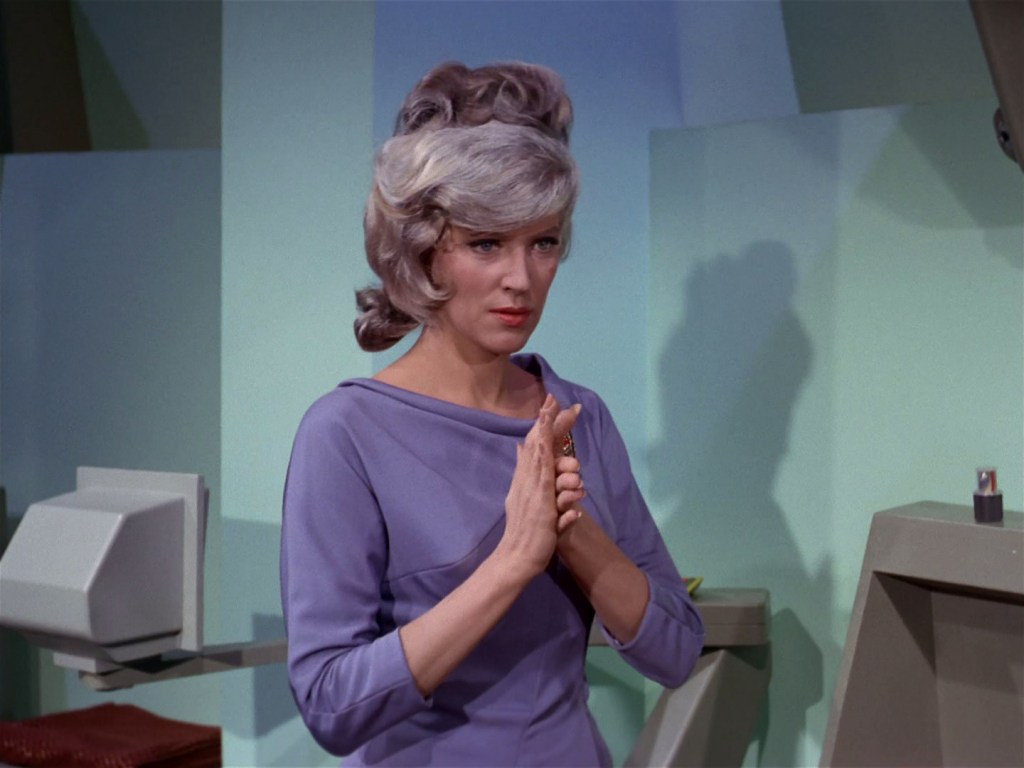
Nurse Chapel is introduced with a truly wild wig – or possibly two wigs. It’s completely impractical but very memorable. Rand’s wig is a bit crazy but at least the woven bit is on top of her head. Chapel’s wig has a lot of styling detail on the sides as well. My guess is that Roddenberry wanted to give Barrett a way to stand out, and she certainly does. 4/5
Visual Effects
This is an episode where it’s probably better to watch the remastered edition. It includes a shot of a station buried in snow on Psi 2000, and the shots of the Enterprise spiraling to its doom as the planet disintegrates are well done. In the remastered edition, they also replace the shots of the manual chronometer with something a bit smoother. Since the chronometer plays such a big part in act three, it makes sense that they chose to spend time on it. 4/5
Music
This episode has a score by Alexander Courage. It’s most memorable towards the end when the Enterprise is spiraling. 4/5
Acting (series regulars and guests)
The acting is strong in this episode. I think actors always enjoy getting to play something different, so Takei and Nimoy probably especially enjoyed this one. Barrett gets to play some quite emotional beats in her love scene with Spock. 5/5
Direction (coherent, memorable)
This episode was directed by Marc Daniels whom we’ve already gotten “The Man Trap” from. He does a great job. He gets to have some fun with Sulu fencing in the corridor, and he establishes the camera angle looking down into the Jeffries tube for the first time. The most memorable scene for me, is Spock’s break down in the briefing room. Daniels shoots this as a oner which probably made it easier on Nimoy, but it also serves to heighten the emotion. A very similar shot will be seen years later in the TNG episode “Sarek” when Patrick Stewart as Picard is suffering an emotional break down from a mind meld. I like to think that it’s an intentional homage to Daniels in this episode. 5/5
Philosophy
Is it thought-provoking?
I think mostly of Spock. We learn here how it’s really a constant struggle for him to keep his emotions in check. This is a conscious choice he made in order to live a Vulcan life and he must be conscious of it every waking moment. I suppose the episode generates empathy. 4/5
Does it deal with a moral or ethical issue?
There’s no particular ethical issue here. This episode introduces time travel, the ethics of which will later be explored, but I didn’t find anything else here. 1/5
Is it consistent with Trek’s optimism and Humanism?
I believe it is. We get to see varied facets of our characters, making them more three-dimensional. Chapel’s empathy and love for Spock are two of the best traits of Humanity. 4/5
IDEA (Inclusion, Diversity, Equity, Accessibility)
This is the first episode where I feel like race is more at the fore than gender. Sulu gets more screentime than he generally will, and he’s presented in kind of an heroic way. I can’t think of other examples of this for Asian men in 60s television. I mentioned Kirk’s apology to Uhura above. It seems trivial today, but having the ship’s captain apologize to a Black woman in 1966 probably felt like a big deal. It says something about who Roddenberry designed Kirk to be, and how he envisioned the future. 4/5
Conclusion
My ratings add up to 80/100 — my highest so far. This is an entertaining episode that I will always stop to watch.


4 comments