
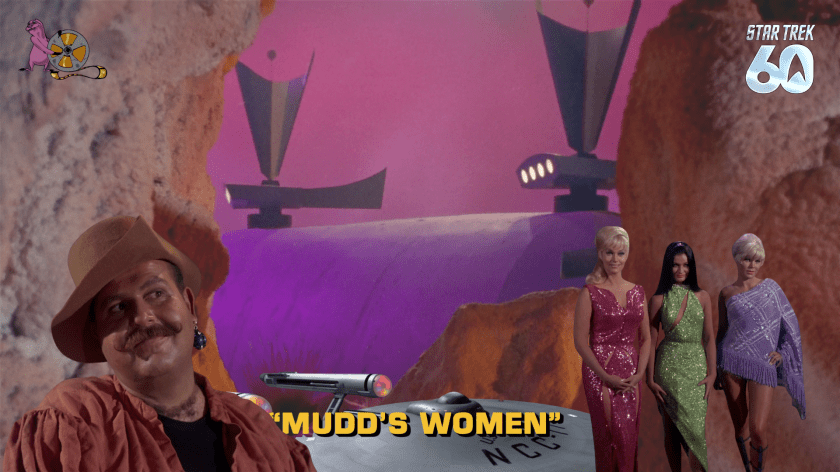
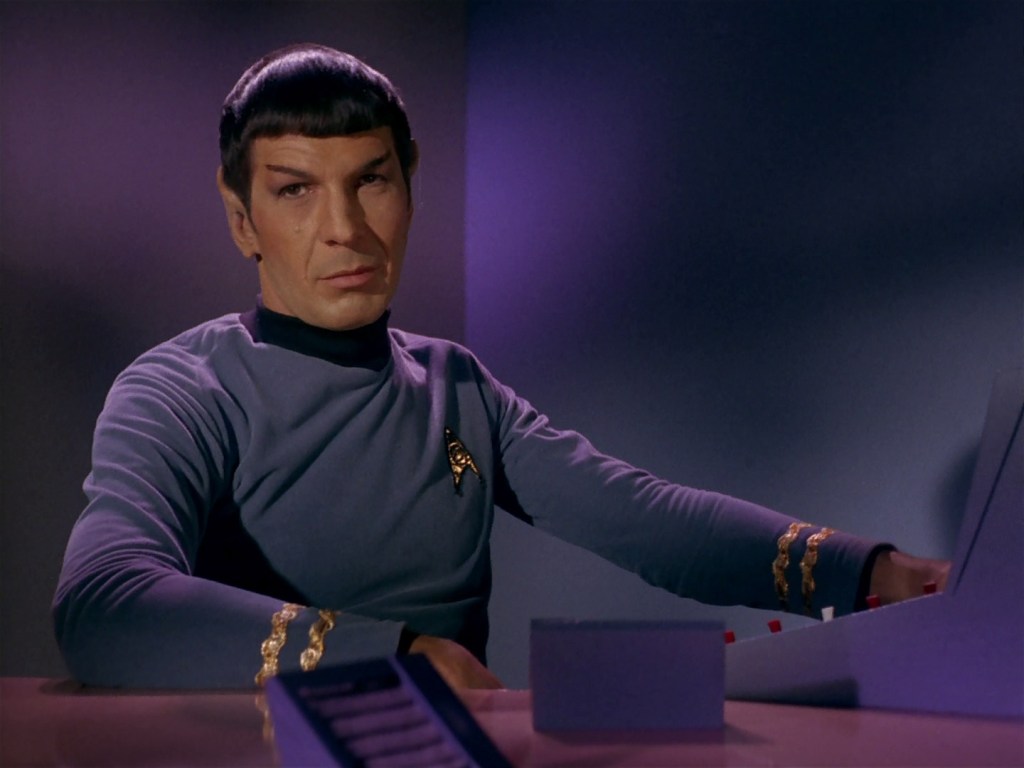
“I’m happy the affair is over. A most annoyingly, emotional episode.”
Last night I watched “Mudd’s Women”. This was the fourth TOS episode produced, and the sixth to be released. It was written by Stephen Kandel from a Gene Roddenberry story, and first aired on October 13, 1966.
Story
Is it a coherent story?
The Enterprise pursues a small, unregistered cargo ship into an asteroid belt where the ship’s engines fail. Kirk beams aboard the crew which consists of “Captain Leo Walsh” and three beautiful women. Walsh is actually a small-time criminal called Harry Mudd and the women are his cargo. He’s transporting them to a planet where husbands are waiting for them. The women have an unusual effect on the Enterprise crew.
The story is coherent, though somewhat unbelievable. 4/5
Is it enjoyable to watch?
It’s difficult not to cringe at some of the overt sexism but we’re at a point where it’s almost more laughable than disturbing (I say with the privilege of a man). The episode is generally enjoyable to watch. 4/5
Is the dialogue strong and/or memorable?
I made note of a few moments that were memorable. There’s a scene where Evie has been sent to attempt to seduce Kirk in his quarters. She says, “I read once that a commander has to act like a paragon of virtue. I never met a paragon.” Kirk replies, “Neither have I.” It’s an endearing moment for both of them.
Another line that I always remember, but that is much less endearing, is from McCoy to Kirk: “Are they actually more lovely, pound for pound, measurement for measurement, than any other women you’ve known?” It’s the kind of gross thing we might expect men to think and say, but it’s really inappropriate in this case as they’re standing on the bridge – an ostensibly professional setting.
The dialogue that is at the crux of the episode is between Kirk and Mudd when they are speaking to the miner, Childress, and Evie. Kirk says, “There’s only one kind of woman.” Mudd adds, “or man, for that matter,” and Kirk continues, “you either believe in yourself or you don’t.”
Finally, at the end of the episode, Spock says to McCoy, “The fact that my internal arrangement differs from yours, Doctor, pleases me no end.” He says something similar in “The Naked Time.” 5/5
Does it serve the main cast well?
Kirk comes across pretty well in this episode. It’s clear that he finds the women attractive, but he’s able to restrain himself from becoming a drooling idiot, where McCoy, Scotty, and Sulu are not. Mudd tells the women that starship captains are married to their vessels. This won’t be the last time that idea comes up for Kirk.
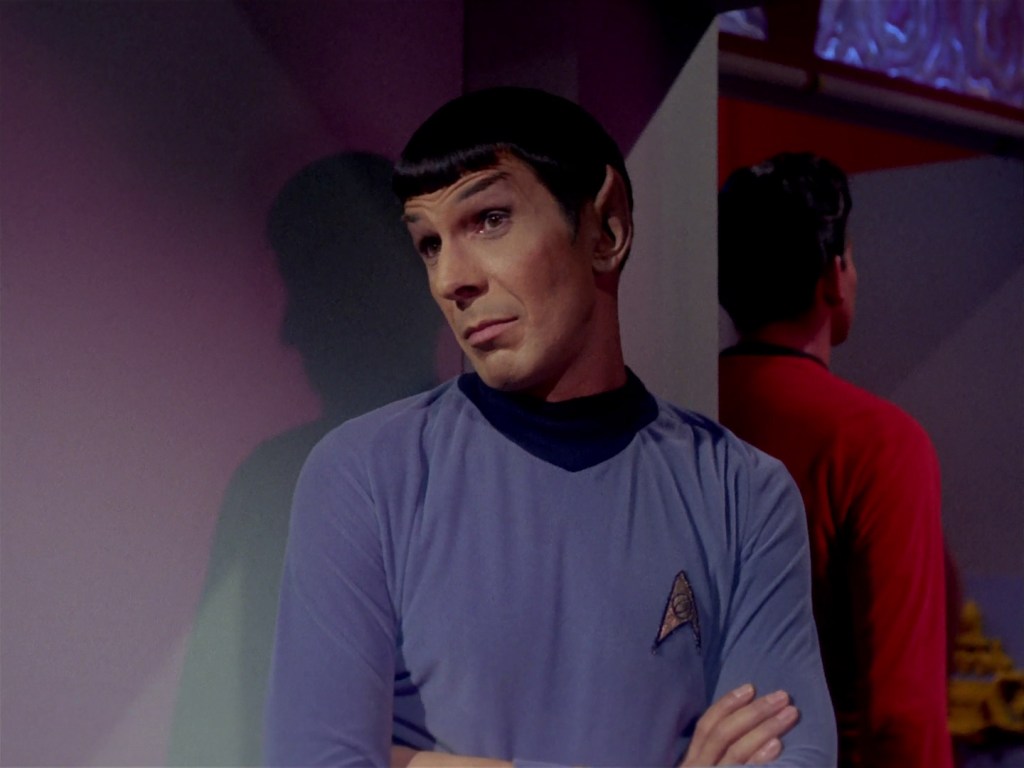
Mudd recognizes that Spock is “part Vulcanian”. He tells the women that their charms won’t work on Spock because he’s able to turn his emotions off. How Mudd is able to tell that Spock isn’t a full Vulcan isn’t clear. Spock is quite sassy in this episode. He seems sort of bemused by the whole thing and there are a couple of great shots of him giving amusing looks.
McCoy may come out of this episode the least well. He’s a mature man and should be able to control himself a bit better. 3/5
If there are guest or recurring characters, are they memorable or interesting?
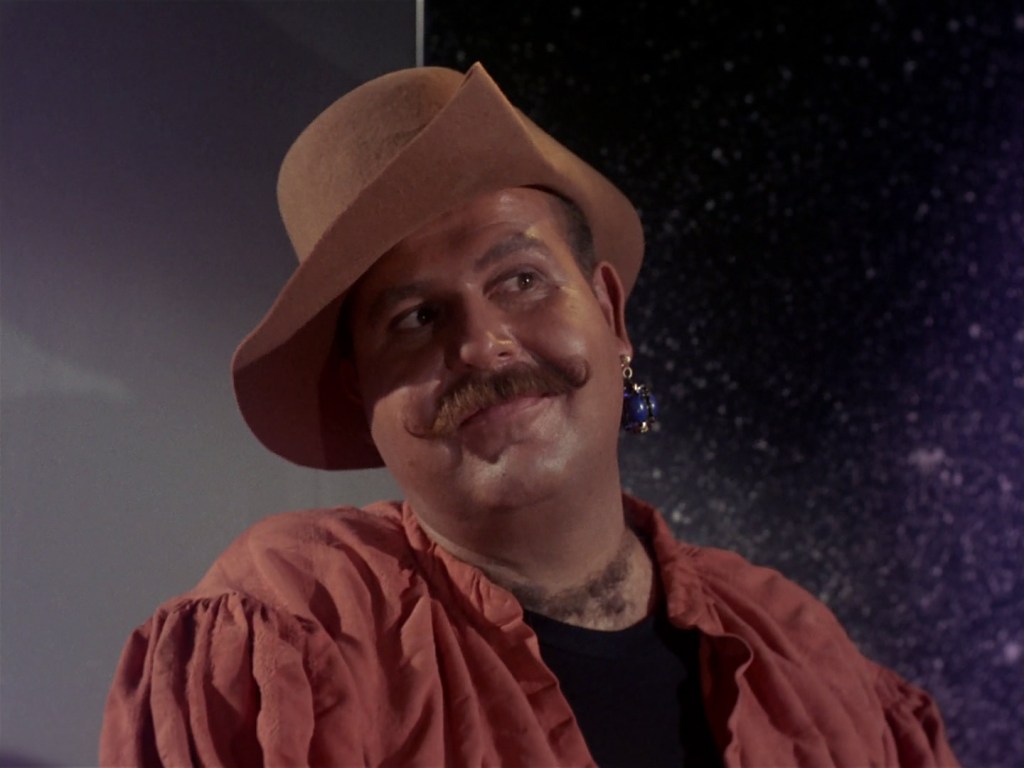
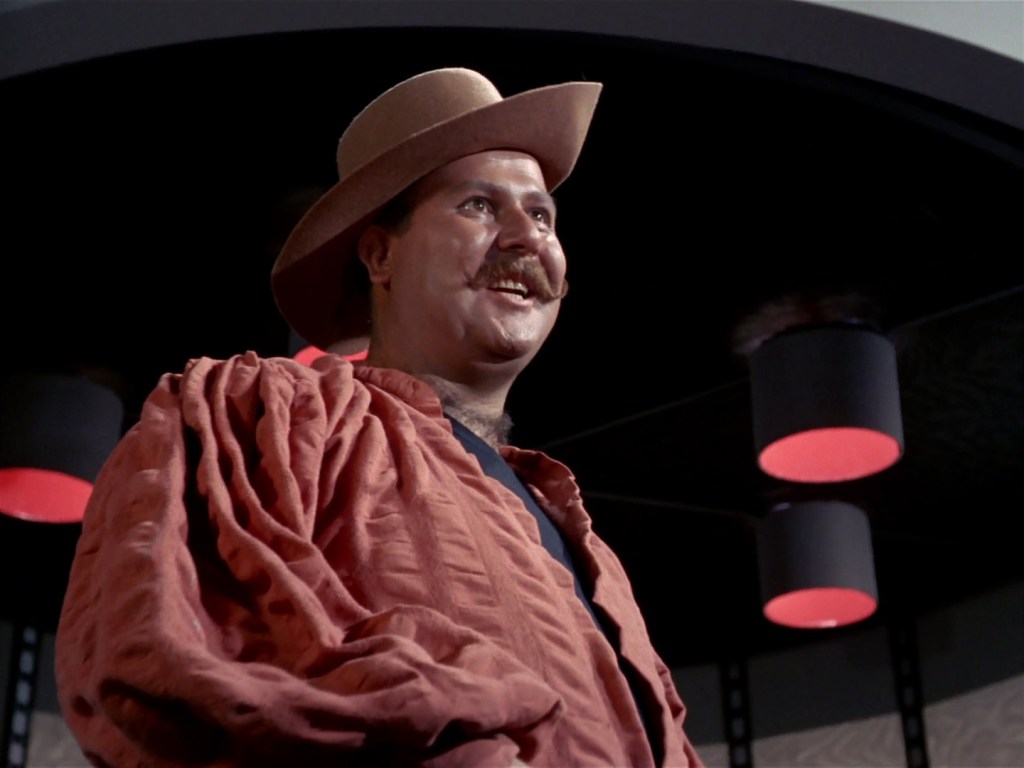
Roger C. Carmel as Harcourt Fenton Mudd is very memorable. So much so, that he will return in a future TOS episode, and an episode of The Animated Series. If this episode were being made today, Mudd would be a much more sinister character, but the intention in the 60s was that he come across as a lovable rogue. Despite basically being a human trafficker, Mudd is played mainly for comedy.
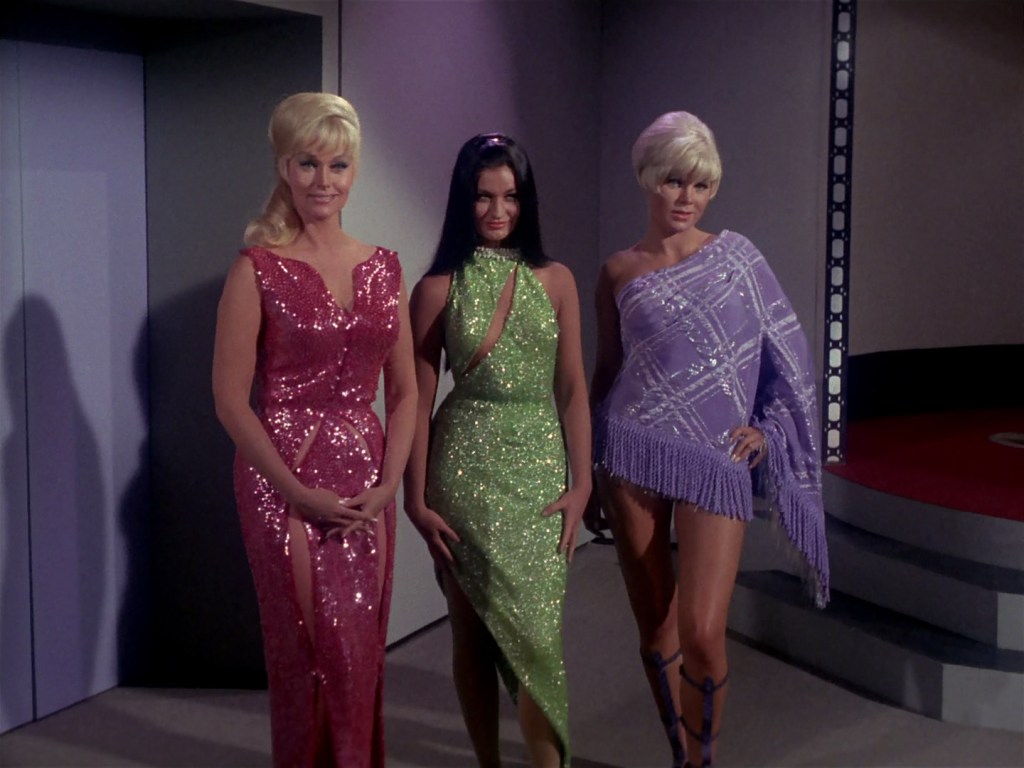
Karen Steele as Eve, Maggie Thrett as Ruth, and Susan Denberg as Magda do a good job with what is given to them. Steele has the most to do and her scenes with Gene Dynarski as Ben Childress are the most memorable. Dynarski is one of the handful of TOS actors who would later make appearances in TNG.
Finally, there’s Jim Goodwin as Lt. Farrell. Goodwin is, shall we say, distinctive looking. We’ve already seen him in “The Enemy Within” and he’ll appear in one more episode this season. He’s perhaps the worst offender amongst the crew for acting bizarrely with the women. 4/5
World-building
Does it contribute positively to the Trek Universe?
When the Enterprise rescues Mudd and the women from their ship, Kirk has to order Enterprise’s deflectors extended around the cargo vessel to protect it from asteroids. This over-taxes the Enterprise’s power systems. The power drain provides a ticking clock for the episode.
We learn that an essential part of those systems is “lithium crystal circuits”. I’m pretty sure this episode is the only one that mentions lithium crystals. Later, the Enterprise (and most other vessels in the universe) will use dilithium crystals to manage the matter-antimatter reaction in its warp core and power the ship. More than likely, production just changed the name from lithium to dilithium because it sounds more alien. An in-universe explanation might be that the lithium crystal circuits are another part of the power systems.
We learn that there are mining colonies like the one on Rigel XII where lithium crystals are mined. We’ll later see, or hear of, similar facilities for dilithium mining.
Another important introduction in this episode is that the Enterprise computer can be voice-activated and can respond with its own voice (provided by Majel Barrett). We see this being used in the briefing room for Mudd’s hearing. Barrett would go on to provide the voice of Starfleet computer systems through the Star Trek (2009) film. 4/5
Is it consistent with the rest of canon?
Aside from the lithium/dilithium issue, this episode is consistent with canon. When the Enterprise is en route to Rigel XII, Mudd uses a communicator on subspace frequency 3-9 to contact the miners. Subspace communications are already becoming the standard.
When the Enterprise arrives at Rigel XII, the planet is besieged by a magnetic ion storm. We will see many more magnetic storms and ion storms in future Trek episodes.
At one point, after Childress rescues Eve from the storms, she is seen playing a solo card game she calls double-jack. I think this is the only mention of that game, but she uses the circular playing cards we saw in “Charlie X”, helping establish them as a Trek staple. 3/5
Is there something new and unique?
The episode helps to continue fleshing out the Trek universe. Mining colonies, cargo ships, nefarious space-faring characters, etc. all help us to better understand the galactic landscape. Maybe Mudd is the new and unique thing from this episode. He’s certainly memorable. 3/5
Does the science seem plausible?
There’s really two bits of science in this episode. The first has to do with the Enterprise power systems and lithium crystal circuits. We never really get enough detail about what these actually do or how they work to judge whether they’re plausible or not. This is just presented as the way it is and we buy it.
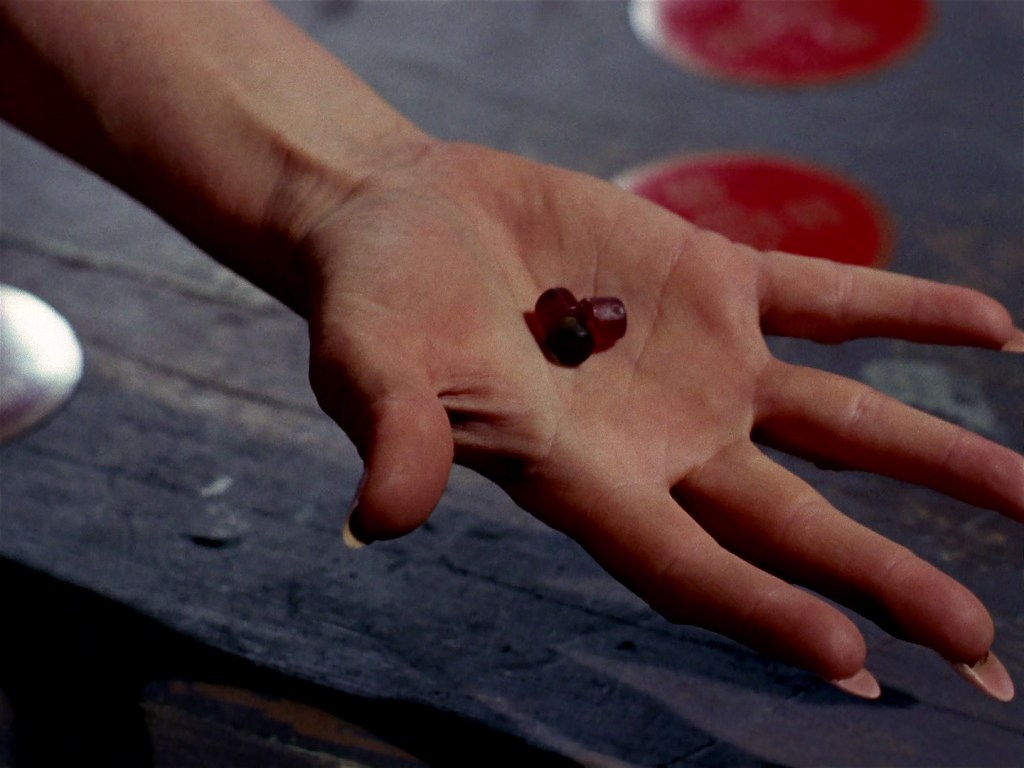
The other bit is the Venus drug. Mudd says this essentially gives one more of whatever they have. He says it makes men more muscular and aggressive, and women rounder and more feminine. The episode seems to prove that this drug is just a placebo, but it’s not 100% clear that the version Mudd originally gives to the women does nothing. The effects we see when Eve takes the placebo seem quite extreme but we’re meant to believe this is all down to one’s self-confidence. 3/5
Production
Production design (sets, props)
They’re still using the white-handled phasers in this episode. We see a security guard with one.
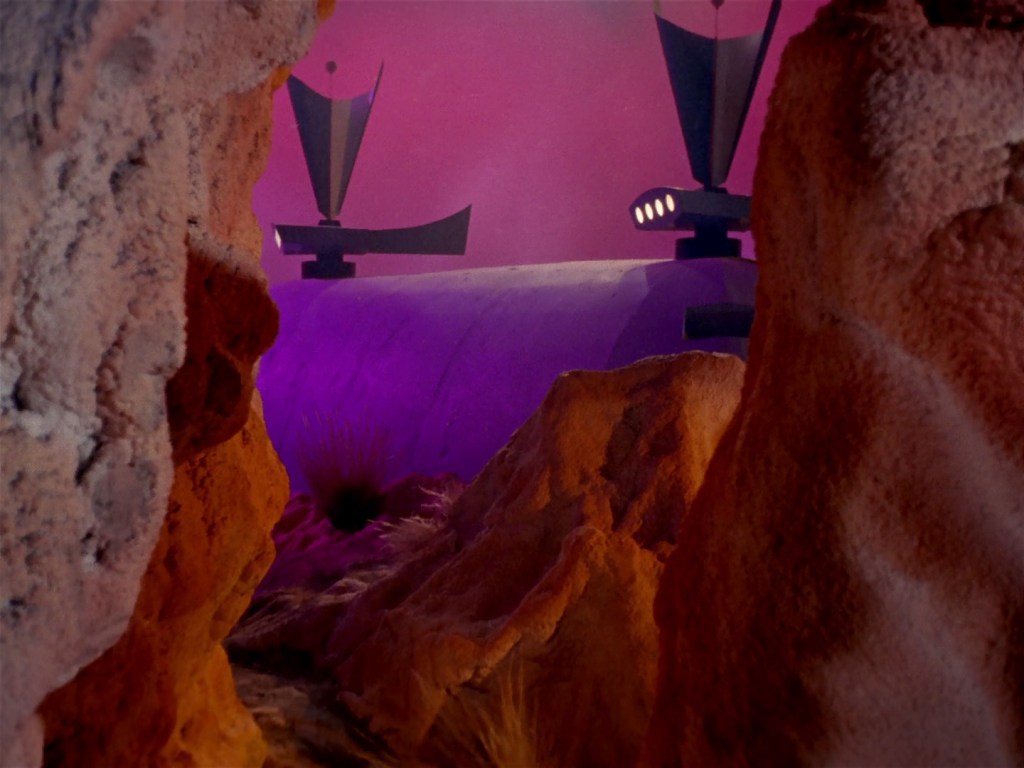
The miner’s dwelling we see on the planet’s surface is not 100% visible, but it seems to be some kind of metallic dome built on top of the rocky surface. The door and walls seem to be made of rock. There are some nifty spinning antenna-like things on the roof of the building which makes it memorable.
The two new props we see are a burnt-out lithium crystal and the Venus drug. The drug looks like a red gumdrop. Kirk says the placebo version is coloured gelatin. 4/5
Costumes
We see Uhura in a gold uniform in this episode. This will soon switch permanently to her usual red.
We have several guest stars in this episode so William Ware Theiss has new costumes to design. The most memorable are the gowns worn by the three women. These are glittery masterpieces that start to illustrate Theiss’ “barely there” style. There are also the three costumes worn by the miners, and Mudd’s pirate-esque ensemble. Mudd has this large dangly earring that looks something like a blue disco ball. It’s silly, but memorable. 4/5
Make-up and Hair
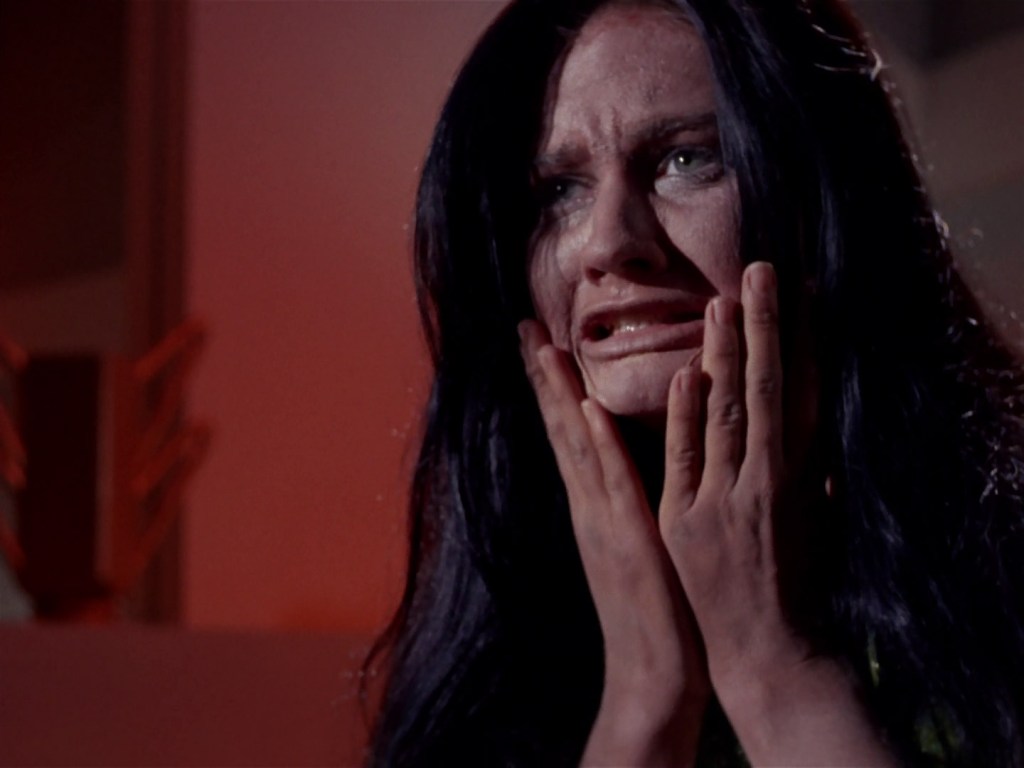
In the make-up and hair department we’re mostly talking about the women. They’ve got standard beauty make-up and their close-ups are usually shot with soft focus (not uncommon on 60s TV in general). When the effects of the Venus drug wear off, we see the women with make-up that is part aging and part tired. The aging is maybe most evident on Ruth, where Eve mainly just looks tired. Eve’s hair looks incredibly thirsty. I’m not certain if it’s a wig or Steele’s actual hair but conditioner is needed. Childress describes Eve as being “plain as an old bucket” when she’s not Venus-ed up. 4/5
Visual Effects
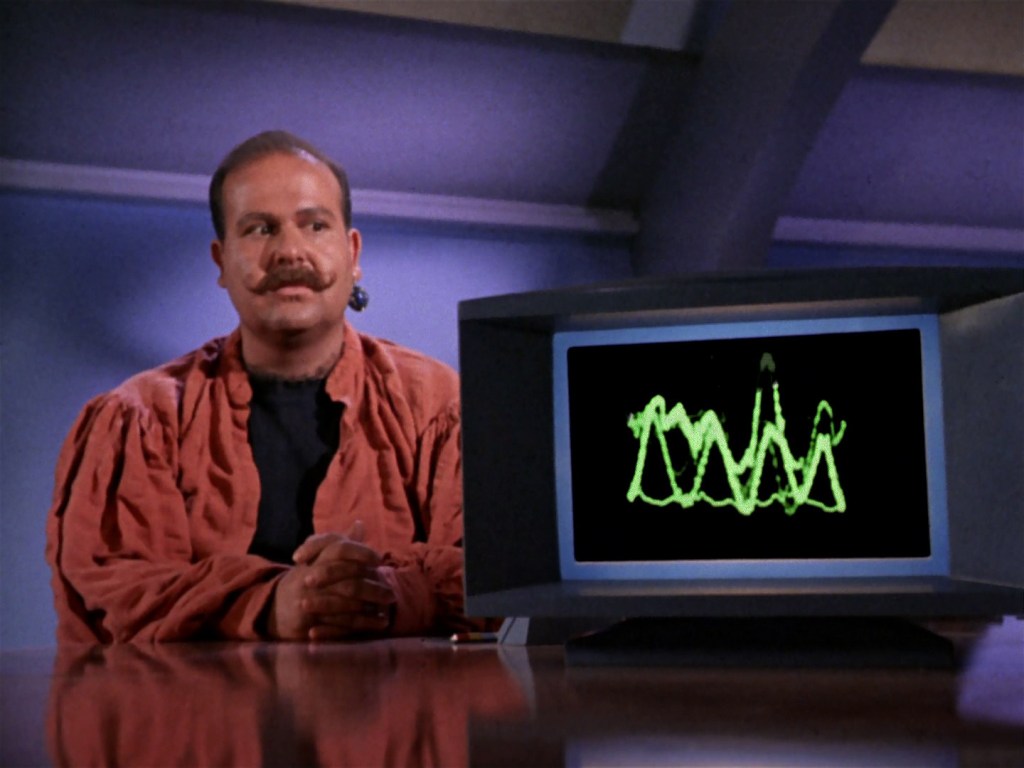
I didn’t note many visual effects in this episode (aside from the exterior ship shots, of course). When we first see the Venus drug, there is an animated sparkle effect added to it. This is part of what makes me unsure whether Mudd’s version actually does something. The sparkle is not present with the placebo that Kirk gives Eve. There’s also the burn-in on the screen in the briefing room during the hearing scene. 3/5
Music
The music for this episode was written by my favourite: Fred Steiner. He composed a wonderful, groovy, sexy melody for the women. It’s especially notable early in the episode when they walk through the corridors, drawing attention from the Enterprise crew. There’s also some hypnotic music that is most obvious when Kirk sees the women. It’s a memorable score and these themes will be used again. 5/5
Acting (series regulars and guests)
All the acting is strong in this episode with the possible exception of Jim Goodwin who’s telegraphing a bit as Farrell. 4/5
Direction (coherent, memorable)
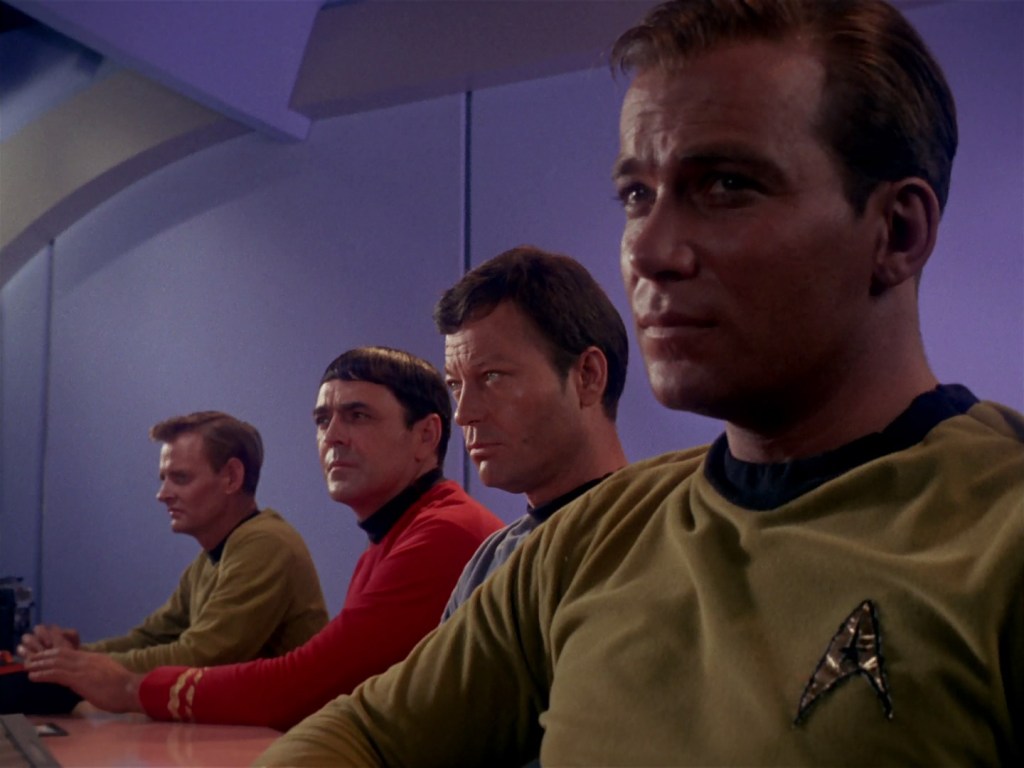
This episode was directed by Canadian Harvey Hart. The producers apparently didn’t like him because he didn’t always get the standard coverage that makes it easy to cut in post-production. Hart tended to direct more cinematically. He knew what he wanted the final cut to look like. I’ve read that he went over by a day on this episode so he wasn’t invited back. Probably the most memorable shots in this episode are the salacious booty shots, following the women as they walk through the corridor. Between the camera work and Steiner’s music, this is a very memorable scene. There’s also a nice shot of four officers in the briefing room. 4/5
Philosophy
Is it thought-provoking?
The thought-provoking piece is about how a person’s confidence affects their appearance. I know from personal experience that confidence can really change how one is perceived. I have very low self-confidence, and it has taken a toll on my body over the years. I’ve become more stooped and slumped over time. Confidence can be very attractive – unless and until it veers into arrogance. Believing in oneself certainly can’t effect the kind of change we see in the women in this episode but it definitely benefits people who do it. 4/5
Does it deal with a moral or ethical issue?
For me, the big ethical issue is this pseudo-human trafficking bit. Mudd’s mission is to transport these three women to Ophiucus III to waiting husbands. He describes it as “wiving”. The women seem to be more than willing participants. They say they come from planets where there are no suitable men. When the Enterprise has to head to Rigel XIII for new lithium crystals they are very excited about the possibility of connecting with the miners. Ruth and Magda definitely marry two of the miners (by subspace wedding). It’s implied that Eve will likely marry Childress as well.
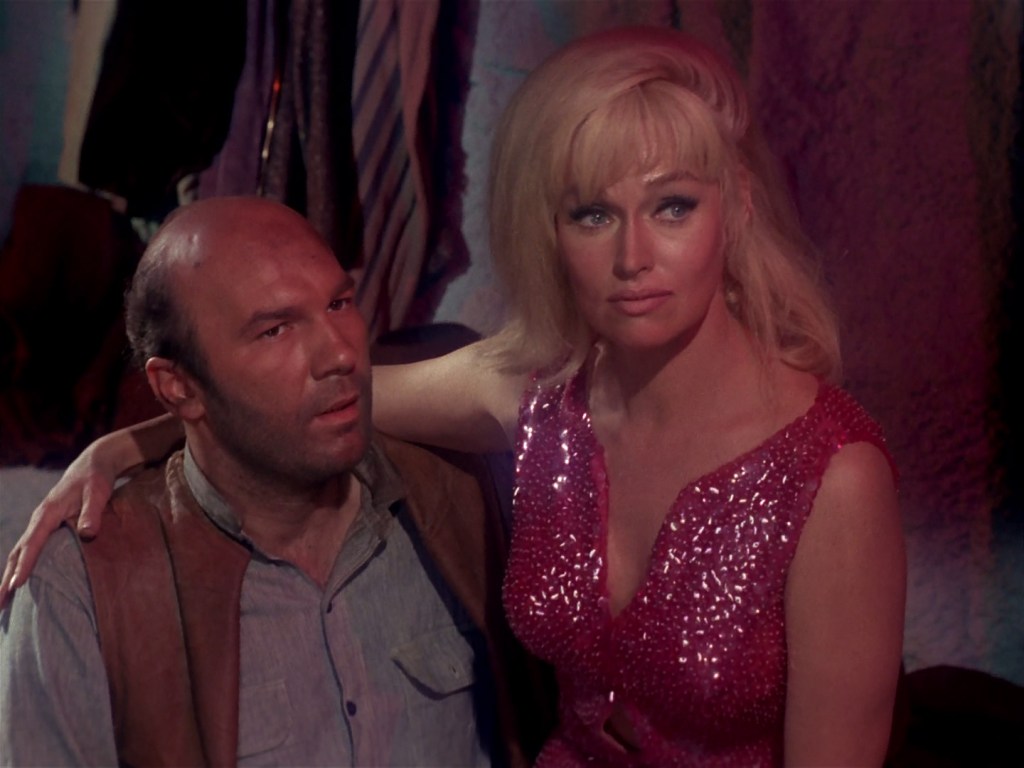
Early in the episode, Mudd describes the women as his cargo. The title of the episode even suggests that they are property: “Mudd’s Women”, but because they seem entirely willing I suppose it’s not really an ethical issue. It just feels really uncomfortable from today’s perspective. 3/5
Is it consistent with Trek’s optimism and Humanism?
I suppose that we leave the women and miners in a place where they’re all happy with one another. That would suggest an optimism about their lives together. The idea that confidence can make one more appealing or attractive does feel like a Roddenberry idea. People have to work at it, but they can improve themselves. 3/5
IDEA (Inclusion, Diversity, Equity, Accessibility)
We’re back to gender here. Something that surprised me on this re-watch is that the women are always referred to as “women” or “ladies”. A lot of women in Star Trek are referred to as “girls”. The only exception in this episode is actually Uhura who refers to Eve as a girl once.
The title of the episode and the women as cargo make me very uncomfortable. The costumes and camerawork definitely objectify the women and the make-up would seem to suggest that only a certain physical type can really be attractive. That’s problematic, but the episode could have done worse. 3/5
Conclusion
My ratings for this episode add up to 74/100 which feels quite respectable. I shake my head a lot while watching this one, but it’s still fairly entertaining. Sassy Spock for the win!


One comment