
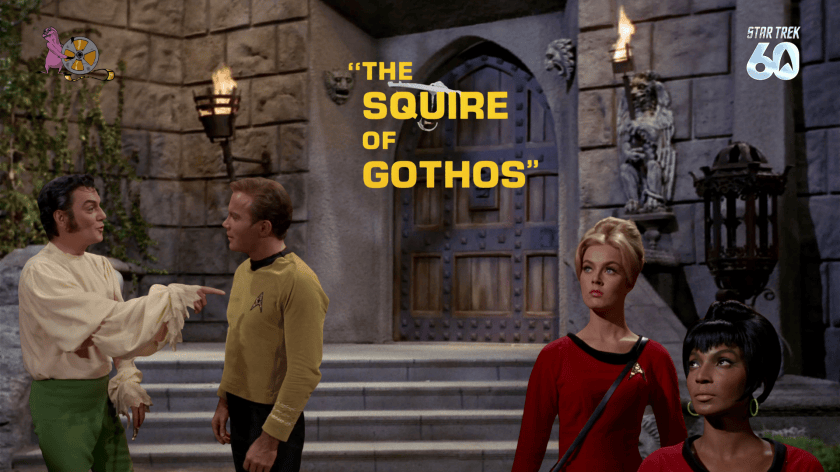
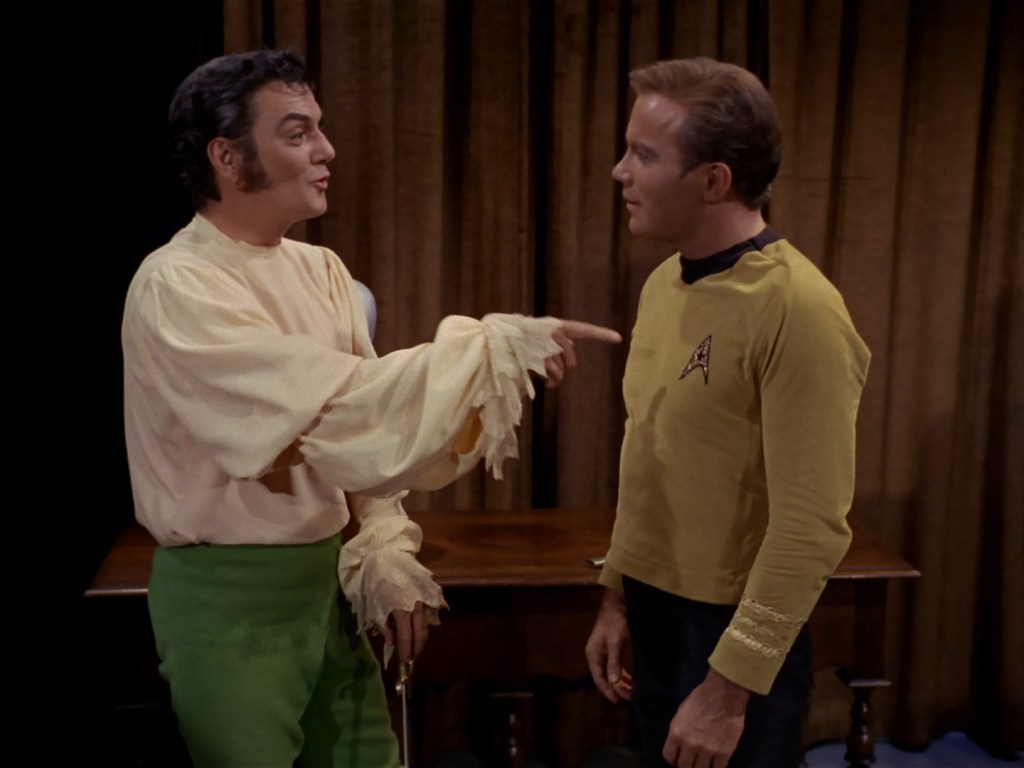
“I object to you. I object to intellect without discipline. I object to power without constructive purpose.”
Last night I watched “The Squire of Gothos”. This was the 19th episode of TOS to be produced and the 17th to be released. The original airdate was January 12, 1967. It was written by Paul Schneider who also wrote “Balance of Terror”.
Story
Is it a coherent story?
While passing through a “star desert” – an area of space where there are few solar systems – the Enterprise encounters a rogue planet. They don’t have time to investigate but they suddenly find the planet will not let them leave. When Kirk and Sulu disappear from the bridge the crew find that they were taken down to the planet where a Human-looking being called Trelane has recreated an 18th century drawing room. Members of the crew are held for Trelane’s amusement until Kirk can determine the source of his super-Human powers. 5/5
Is it enjoyable to watch?
This episode is a lot of fun. It’s very enjoyable to watch. 5/5
Is the dialogue strong and/or memorable?
Spock and Trelane have the most memorable dialogue in this episode. By this point, the writers have really figured out Spock’s voice. When the crew discovers that the food and drink that Trelane creates have no taste, Spock tells McCoy, “Fascinating is a word I use for the unexpected. In this case, I should think interesting would suffice.” He has already deduced that Trelane has been watching Earth without taking into account the amount of time light from Earth would take to reach his rogue planet of Gothos. Spock also gets the wonderful line, “I object to you. I object to intellect without discipline. I object to power without constructive purpose.”
Trelane is one of the most memorable guest characters from the original series because of William Campbell’s terrific performance, but he has great material to work with. He points out to Kirk that Humans are predators: “Do you know that you’re one of the few predator species that preys even on itself?” He also gets a few very memorable one-liners, including, “Are you challenging me to a duel?”, and “You broke it! You broke my sword!” 5/5
Does it serve the main cast well?
Kirk and Spock are both served well by this story. It gives them both the opportunity to deduce that Trelane is imperfect, and eventually realize that he’s only a child. Uhura and McCoy also have a couple of nice moments. 4/5
If there are guest or recurring characters, are they memorable or interesting?
Trelane is a wonderful character. For decades, Trekkies speculated that he might be a Q, like John de Lancie in Star Trek: The Next Generation. A few novels explored this idea and it was canonized in the Strange New Worlds episode “Wedding Bell Blues”. His theatricality and grandiose manner cement him in the memory banks of most viewers.
In this episode, he relies at least partially on a mechanism that helps him achieve his various tricks. Later, we’ll learn that adult Q are virtually omnipotent and need no instrumentation to achieve their will. 5/5
World-building
Does it contribute positively to the Trek Universe?
The Q are an important antagonist for the Trek franchise. This is especially true in TNG but they also make memorable appearances in DS9 and Voyager. If not for Trelane, none of that might have happened. 5/5
Is it consistent with the rest of canon?
At one point, Uhura is ordered to make a report to “Spacefleet Command”. We’re getting closer to Starfleet! Except for the business about needing a machine to assist him, Trelane is consistent with Q we see later. Unfortunately, Strange New Worlds makes some choices that are difficult to square with canon. Just last week, a new episode called “Like Chronitons Through the Hourglass” aired and it makes some of these choices. 4/5
Is there something new and unique?
Trelane is unique, however, he does fall into that category of more advanced alien species the Enterprise keeps encountering. That said, he’s quite different from the others. 4/5
Does the science seem plausible?
Rogue planets definitely exist. Gothos could have been created naturally, or by Trelane. It seems to make sense that he made an error in time, looking back at Earth’s past but believing it to be the present. The details about the fire he creates having no heat and the food he creates having no taste are good touches. There is discussion about matter-energy technology like the Enterprise transporters. 5/5
Production
Production design (sets, props)
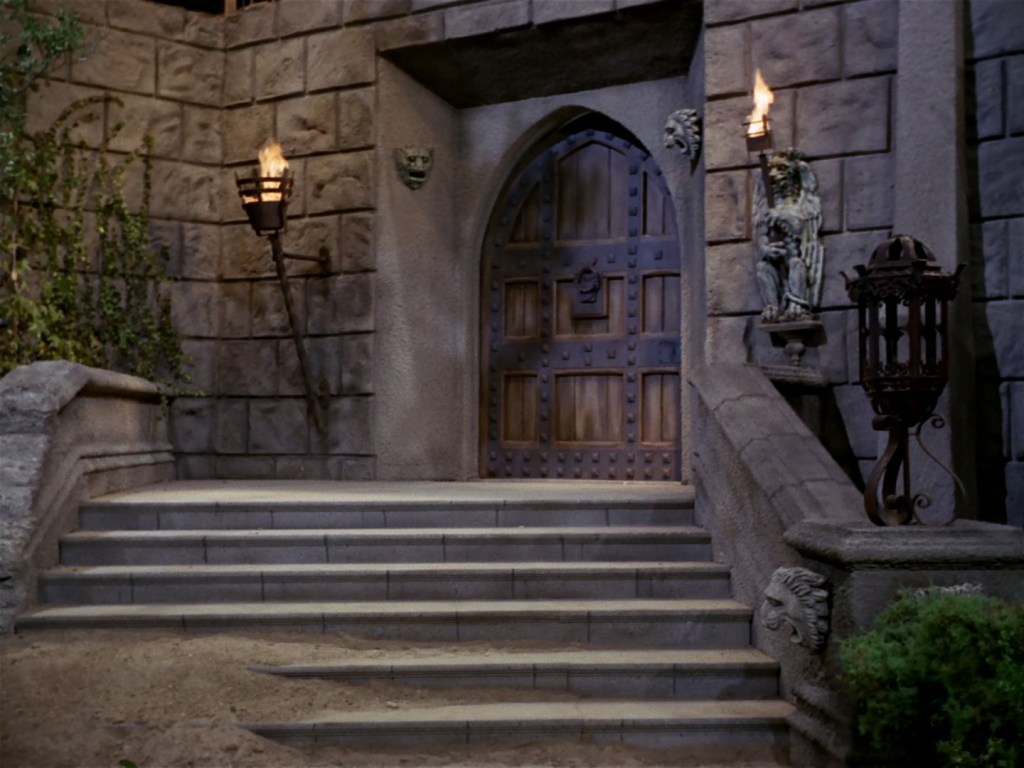
Trelane’s 18th century fascination was a smart production decision because so many props and costumes were readily available at the studio or to rent. The exterior of Trelane’s manor is a wonderful gothic edifice. The interior is largely true to period except that Trelane has a Salt Vampire like the one we saw in “The Man Trap” on display. I think there’s also a bird creature that we caught glimpses of in “The Cage”. 4/5
Costumes
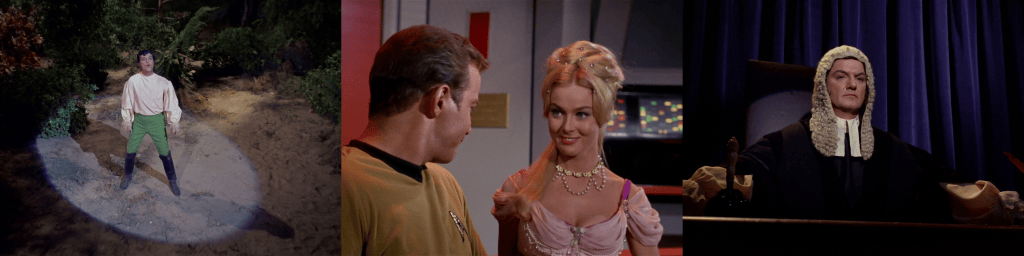
I know Trelane’s costume was rented because I’ve seen it used on Gilligan’s Island and The Monkees. Yeoman Teresa Ross wears a gown that was probably also rented. Both costumes work well. 4/5
Make-up and Hair
I didn’t note anything here. I expect the lambchop sideburns that Campbell had were false. He also gets a great wig when he appears as a judge at one point. 4/5
Visual Effects
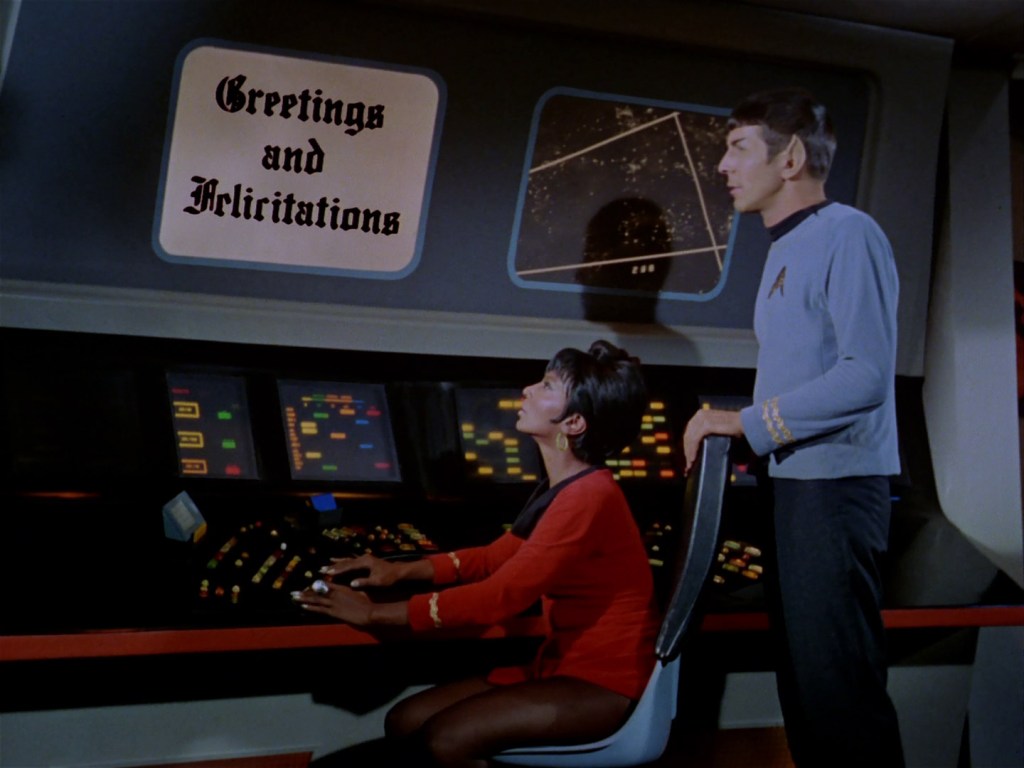
There are phaser blasts, and things being disintegrated. There’s also a lot of people popping in and out from nowhere. Near the end of the episode we see Trelane’s parents represented by two green sparkly effects. I think I’ll also mention here the wonderful text messages that appear on a screen on the bridge from Trelane. “Greetings and felicitations” is a wonderful phrase and I do use it whenever I’m in the presence of other known Trekkies. 5/5
Music
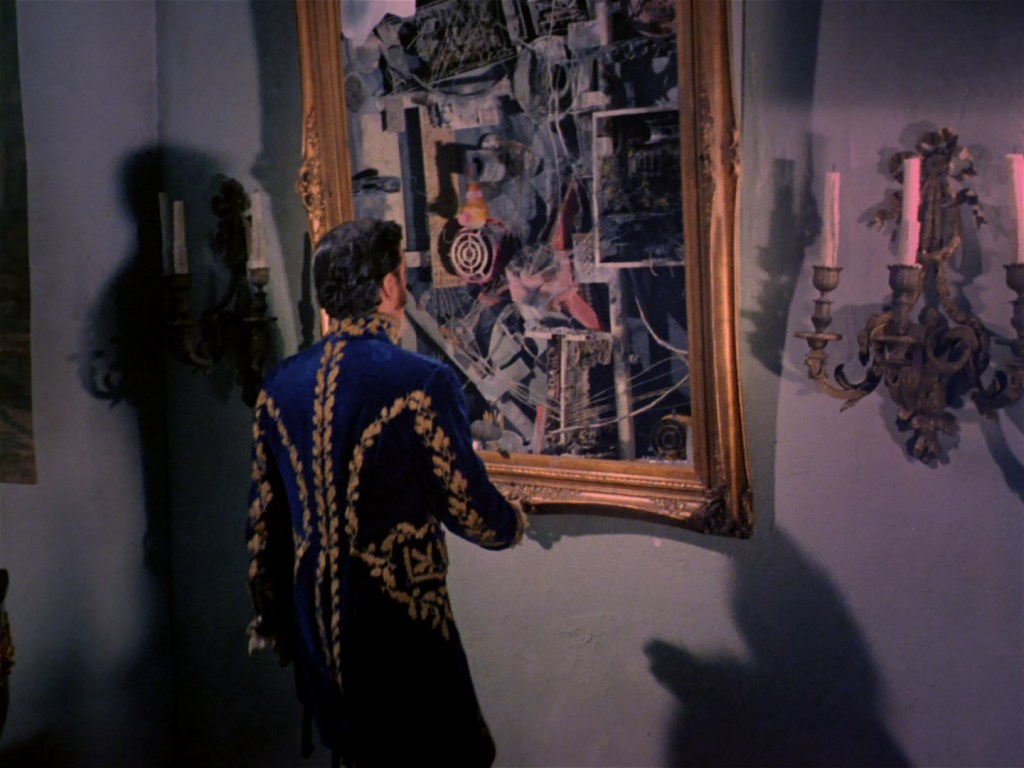
The music for this episode was by Alexander Courage, but it relies heavily on pieces by Domenico Scarlatti and Strauss. I remember those more than I do the rest of the score. I’ll also mention here the sound effects which are quite memorable in this episode. There’s a “pong” sound that occurs when Trelane makes something appear or disappear. There’s also a wonderful mix of crazy sound effects when Kirk destroys Trelane’s mirror machine. 4/5
Acting (series regulars and guests)
The cast all do a great job. Richard Carlyle plays a Starfleet officer called Lt. Jaeger. He was written as a really clever person which is consistent with Roddenberry’s idea that the best and brightest make up Starfleet. We never saw him again but I would have liked to. Venita Wolf plays Teresa Ross – another potential replacement for Grace Lee Whitney whom we never saw again.
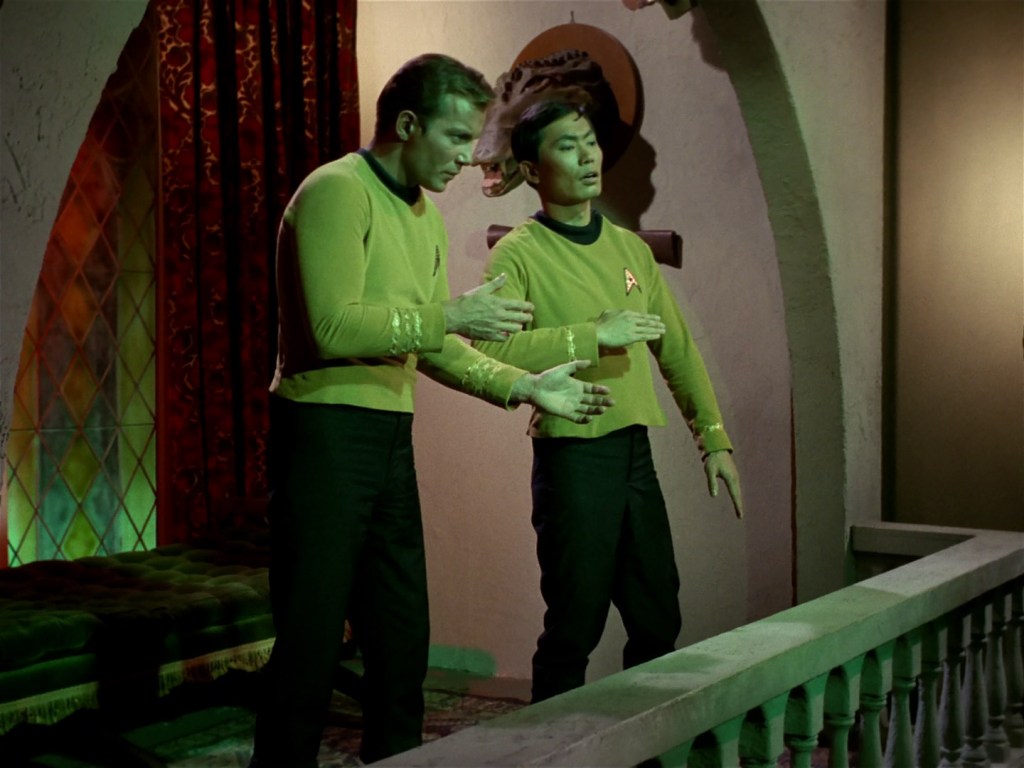
Shatner and Takei, along with Michael Barrier as DeSalle, get frozen by Trelane and have to remain completely still at a couple of points. This is a unique acting challenge that’s really difficult to pull off. 4/5
Direction (coherent, memorable)
This episode was directed by Don McDougall. This was his only episode and I think he did well. He and Jerry Finnerman did some interesting things with lighting when our crew members are frozen, and shadow when Kirk is put on trial and sentenced by Trelane to hang. 4/5
Philosophy
Is it thought-provoking?
It’s compelling to imagine an omnipotent being and consider what one might do with such abilities. Here, Trelane is interested in Kirk’s feelings on war, killings, and conquest. Unfortunately, these are things Trelane would see whether he was watching 18th, 19th, 20th, or 21st century Earth. I think it’s embarrassing. If any outside intelligence were watching us I’m sure they would never engage with so violent a species as man. 4/5
Does it deal with a moral or ethical issue?
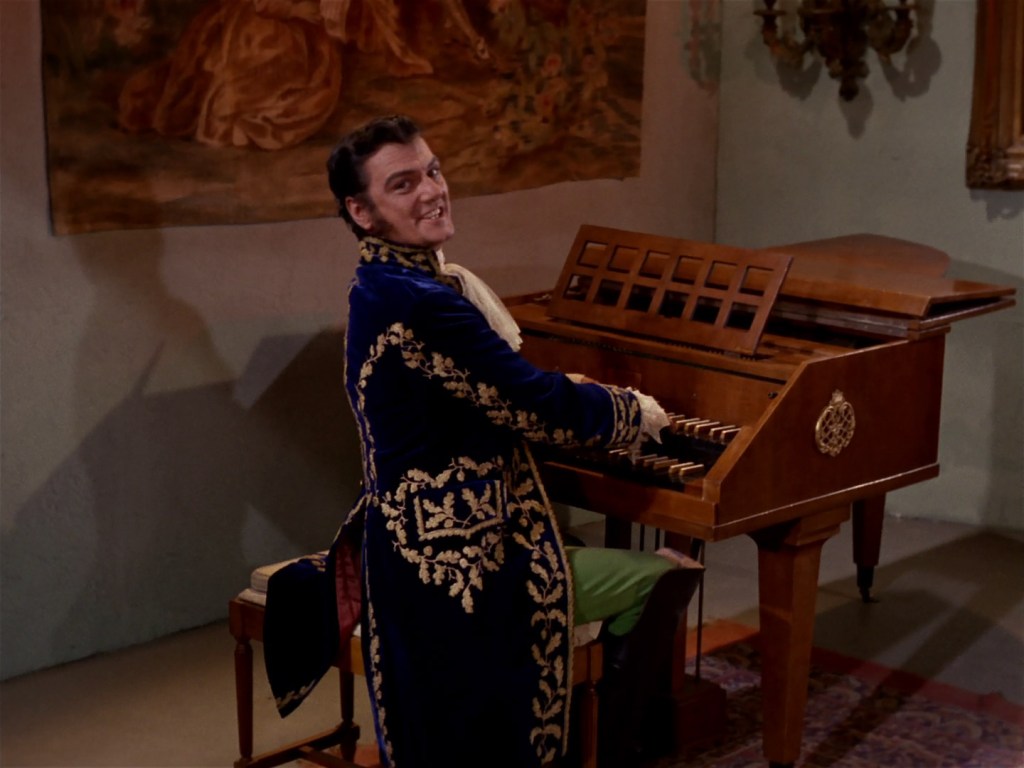
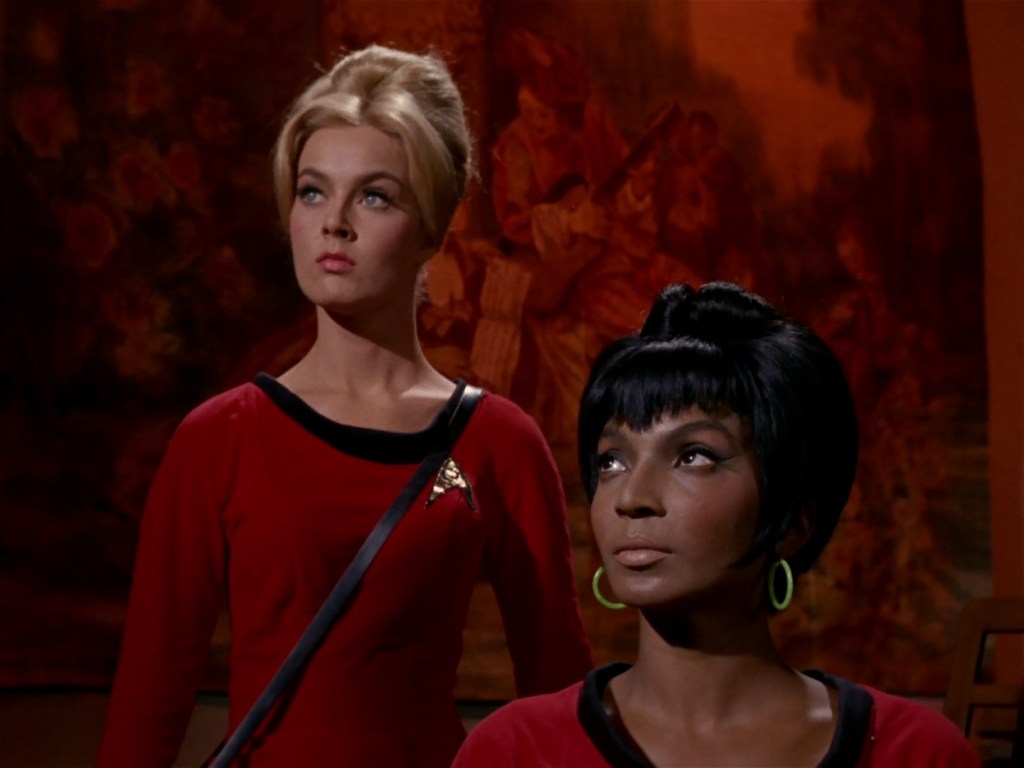
What comes up for me here is around consent, similar to what I said about “Shore Leave”. Our crew are waylaid and forced to participate in Trelane’s shenanigans, which – it turns out – might have been quite fatal. Uhura’s body is taken over and forced to play a harpsichord and Yeoman Teresa is forced to wear a dress and dance with Trelane. The issue would seem to be the idea that “Power tends to corrupt, and absolute power corrupts absolutely.” When a being is omnipotent they might tend to see themselves as being far above other beings and be inclined to take actions like Trelane’s here. The danger is when someone believes themselves all powerful but really has the mind of a child – like a certain sitting American president, for example. 5/5
Is it consistent with Trek’s optimism and Humanism?
I think this episode calls out the fact that Humans are a violent, predatory species. Kirk and crew are definitely not above this, but they generally tend to be defensive rather than offensive. This is part of Roddenberry’s thesis that Humanity has great potential and could become something wonderful someday. I think this episode is meant to remind us of that. 4/5
IDEA (Inclusion, Diversity, Equity, Accessibility)
Racism and colonialism play a part in this episode. At one point, Trelane refers to Uhura as a “Nubian prize” and says she must have been taken on a mission of conquest. This is, of course, referring to a long and dark chapter of Human history, the effects of which are still being dealt with today. It’s a bit shocking and no one really seems to know how to respond. I think acknowledging this history is critical to making change going forward. Civil rights were very much on the minds of Americans in 1967. It’s hard to know how different people might have read this moment at the time. 4/5
Conclusion
My ratings for this episode total 88/100, placing it in the top five for the moment.

