
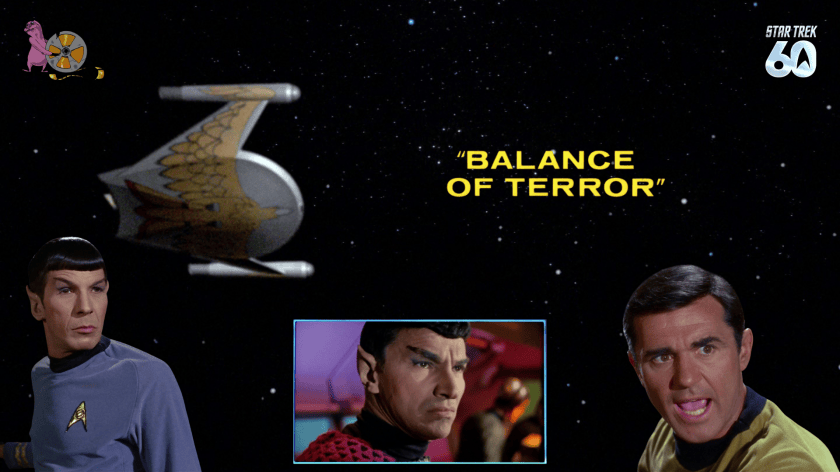
“In this galaxy, there’s a mathematical probability of three million earth-type planets… and in all the universe, three million, million galaxies like this one. And in all of that, and perhaps more, only one of each of us.”
Last night I watched “Balance of Terror” – one of the truly classic TOS episodes! It was the ninth episode produced and the 14th to air. The original airdate was December 15, 1966. It was written by Paul Schneider who would go on to write one more TOS episode and an episode of The Animated Series.
Story
Is it a coherent story?
In an episode inspired by 1950s submarine movies The Enemy Below and Run Silent, Run Deep, a cloaked ship destroys Federation outposts along the Neutral Zone between the Federation and the Romulan Star Empire and the Enterprise faces a calculating enemy that no one has seen for 100 years! 5/5
Is it enjoyable to watch?
Yes, just like the movies it’s inspired by, this episode is very enjoyable to watch – especially on the first viewing. 5/5
Is the dialogue strong and/or memorable?
There is some very memorable dialogue in this episode. Perhaps the most well-known is Kirk’s line to Stiles, “Leave any bigotry in your quarters. There’s no room for it on the bridge.” (more on this later). There are three great lines from Mark Lenard as the Romulan Commander:
“Danger and I are old companions.”
“You and I are of a kind. In a different reality I could have called you friend.”
“We are creatures of duty, Captain.”
My favourite line is delivered by McCoy, and it’s one of my favourite lines in the entire franchise:
“In this galaxy, there’s a mathematical probability of three million earth-type planets… and in all the universe, three million, million galaxies like this one. And in all of that, and perhaps more, only one of each of us.”
If there’s any line that speaks to Roddenberry’s Humanism it’s this one. 5/5
Does it serve the main cast well?
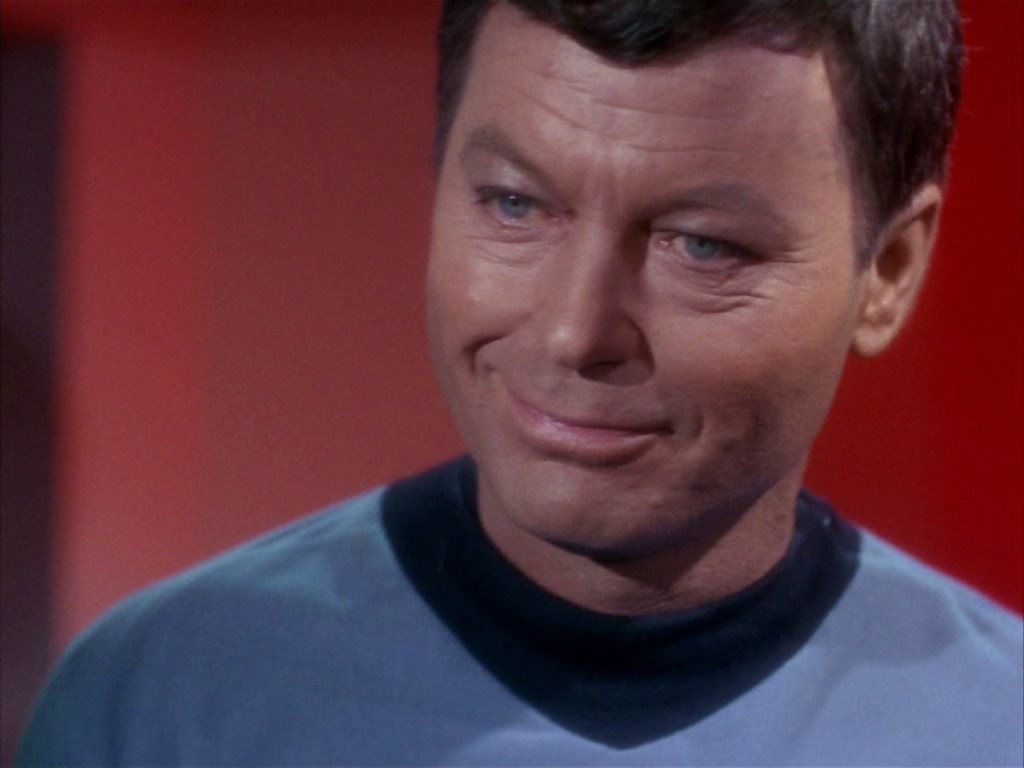
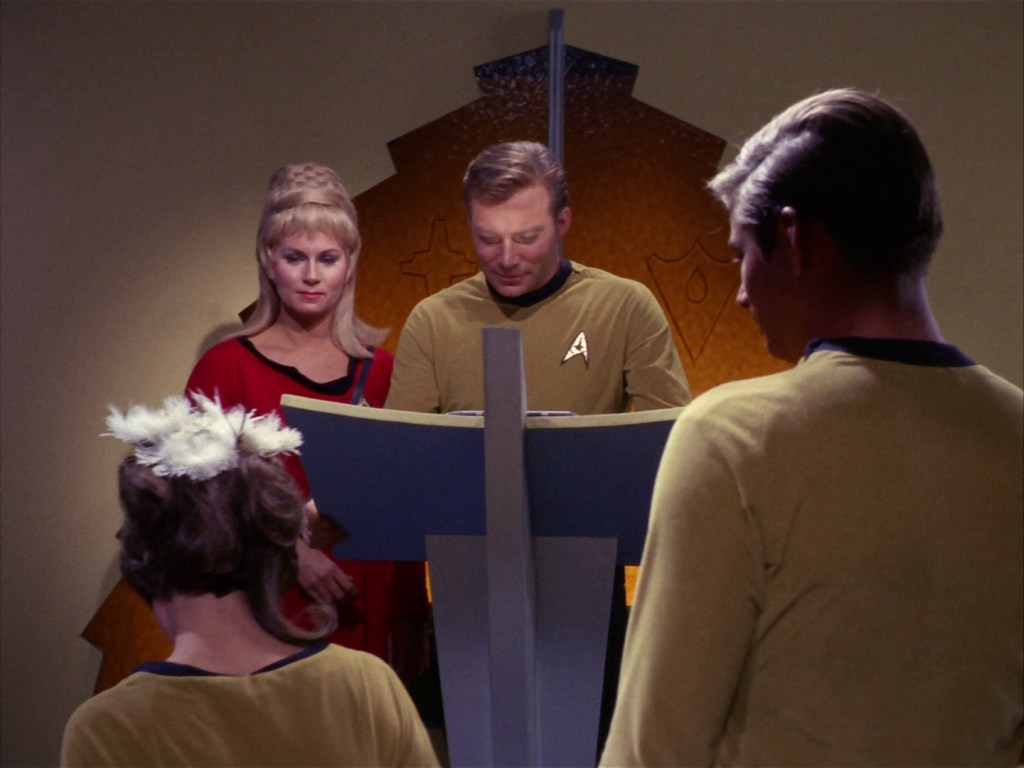
Kirk, Spock, and McCoy are all highlighted in this episode. Kirk gets to demonstrate his battle savvy, but also his tender side. The episode opens with Kirk about to marry two crewmembers. The ceremony is interrupted by the Romulan threat, and one of the affianced is killed in the action. Kirk tries to comfort the survivor in a nice bookend to the episode. He also gets to demonstrate his loyalty to Spock when he warns Stiles about bigotry.
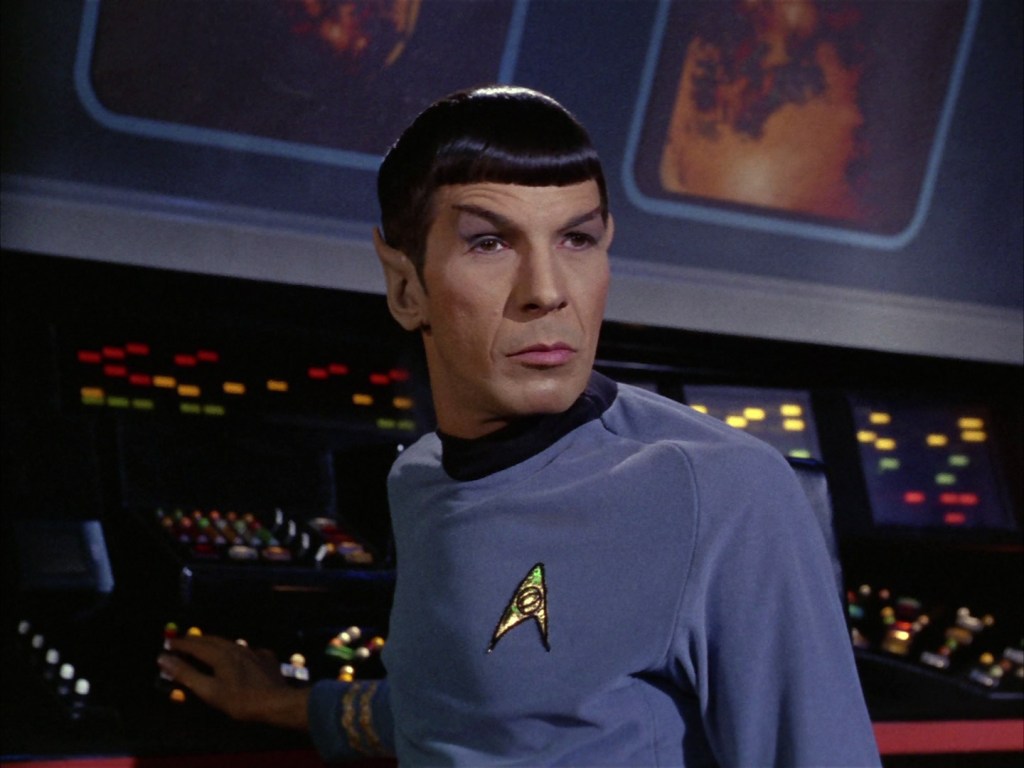
Spock learns that Vulcans and Romulans probably share common ancestry and, though he must be intrigued and want to learn more about them, he demonstrates his loyalty to the ship and crew by agreeing that the Enterprise should attack the Romulan ship if given the chance.
McCoy gets to demonstrate his love for Kirk with that memorable line above. He ends it with, “Don’t destroy the one named Kirk.” He doesn’t even argue for the crew as a whole, just Kirk.
There is a nice moment for Uhura. She takes over the navigation station at one point like it’s no big deal. Kirk asks her to take the station and she slips into it as if it’s second nature. This was really nice to see and was probably an even bigger deal at the time than it is now.
This is the last episode to air that includes Yeoman Rand. There’s a tense moment when she and Kirk share an embrace on the bridge, but she hasn’t been given much to do in the last few episodes and we won’t see her again until The Motion Picture. 5/5
If there are guest or recurring characters, are they memorable or interesting?
Paul Comi plays Lieutenant Stiles. To me, he seems unnecessarily angry and martial from the get-go, but he holds some exposition about the Romulans because of his family history. It’s Stiles who tells us that we’ll know the Romulan ships because they are painted like birds of prey. An ancestor of his fought in the Romulan War 100 years ago and apparently carried a lot of hatred that was passed down to Stiles.
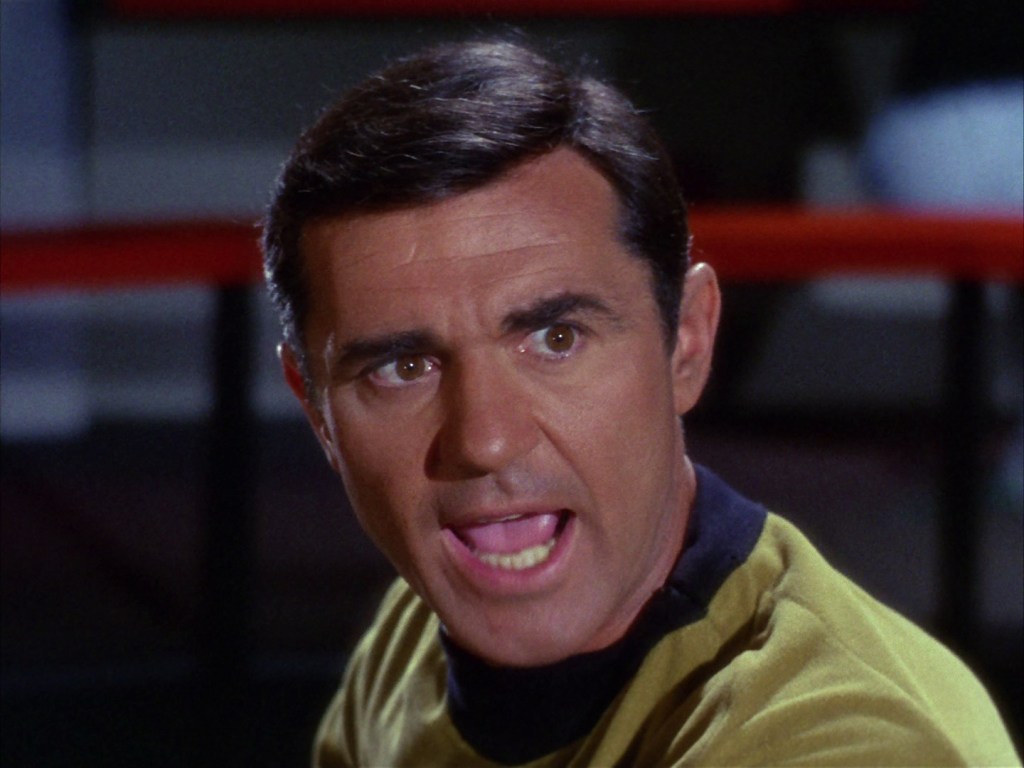
Lawrence Montaigne plays the Romulan officer Decius. He’s kind of a counterpart to Stiles – urging action against the Federation the entire time.
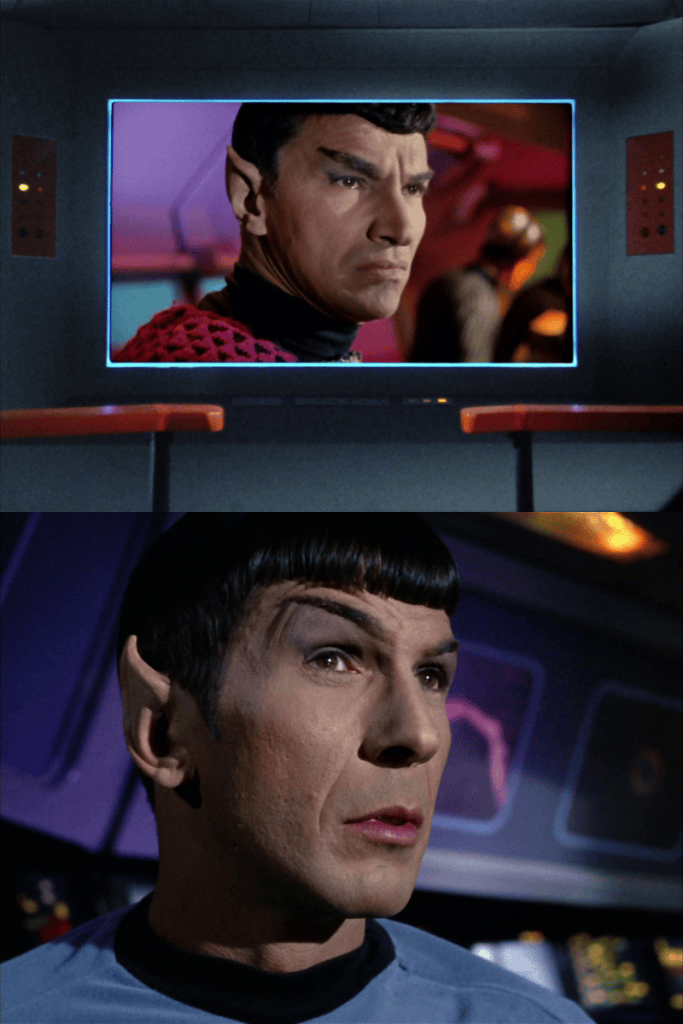
Mark Lenard plays the Romulan Commander. The Star Trek Customizable Card Game called this character Keras (Sarek backwards, after Lenard’s more famous Trek character). Though the name is not canon it’s stuck in my head and I usually think of him as Keras. It’s a dream role for any actor and Lenard does well with it. Keras is a good foil for Kirk, but I don’t think his characterization is entirely consistent. For example, at one point he reveals to the Centurion (John Warburton) that he finds himself wishing for destruction before they can get home. That’s a crazy thing for a starship commander to say out loud! I’d be tempted to mutiny if I were serving under him. He backpedals quickly and says he’s too well trained to allow it but his uncertainty and general exhaustion make him feel more like Pike in “The Cage” than Kirk. Nevertheless, he’s a compelling character. 5/5
World-building
Does it contribute positively to the Trek Universe?
This episode is exciting because it introduces the Romulans – probably the best known Trek alien race after Vulcans and Klingons! What’s interesting is that they are introduced with a history that we haven’t seen on screen. It makes them feel immediately more real. Hearing the Enterprise crew talk about a conflict 100 years in the past also reinforces just how far in the future we are. The map of the Neutral Zone with the Federation outposts is something that many Trekkies have paused on VHS and DVD to examine. It’s extremely memorable.
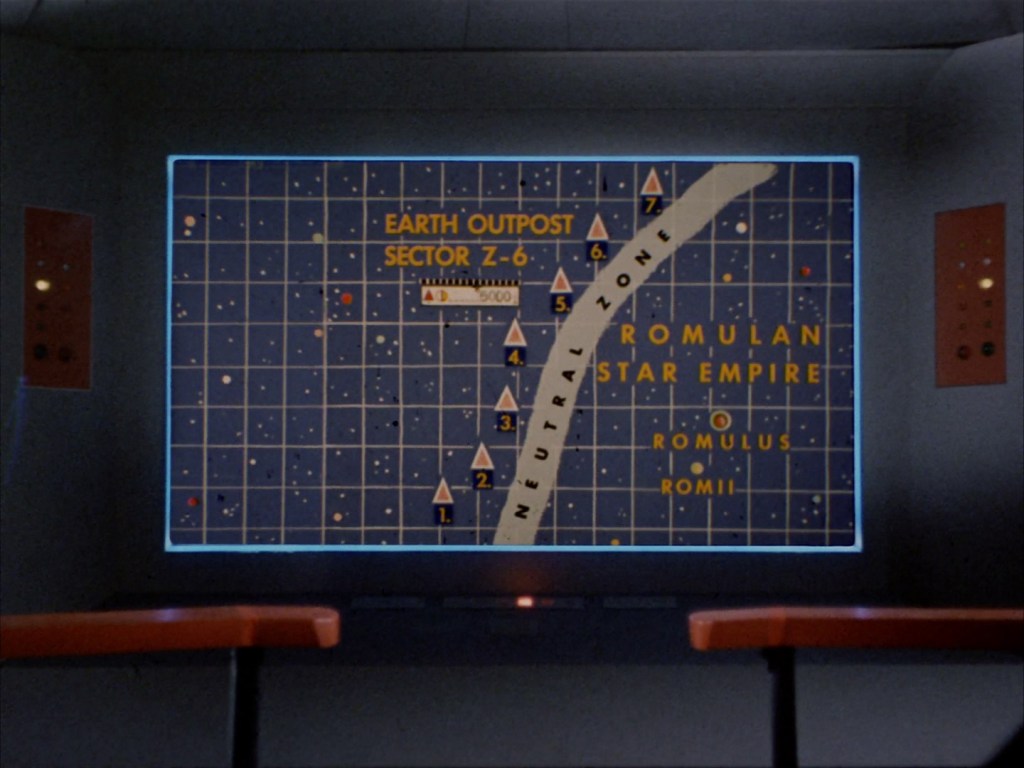
We also learn that the Vulcans and Romulans share common ancestry. Later in the franchise we learn that the Romulans left Vulcan centuries ago to pursue lives that were not governed by logic. It makes them a fascinating species and the divide serves as story fodder for years to come.
We learn that Starfleet ship captains are able to perform marriage ceremonies. This carries through the rest of the franchise. 5/5
Is it consistent with the rest of canon?
Trek has a problem with prequels. When they made Star Trek: Enterprise, there were appearances by the Romulans. They were careful to never have the Enterprise crew see any of the Romulans to preserve the surprise for Spock in this episode. However, we’re told in this episode that at the time of the Romulan War there was no visual ship-to-ship communication which is something that ENT couldn’t stick with.
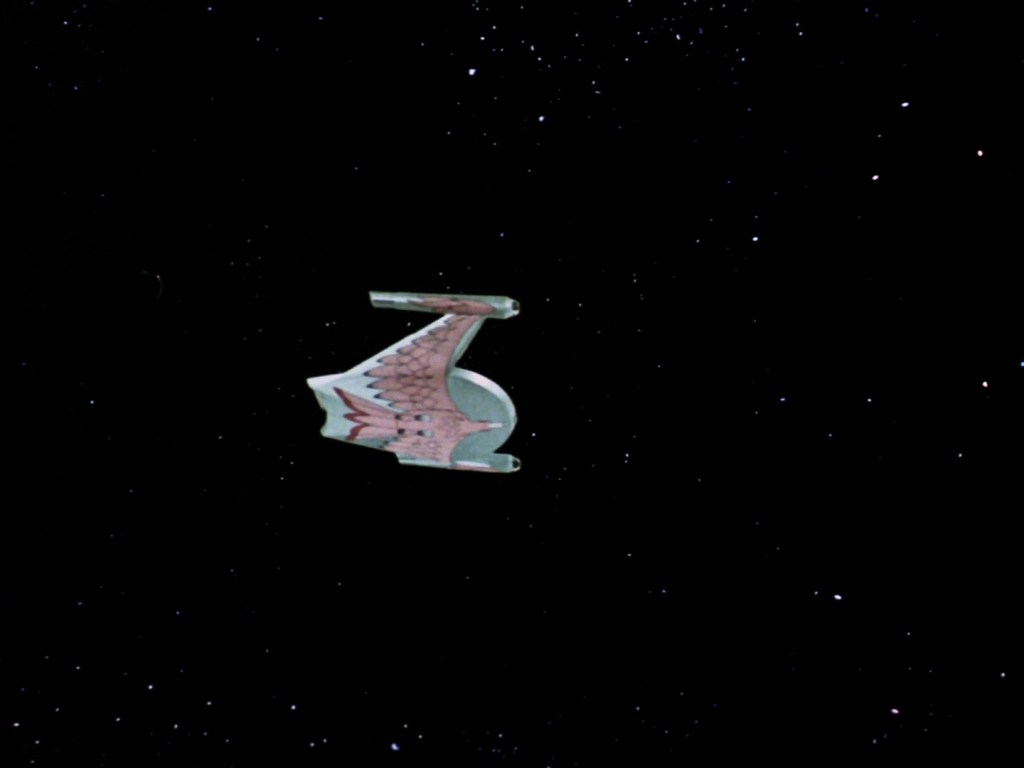
The other problem with ENT is that the Romulan ships do not have the painted bird of prey design on their hulls as Stiles says they did. I remember reading an interview with Doug Drexler some years ago where he said the ENT art department advocated for this but they were shot down. So, this episode builds a lot of canon that was consistent until it wasn’t. 5/5
Is there something new and unique?
The Romulans and the Neutral Zone are new and unique. We couldn’t ask for more. 5/5
Does the science seem plausible?
Three things came up for me here. The Federation outposts have armour made from cast Rodinium which is described as the hardest substance known to science. The Starfleet Medical Reference Manual (a book which may or may not be considered canon) says that Rodinium has atomic number 125. The Internet tells me that element 125 has yet to be discovered so it’s possible we might at some point discover it and call it Rodinium.
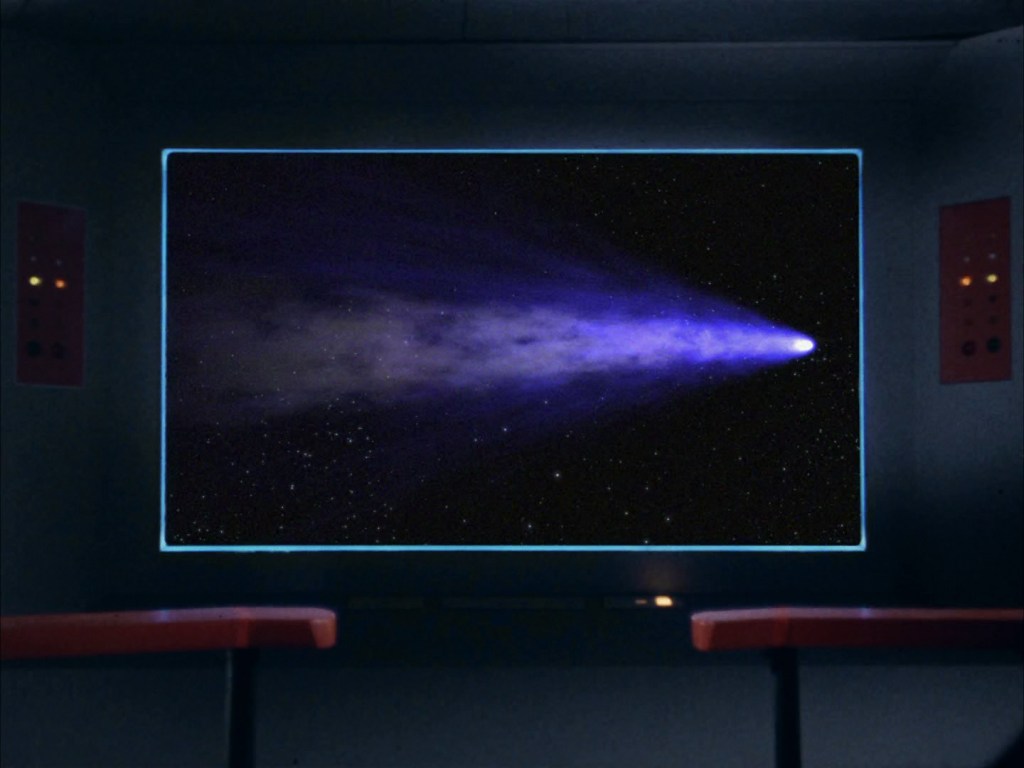
The second thing is the comet. This is the first comet we’ve seen on Trek and Kirk cleverly lays a trap for the cloaked Romulan ship, theorizing that if it passes through the comet’s tail it will become visible. The comet in the remastered edition looks really beautiful.
Finally, building off those WWII submarine movies I mentioned, there is a sequence when the crews of both ships have to remain silent in order to avoid detection. This doesn’t make any sense to me because, as far as I know, sound doesn’t travel through space. If they were in an area like a nebula or there was a lot of particulate matter then I think sound might travel through that. But we don’t see that they are. It’s very dramatic but I don’t think it makes sense. 3/5
Production
Production design (sets, props)
The chapel set is interesting. It’s relatively non-denominational which I’m good with. I think it might be a re-dress of the briefing room. There’s a really cool podium/lectern that Kirk stands at. The other set we see is a phaser control room. This is something that future series abandon. It makes sense that more automation would be developed over time and these kinds of rooms would be less necessary.
The Romulan bridge looks like a re-dress of the Enterprise observation deck we saw in “The Conscience of the King” – except that this episode was produced first which means the observation deck was actually a re-dress of the Romulan bridge.
There is a moment where a little fire breaks out in a panel on the bridge. I made a note of it being neat. That is all. 5/5
Costumes
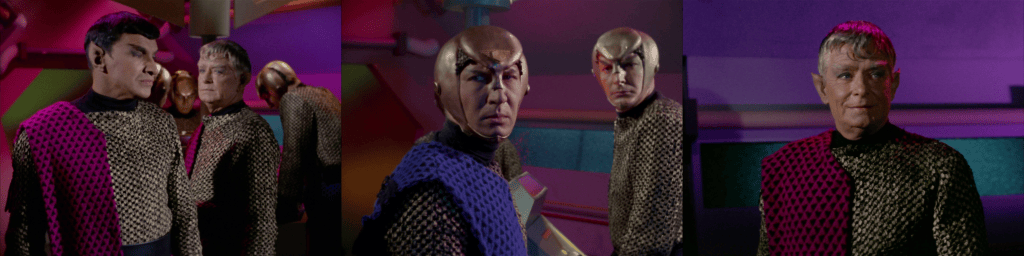
The Romulan costumes are terrific. For me, they’re some of the most memorable from TOS. They cleverly created helmets for most of the Romulan officers so that they could save time and money not having to apply prosthetic ears and style their hair. This trick would be used again in Star Trek III: The Search for Spock. There are dozens of Vulcan extras in that film and they give most of them ceremonial hats to avoid having to apply ears. I own some of these costumes and they’re favourites of mine. I’d love to have one of the Romulan helmets from this episode someday. 5/5
Make-up and Hair
Mark Lenard as Keras and John Warburton as the Centurion get Spock-like make-up which is pretty effective. I didn’t note anything else here. 4/5
Visual Effects
The Romulan ship (which is the praetor’s flagship) is armed with a plasma weapon. The blasts from that are visual effects that are effective in both the original and remastered editions of this episode. I already mentioned the wonderful comet. The remastered version of the Romulan ship is also wonderful. I believe the original model was created by Wah Chang and he apparently destroyed it because of some kind of dispute with Desilu over payment. It’s a shame it doesn’t still exist. 5/5
Music
The music for this episode was written by my favourite, Fred Steiner. His famous Romulan theme would be re-used decades later in Star Trek: Picard. It’s an extremely memorable piece of work. I did also note a re-use of some of Alexander Courage’s score from “The Cage”. It’s especially noticeable at the end of the episode when Kirk is trying to comfort the officer who would have been married. 5/5
Acting (series regulars and guests)
The acting in this episode is strong all around. Lawrence Montaigne has a great presence as Decius. We’ll see him later as an important character. This is Mark Lenard’s first appearance in Trek but he’ll recur in the more famous role of Spock’s father, Sarek. He also makes an appearance as a Klingon in Star Trek: The Motion Picture. I think that makes him the first actor to play a Vulcan, Romulan, and Klingon. Lenard was the first actor I met at a Trek convention (Odyssey Trek ’94 in Niagara Falls) and he made a big impression on me.
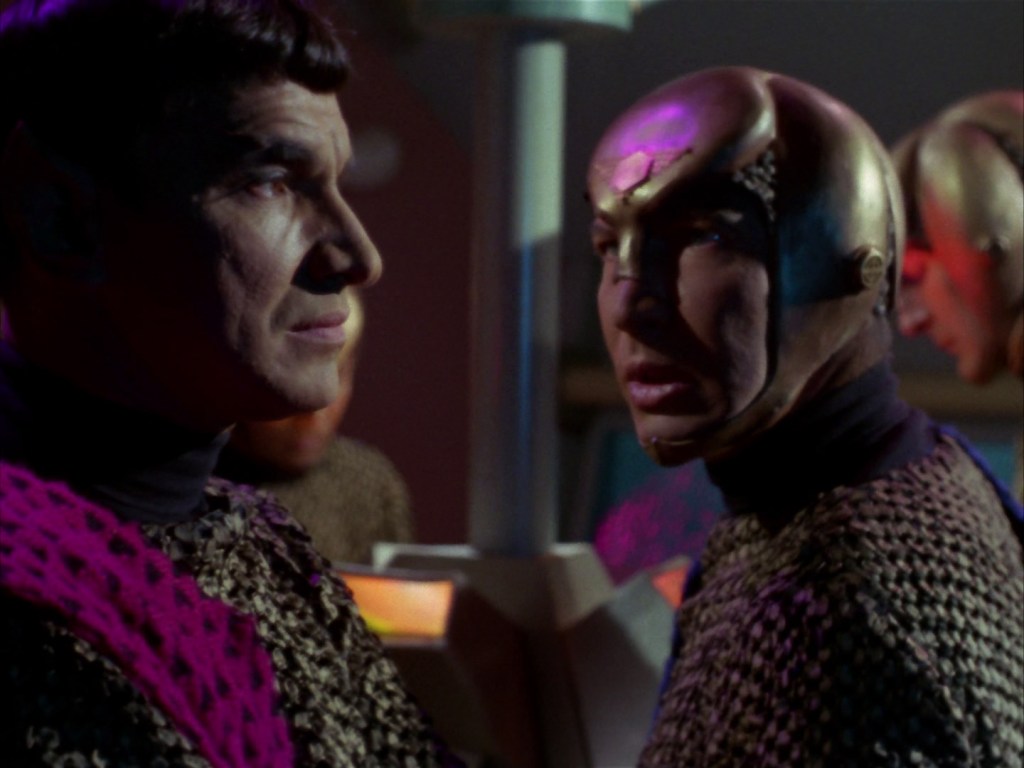
The one mis-step for me is John Warburton as the Centurion. He comes across as a very gentle, grandfatherly figure. Maybe that was the intention, but for a character who would seem to be a veteran of many wars, I might have expected someone more gruff or intense. It feels like a mis-match to me. 4/5
Direction (coherent, memorable)
This episode was directed by Vincent McEveety whom we already know from “Miri” and “Dagger of the Mind”. I think he got the memo that this was inspired by those WWII submarine movies. He certainly takes some cues from them. There are some great close-ups of Kirk with dramatic lighting. There’s also the wonderful push-in on Spock raising his eyebrow when he first gets a glimpse of the Romulan Commander. That’s a signature shot from TOS that appears in many documentaries and bonus features. 5/5
Philosophy
Is it thought-provoking?
This episode is definitely more space battle than philosophy. There’s nothing particularly thought-provoking, except if you start thinking about where the Romulans came from (which many Trekkies did). 3/5
Does it deal with a moral or ethical issue?
The only thing that occurs to me here is at the end of the episode. When the Romulan ship is damaged beyond repair, Kirk offers to beam aboard its survivors. The Romulan Commander refuses, saying it is not their way. He ends up getting his wished-for destruction. It says something about Kirk and Starfleet that they would be willing to rescue enemies who have just killed who knows how many people on the Federation outposts. That’s why they’re our heroes. 4/5
Is it consistent with Trek’s optimism and Humanism?
I think so. That quote from McCoy is worth repeating: “In this galaxy, there’s a mathematical probability of three million earth-type planets… and in all the universe, three million, million galaxies like this one. And in all of that, and perhaps more, only one of each of us.”
There is a recognition that every individual life is valuable. That’s why Kirk offers to rescue the Romulans. 5/5
IDEA (Inclusion, Diversity, Equity, Accessibility)
The quote that often gets pointed to in order to illustrate Trek’s woke-ness is Kirk’s line to Stiles: “Leave any bigotry in your quarters. There’s no room for it on the bridge.”. For me, this is only half the journey. If this were TNG we’d expect there to be no bigotry anywhere, public or private, from Starfleet members. I like that Kirk says this, but it’s kind of the difference between tolerance and acceptance. Is Stiles actually going to leave his racist attitudes behind, or just tolerate Spock when they serve together? Is he going to change his mind and embrace diversity? The episode puts Spock in the position to rescue Stiles, so the implication is that this act convinces Stiles that Spock’s not a bad guy. We hope he has grown. Possibly this tolerance is the best we could expect for 1966. 4/5
Conclusion
My ratings for this episode total 92/100 making it the new top place! It definitely is a favourite and I highly recommend it.


4 comments