
“The more complex the mind, the greater the need for the simplicity of play.”
Last night I watched “Shore Leave”. This was the 18th episode of TOS produced, and the 15th to air. The original air date was December 29, 1966 – a nice, light episode for the holiday season. It was written by Theodore Sturgeon, a science fiction writer known for writing this and one other expansive and expensive TOS episode.
Story
Is it a coherent story?
Having been through a challenging three months, the Enterprise crew is in need of shore leave. They locate an idyllic, Earth-like planet in the Omicron Delta Region where there are no inhabitants and no animals. Things start to go awry when landing party members encounter a variety of strange and sometimes dangerous creatures and people. 5/5
Is it enjoyable to watch?
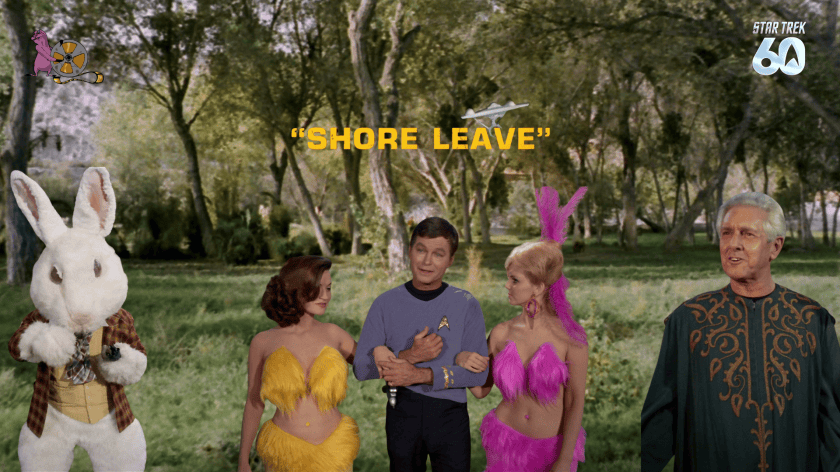
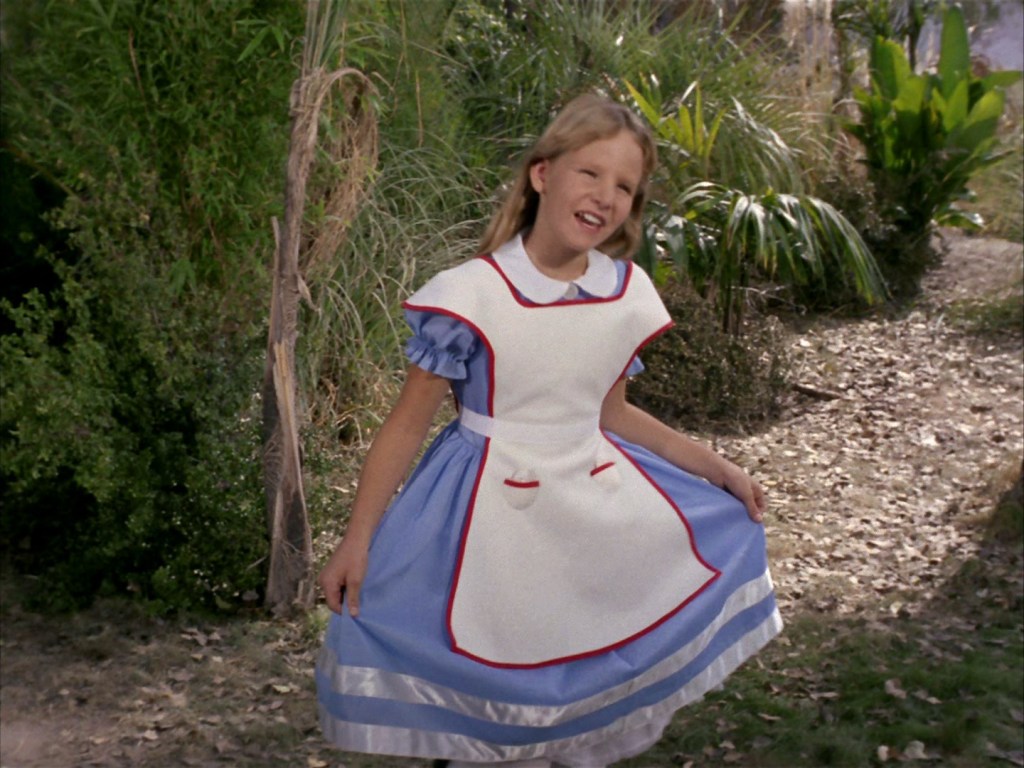
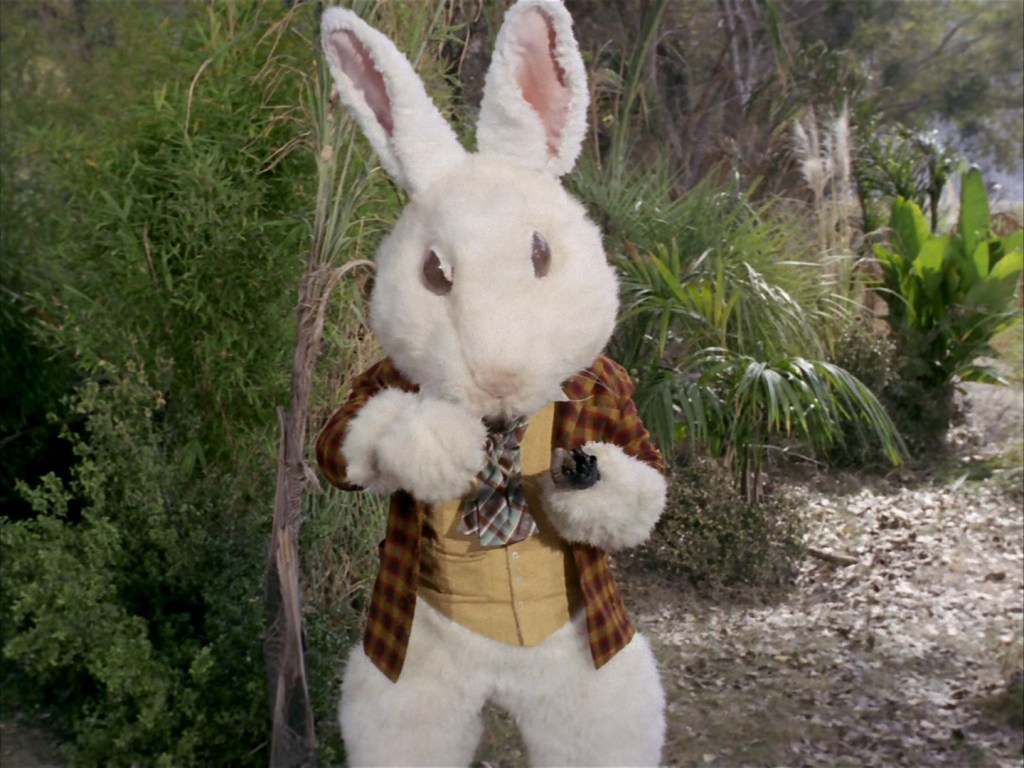
I feel like our crew should have been able to figure out the mystery earlier than they do, but aside from that, it’s fun to watch. We’ve been more or less ship-bound since “Miri” so the wonderful locations they filmed at really open things up. There are a number of fantastical creatures and costumed characters, animals and aircraft, etc. The image of the White Rabbit is perhaps one of the most memorable from TOS. 5/5
Is the dialogue strong and/or memorable?
There are a number of memorable lines, mostly for McCoy. For example, when Yeoman Barrows has to step behind a tree to change clothes, McCoy says “My dear girl, I am a doctor. When I peek, it’s in the line of duty.” He also tells Kirk, “I’ve got a personal grudge against that rabbit, Jim!” which is quite funny.
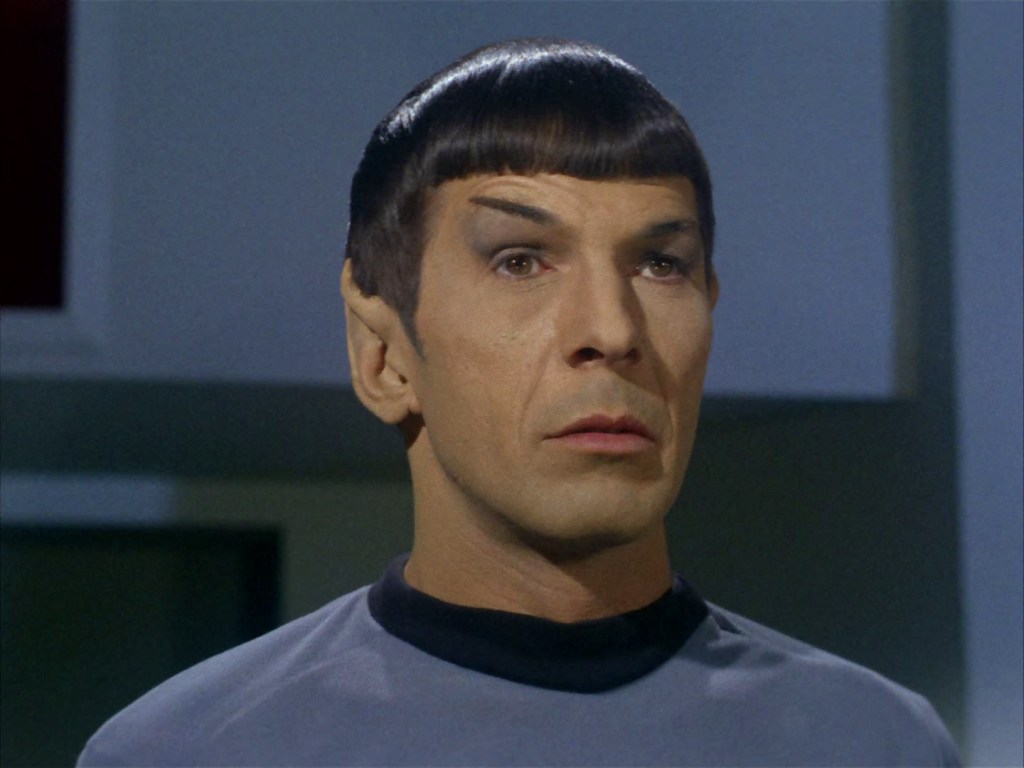
Spock also gets one that I always remember, “On my planet, to rest is to rest. To cease using energy. To me, it is quite illogical to run up and down on green grass using energy instead of saving it.” It’s very revealing of his character, reminding us that he’s not Human, and that logic is at the centre of his being.
Once Kirk understands what the planet is about, he immediately understands the necessity of it. He says, “The more complex the mind, the greater the need for the simplicity of play.” This is quite wise. 5/5
Does it serve the main cast well?
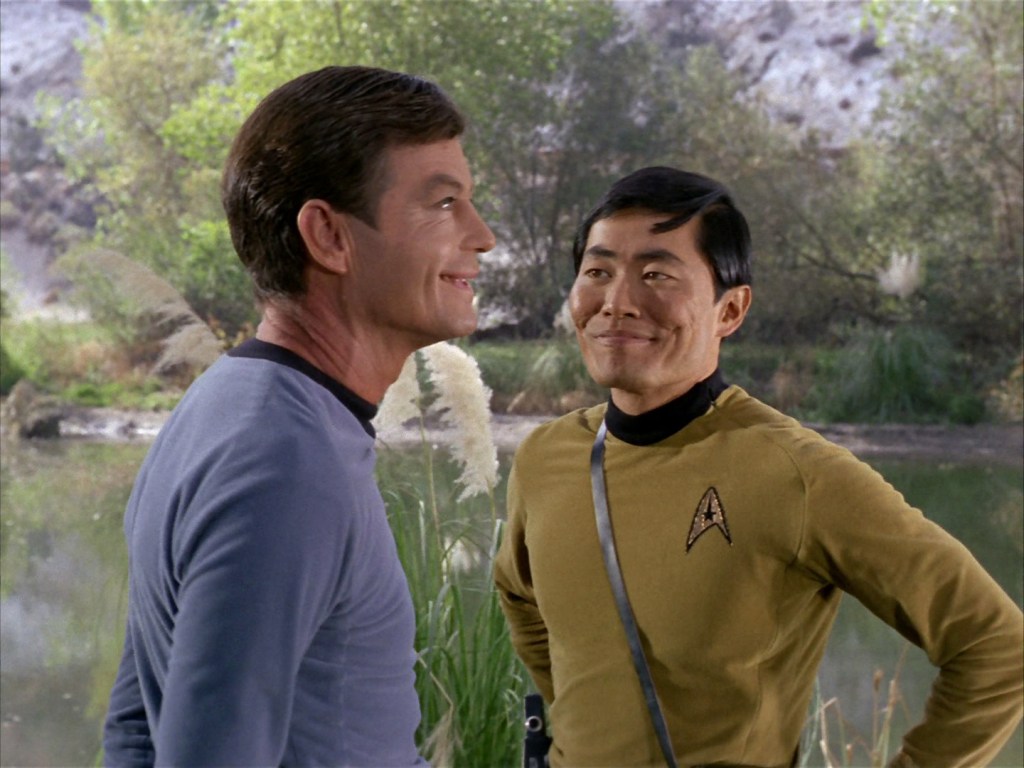
Kirk, Spock, McCoy and Sulu are all served well by this episode. McCoy probably has the most dialogue he’s had yet in a single episode. He’s the one who first spots the White Rabbit and Alice. He has some flirtatious scenes with Yeoman Barrows, and is killed and resurrected! The flirtatious scenes build on what we have already seen of his attitude towards women. He tends towards inappropriate behaviour with female crewmembers (but so do most of the men). Emily Banks would have been around 28 while playing Barrows, and Kelley would have been around 46. Both the age difference and the power imbalance due to rank make his overtures inappropriate but Barrows seems pleased by his attentions. However, on the plus side, McCoy reminds Sulu that Kirk is thinking about the problems of 430+ crewmembers. That’s the kinder, gentler McCoy that people know and love.
Kirk is confused about the situation longer than he should be. I think he should have been able to put the pieces together more quickly. There’s a lot of action for Kirk in this episode: fist fights, running, kissing, etc. When McCoy reminds Kirk that he was serious as a cadet in the Academy Kirk says he was actually “positively grim.” We then learn that he had a bully; an upperclassman called Finnegan. We also meet a young lady called Ruth whom he says he hasn’t seen in 15 years. I wonder whether Ruth is the blonde lab technician that Gary Mitchell said he fixed Kirk up with in “Where No Man Has Gone Before.”
Spock’s best moments are when he more or less forces Kirk to take shore leave because the captain is functioning at less than his best. The mentions of the White Rabbit and Alice should have special meaning to Spock because we learn in Star Trek: Discovery that his mother read that book to he and Michael as children. Of course he doesn’t really react to it but it’s an interesting thread to think about.
Sulu gets back to his horticultural roots we first saw in “The Man Trap”. Even on shore leave, he’s interested in collecting specimens of flora to help him understand the planet’s biology. We learn that he’s a collector of 20th century firearms and we briefly see him face off against a samurai. 5/5
If there are guest or recurring characters, are they memorable or interesting?
Emily Banks as Yeoman Barrows is the first person to step into the role left by Grace Lee Whitney’s Janice Rand. There’s an amusing moment at the beginning of the episode where she’s standing next to Kirk on the bridge. Kirk expresses he has a knot in his back and Barrows massages it. Kirk believes that Spock is the one doing the massage until the Vulcan steps down so Kirk can see him.
We just saw Barbara Baldavin last week in “Balance of Terror” where she played the unfortunate Angela Martine who lost her fiancé on their wedding day. Here she plays an officer called Angela Teller. Her presence with a new name so soon after her first appearance is fairly confusing.
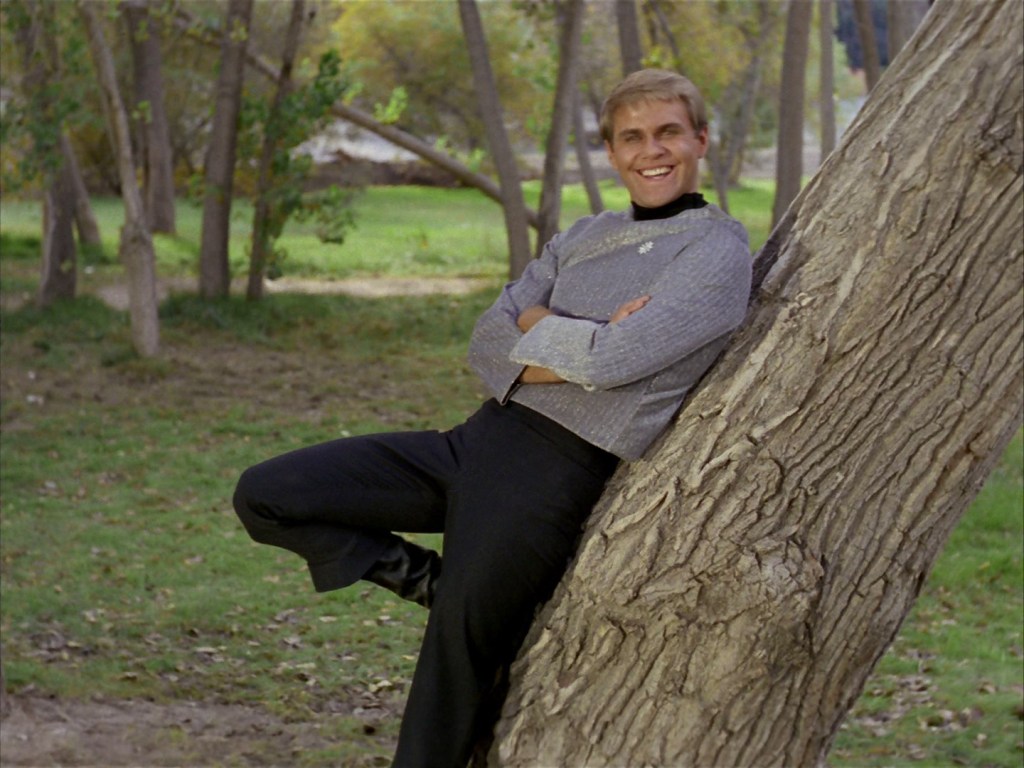
Bruce Mars is extremely memorable as Finnegan (even though he’s a decade older than the character is meant to be). Finnegan leaps around like a leprechaun and seems to delight in tormenting Kirk. It’s a bit of a caricature but a memorable one. 4/5
World-building
Does it contribute positively to the Trek Universe?
It introduces a fascinating new planet that the crew would revisit in The Animated Series. It also introduces the idea that there are pleasure planets or vacation planets which we’ll see more of in the future. It also adds to Kirk’s backstory and gives us some idea of what the Academy might have been like when he was there. 4/5
Is it consistent with the rest of canon?
I think so. I like the idea that Ruth might be the lab technician Mitchell mentioned. The lab technician might also be interpreted to be Carol Marcus. 4/5
Is there something new and unique?
The concept of an amusement park planet is unique. However, the idea that there is yet another mysterious, advanced race that Humans aren’t quite ready to know is becoming a trope. It really leans into Roddenberry’s idea that Humanity is a child race and there are many other species in the galaxy we can learn from. 4/5
Does the science seem plausible?
This episode requires some substantial suspension of disbelief. We are meant to believe that the developers of the planet placed technology underground (seen in the form of antennae watching our heroes) that can read minds and then relay what they learn to machines that can quickly manufacture people and items as diverse as a tiger and a WWII fighter plane. They must be incredibly advanced indeed!
The other thing I wonder about is a planet with flora but no fauna. I think many plants require insects for pollination – especially flowering plants and fruit-bearing plants. On a planet with no insects the pollination would be left to the wind, I suppose. I think that would mean a relatively small selection of plant life but I could be wrong. 3/5
Production
Production design (sets, props)
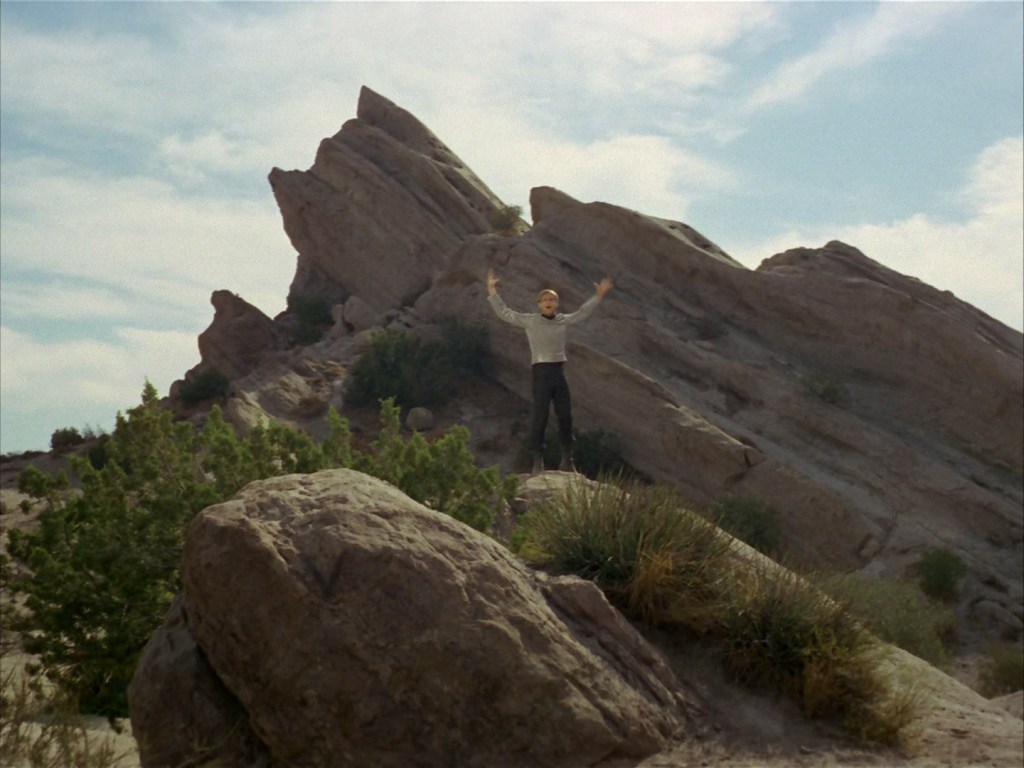
This episode is largely on location. We see a few Enterprise sets, but mostly we’re in Marine World/Africa USA and at Vasquez Rocks. They’re great locations. The only props we see (aside from standard landing party equipment) are weapons: Sulu’s handgun, the Samurai’s sword, and the Black Knight’s lance. There is some modification to the locations. Some of the trees appear to have been spraypainted red and there are a few false rocks and flowers. 3/5
Costumes
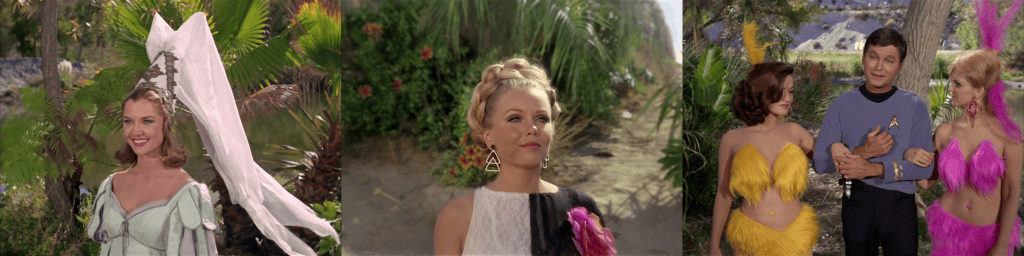
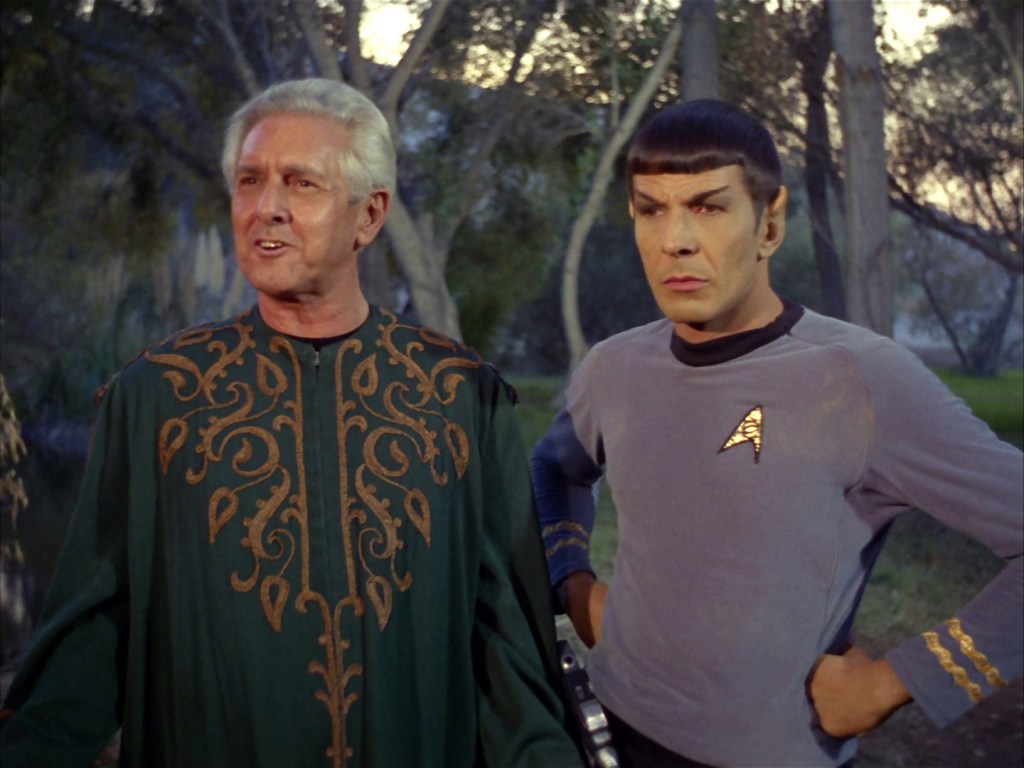
There are many costumes in this episode. A few might be rented. I’m thinking of the rabbit suit, the Alice costume, Barrows’ princess gown (not the last time we’ll see one of those pointed princess hats in Trek), Don Juan’s costume, the Samurai’s costume, and the Black Knight’s costume. The two showgirls at the end are definitely wearing Theiss creations which are quite memorable. The Caretaker’s costume might be an original by Theiss. It’s quite distinctive. There’s also Ruth’s outfit and Finnegan’s Academy uniform. 5/5
Make-up and Hair
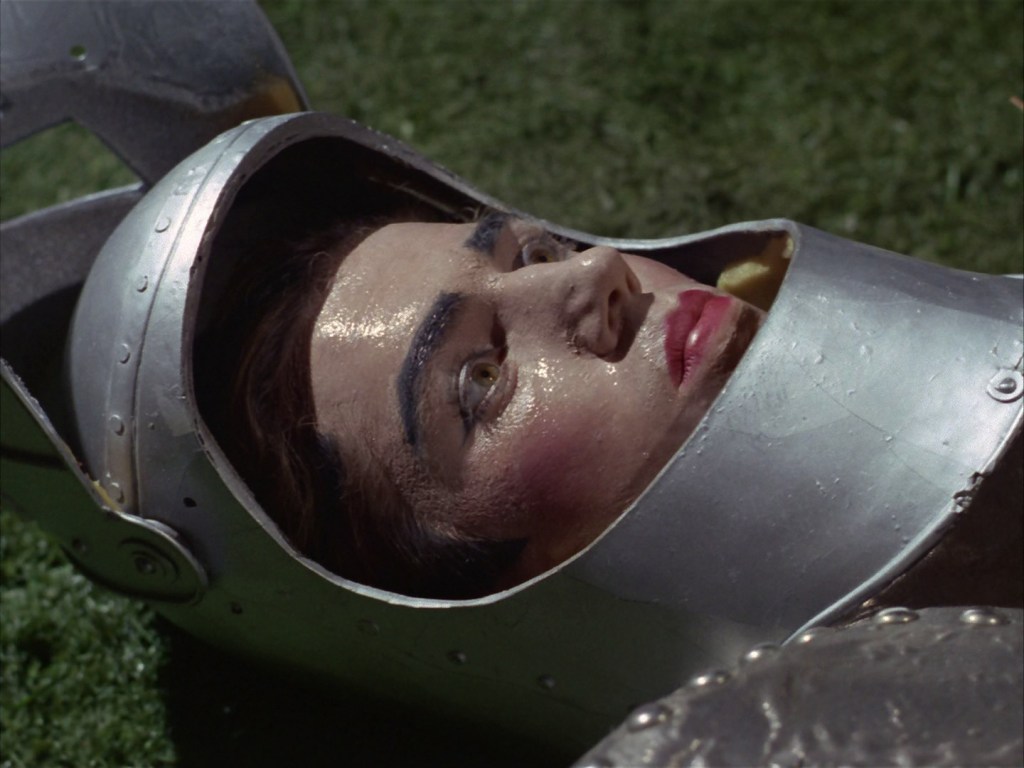
Ruth’s hair is particularly beautiful. Kirk gets quite a bit of bruising and dirt make-up during his fight with Finnegan. There’s the dummy revealed in the Black Knight’s armour after Kirk shoots him. That may or may not have been specially created for this episode. Nothing else stood out to me here. 4/5
Visual Effects
I think they blew the budget on location shooting. I’ve read that Sturgeon’s original script was much more fantastical. One imagines there might have been some suggested effects in it. There is some stock footage use, and there are on-set special effects like the bullets from the planes strafing. We see Spock transport to the surface and it’s an extended effect because the transporter’s power has been drained. 3/5
Music
The score for this episode was written by Gerald Fried and it’s really excellent! This is the first episode he scored but some of what he produced here would be re-used in many, many later episodes. There is a love theme that’s particularly nice, and an action piece inspired by Irish folk music that I think of as the signature for this episode. 5/5
Acting (series regulars and guests)
The acting is solid all around. I really like Oliver McGowan as the Caretaker. Emily Banks as Yeoman Barrows was great. I wish they’d brought her back. Bruce Mars as Finnegan and Shirley Bonne as Ruth deliver really solid performances. 5/5
Direction (coherent, memorable)
This episode was directed by Robert Sparr. I think he did a great job but he wasn’t invited back. This episode went a day over schedule because there were a lot of last minute script re-writes. He does some really memorable tracking shots through the area that Kirk refers to as the glade. One can tell there were some moments captured when light was fading. In Vasquez Rocks, especially, you can see some bounce boards or reflectors at work. I think this was the first time they did location work outside of a backlot so the crew probably learned a lot about what was needed for Trek on location. 4/5
Philosophy
Is it thought-provoking?
This episode isn’t particularly thought-provoking. As I mentioned above, it’s kind of a light, playful holiday episode. There’s a lot of action and not much philosophy. It does make one wonder what one might wish to encounter on an amusement park planet. 3/5
Does it deal with a moral or ethical issue?
What comes up for me here is the idea of consent. First, the Enterprise landing party is having their thoughts scanned without permission. You’d think the species that developed the planet would leave an orbiting buoy with some instructions or something. Second, Kirk’s mind conjures up actual people from his past and those people have no say in the matter. Because they’re interactive it’s much more than looking at pictures of someone you knew. It’s akin to creating hologram versions of people you know on later Trek series – something which is generally frowned upon. 4/5
Is it consistent with Trek’s optimism and Humanism?
I think so. This episode is largely very upbeat. Our characters are experiencing joy and happiness. Humans of the 23rd century still need rest and breaks and it’s good to know that Starfleet makes accommodations for shore leave. 5/5
IDEA (Inclusion, Diversity, Equity, Accessibility)
Any time a racialized person is given screentime in the 60s I think it’s a move forward for inclusion. That’s especially true if the character has a name and they have lines. Sulu gets a lot to do in this episode. Perry Lopez as Rodriguez reads as a Latinx person and McCoy knows his first name. These seem like the bare minimum today, but at the time this was made I think it meant a lot more. I don’t mean to say that it was enough in the 60s, but in comparison to other shows of the time Trek was ahead of the game.
Conclusion
My ratings for this episode add up to 84/100, tying it with “The Menagerie, Part I” and putting it in the top 10 so far.


Enjoyed this post on one of my favourite ST episodes. I’d hv preferred Uhura instead of Barrows. That would hv cut the flirting also b/w Bones and Barrows which really was not needed.
LikeLike
That’s a great point! It would been nice to see Uhura in more landing parties.
LikeLike