
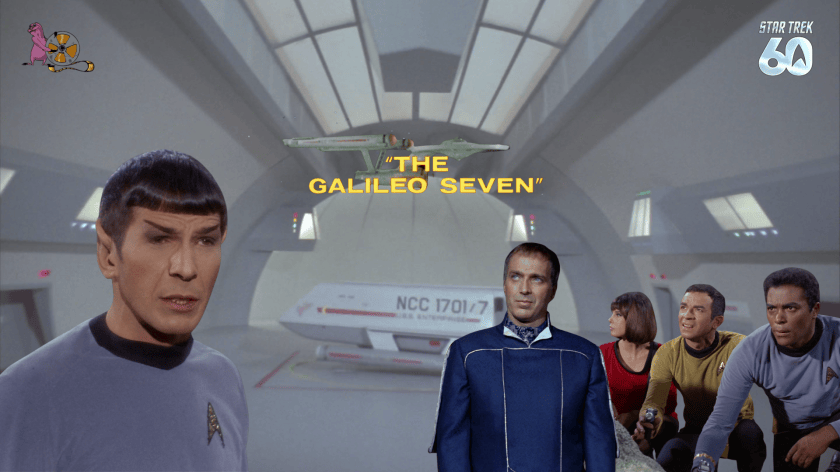
“Mr. Scott, there are always alternatives.”
Last night I watched “The Galileo Seven”. This was the 14th TOS episode produced and the 16th to be released. The original airdate was January 5, 1967. The story was written by Oliver Crawford and the teleplay was written by Crawford and S. Bar-David (aka Shimon Wincelberg) who also wrote “Dagger of the Mind”.
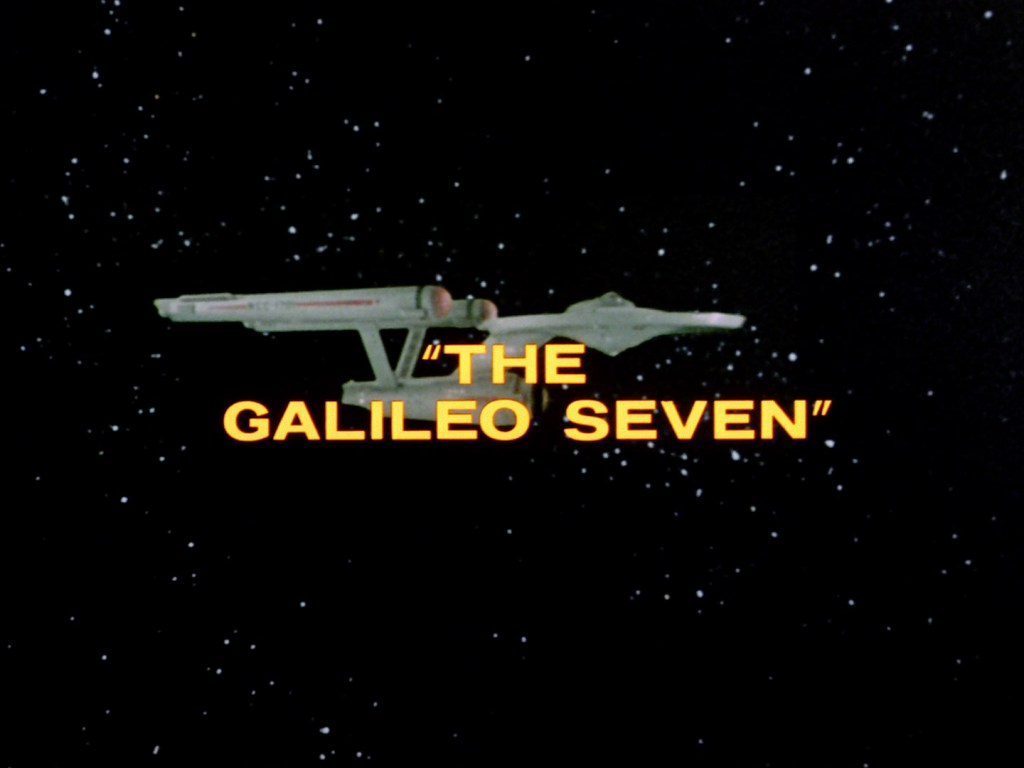
Story
Is it a coherent story?
The Enterprise is en route to Makus III to deliver medical supplies when they discover Murasaki 312, a quasar-like formation. Despite the urgency with which the medical supplies are needed, Kirk obeys his standing orders to investigate all quasars. Spock takes the shuttlecraft Galileo out with six other crew members to investigate but they are caught in an ion storm and crash land on a planet. With no way to communicate, and the clock ticking down to the last moment the Enterprise can leave and still get to Makus III in time, Kirk must locate the Galileo by sight or leave seven crew members behind.
There are a few TOS episodes that have titles which could be interpreted in more than one way. In this case, I think the “seven” is probably intended to refer to the crew members aboard the Galileo. However, “7” is also the shuttlecraft’s number. If one is really into starships, one might think the episode is named for the shuttle. 5/5
Is it enjoyable to watch?
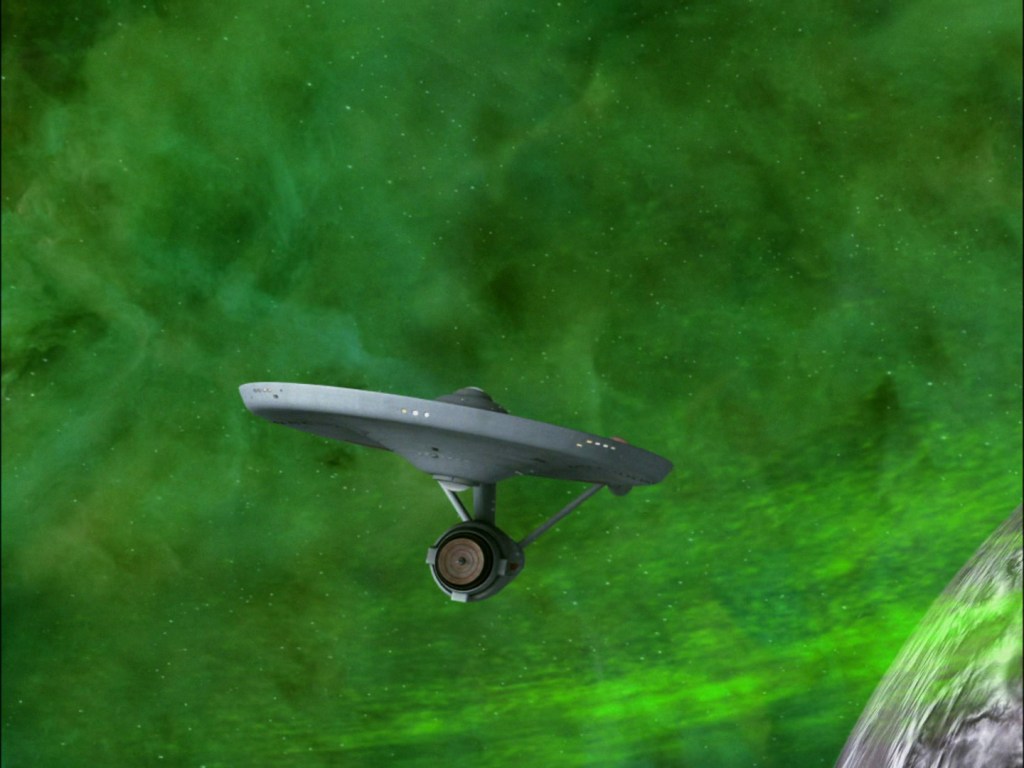
We love a ticking clock! This is a great episode for Spock, which I also love. This is an episode where watching with the remastered visual effects does make a difference. I know some people don’t like them, but there are a lot of great space shots of both the Enterprise and the Galileo with the backdrop of the Murasaki effect. 5/5
Is the dialogue strong and/or memorable?
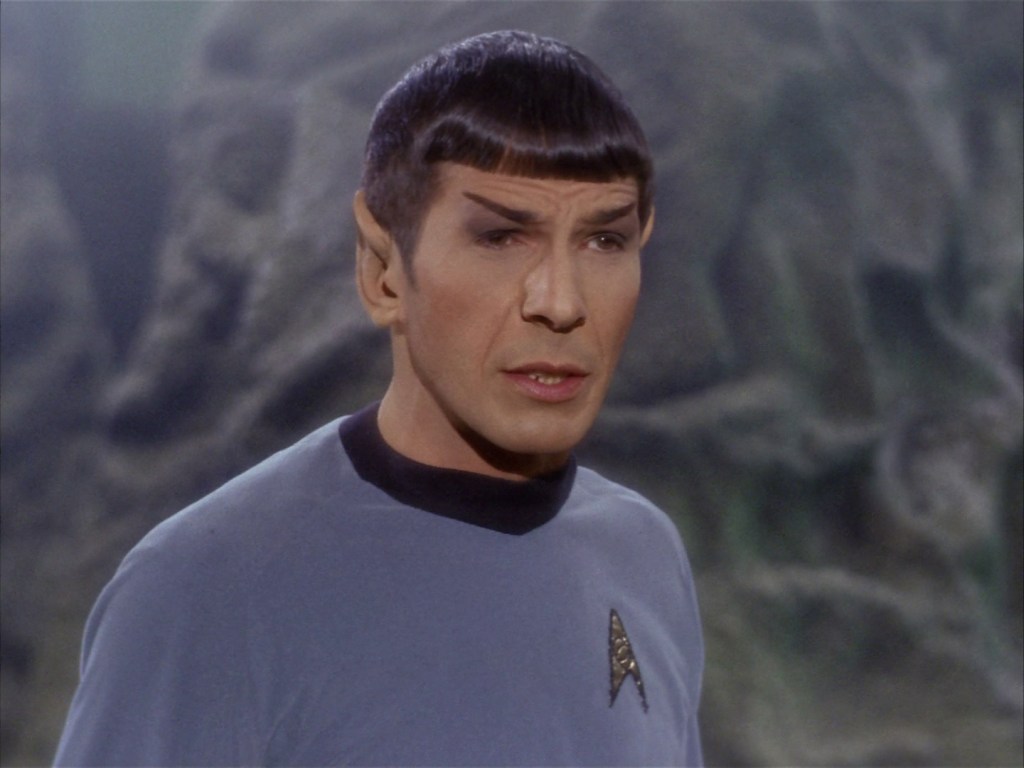
Spock has some particularly memorable lines in this episode that really help to demonstrate his thought process. His discussions with McCoy are especially revelatory – although, at this stage of his life, it seems unlikely that Spock wouldn’t have considered some of McCoy’s points already. For example, McCoy says, “Mr. Spock, respect is a rational process. Did it ever occur to you they might react emotionally? With anger?” Spock has been serving amongst Humans on the Enterprise for many years. His adventures on SNW demonstrate more than a passing familiarity with emotional reactions.
At one point, Spock says, “It is more rational to sacrifice one life than six, Doctor.” which really foreshadows the more famous line from The Wrath of Khan: “The needs of the many outweigh the needs of the few, or the one.” Spock also says, “I’m frequently appalled by the low regard you Earthmen have for life.” Which is a line I frequently remember. Finally, there’s “Mr. Scott, there are always alternatives.” This is a really important line for Spock because it illustrates how he approaches any decision. He considers as many alternatives as possible and then picks the one that seems the most rational or logical.
Mr. Boma also has some memorable dialogue but it’s very hostile towards Spock – similar to Stiles in “Balance of Terror” but I think Boma really takes it too far. If we were in TNG he would be reprimanded significantly for saying things like “If any minor damage was overlooked, it was when they put his head together.” about a superior officer. Or, “I’m sick and tired of this machine!” 5/5
Does it serve the main cast well?
The focus is on Spock who has McCoy as an emotional foil. The episode serves them both well. Spock learns that command is not just about the success of the mission. It’s also about people management and ensuring that those under his command feel listened to. That said, I think the crew members push harder against Spock than they do against Kirk. It seems like Spock’s alien-ness gives them permission to be more contrary.
For Kirk, this episode is another opportunity for him to demonstrate his loyalty to his crew. He goes to the greatest lengths possible to try to locate the Galileo before he’s forced to leave in order to get to Makus III on time. It’s also the first time we see Kirk’s impatience with diplomats and politicians in the person of Galactic High Commissioner Ferris (a great title, by the way).
This episode is also decent for Scotty. He definitely gets to show off some engineering expertise. I do wish he had stood up for Spock, though. 5/5
If there are guest or recurring characters, are they memorable or interesting?
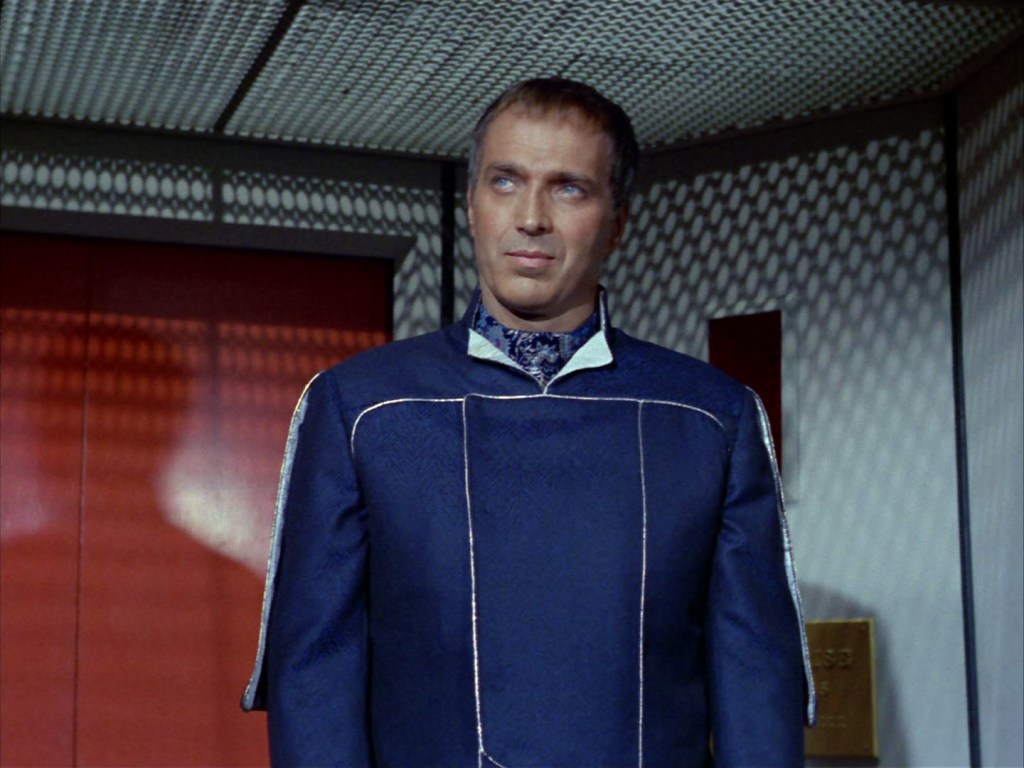
Commissioner Ferris (John Crawford) is there mainly to annoy Kirk but Ferris is actually completely in the right. The Enterprise has medical supplies that are desperately needed for a plague on Makus III. The more logical decision for Kirk to have made was to go to Makus III, then come back to investigate Murasaki 312. There’s no indication that the quasar is going anywhere and the needs of the many…
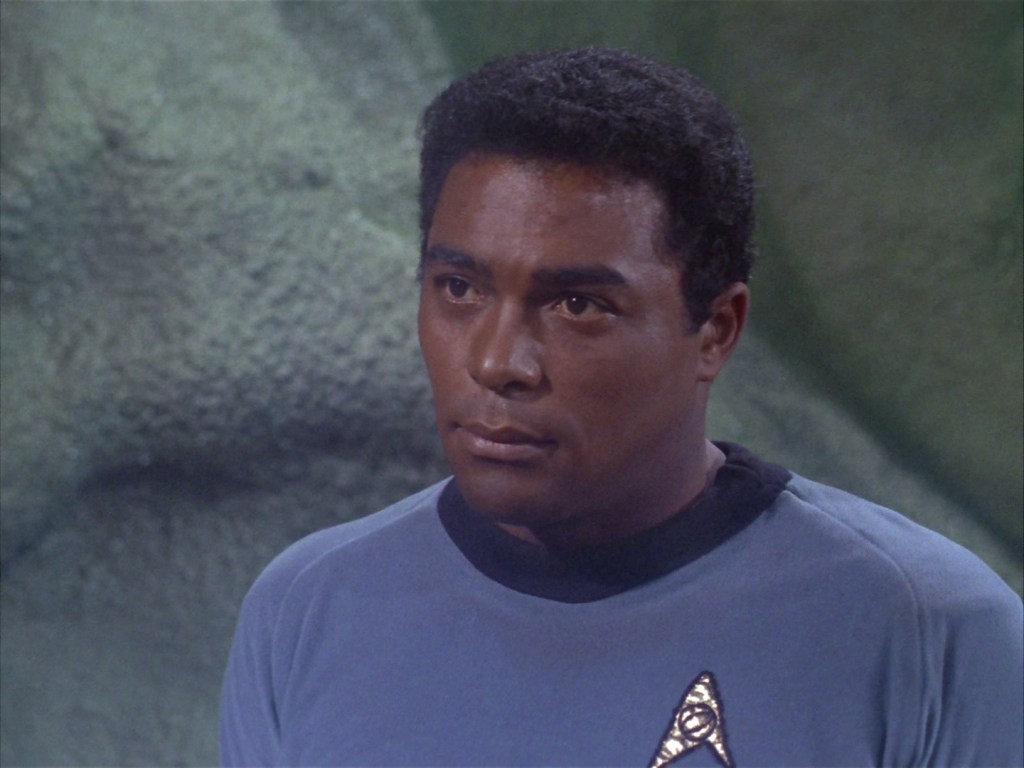
Lt. Boma (Don Marshall) is, at first, a very likable character. He’s clearly extremely intelligent and knowledgeable as an astrophysicist. However, as mentioned above, once the situation becomes tense he really lays into Spock inappropriately. The other crew members are not particularly interesting. 4/5
World-building
Does it contribute positively to the Trek Universe?
I think this is the first time we explore real world astrophysics in any real way. The idea that Kirk would prioritize the study of a quasar over delivering medical supplies says something about Starfleet’s interest in science. This episode is mostly a character piece. It contributes positively to the development of beloved characters. 4/5
Is it consistent with the rest of canon?
Yes, at this point we’ve established a lot of locations and colonies throughout the galaxy. We have a sense of how large the Federation is and Ferris gives us a sense of the civilian diplomats who run it. The only problem I caught is that Spock says he doesn’t believe in angels. In the second season of Star Trek: Discovery, Spock has extensive interaction with a figure dubbed the “Red Angel”. This is another example of a new series causing problems. 5/5
Is there something new and unique?
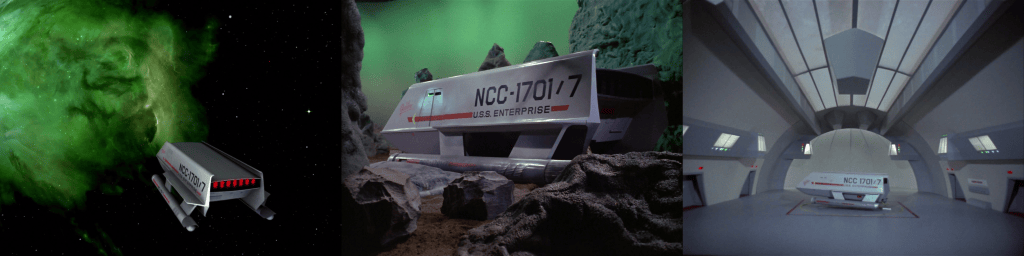
We’ve already seen Starfleet shuttlecraft in “The Menagerie, Part I” but this episode was actually produced first so this is really an introduction to the shuttle. The exterior shuttlecraft could not be built at full scale and they do a good job of only showing bits of it with our actors so they don’t give it away. The interior set is clearly larger than the exterior, though. The TOS Set Tour in Ticonderoga, NY has acquired the original shuttlecraft and it’s debuting on display this month for the 60th anniversary. 4/5
Does the science seem plausible?
I think quasars had been on the radar for less than a decade at this point so the idea of exploring one was probably very exciting in 1966. The original effects budget did not allow for a great representation of Murasaki. The remastered edition of the episode has a lot of great new shots where it really looks like what we understand a quasar to be. Ion storms are definitely real and I think I have read about ionized winds coming from quasars. Without doing any research, the science seems plausible to me. 5/5
Production
Production design (sets, props)
We get to see a miniature of the hangar deck in the original episode (and a CGI recreation in the remastered edition), both of which are pretty great. The shuttlecraft exterior set is pretty cool. The interior is less interesting but still a great expansion of the designed Trek world. The Taurus II planet set is mostly effective. There is a shot where Gaetano is trying to scale a rock face and his boots scratch off bits of foam. Unfortunately, it’s quite noticeable.
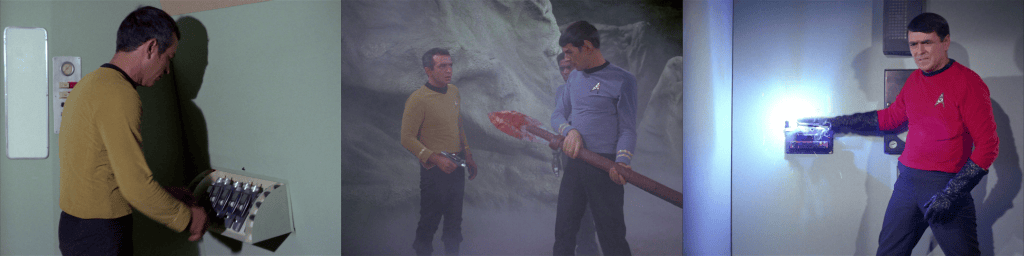
In terms of props, we get to see several phasers all at once in the shuttlecraft weapons locker. It’s fun to see them in volume. The other major props are the giant spears thrown by the anthropoid inhabitants are not entirely successful. They’re not weighted properly so they mostly fall horizontally which ends up looking a bit comical. 4/5
Costumes
Commissioner Ferris has a wonderful costume. It’s a futuristic suit with these jaunty little sleeve capes that I love. It looks very pompous which matches what we’re supposed to think of his character. The anthropoid creature suit is just OK. It’s mostly (wisely) hidden and seen only in partial glimpses. That shot where Gaetano is trying to scale the wall is when we get the best look at the creature and it’s not great. 3/5
Make-up and Hair
I didn’t note anything. Everyone looks good. There aren’t any unique effects happening. 4/5
Visual Effects
I’ve already talked a bit about visual effects. I think I do prefer the remastered edition of this episode because of the extensive new effects. The original edition still had a great miniature of the shuttlecraft and hangar deck. The shots are just so much more controlled in the remastered edition. There is some kind of weird optical when Gaetano jumps down off a rock at one point. It’s like they felt there wasn’t enough fog on the set so they tried to do a virtual version. I always find it really noticeable and distracting. 4/5
Music
The score for this episode was by Alexander Courage. I didn’t make any notes about it. It was fine. 4/5
Acting (series regulars and guests)
Leonard Nimoy, DeForest Kelley, and William Shatner all do a fine job. Nimoy understands this is his episode to lead and he commands the screen in every scene he’s in. Nichelle Nichols gets some interesting technobabble at the beginning of the episode. It probably would have gone to Spock had be been on the bridge at the time. She does a great job with it. It’s scenes like that that make me wish she had been written for more.
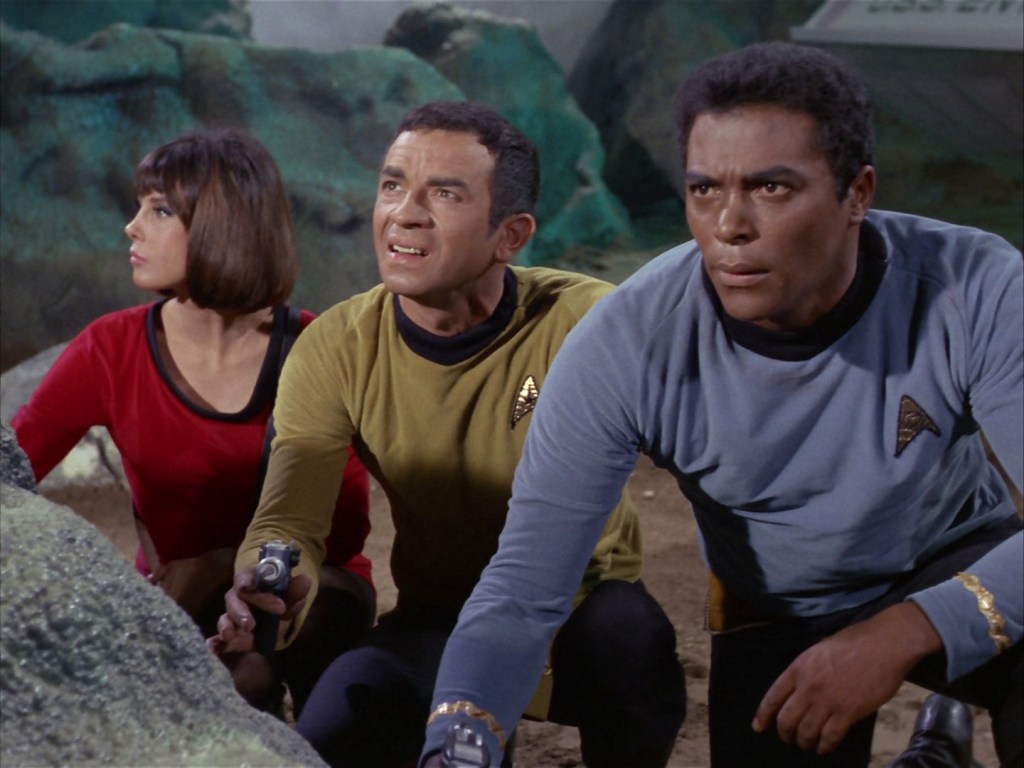
John Crawford is solid as Commissioner Ferris. He knows he’s supposed to be unlikable and plays that well. There’s a moment just after the Galileo is lost when Ferris smirks. It’s a small gesture but really sets the character in our minds. Don Marshall as Boma and Peter Marko as Gaetano are good. 5/5
Direction (coherent, memorable)
This episode was directed by Robert Gist. I think this is the only one he did. He had some unique challenges in dealing with the two different scaled shuttlecraft sets, all the fog on the planet, the not-so-great creature costume, etc. I think this episode is quite successful. There’s nothing that draws your attention to the camera. 4/5
Philosophy
Is it thought-provoking?
The question is whether logic or emotion is the best basis for command. As with most things, I think the conclusion is that a balanced approach is probably most effective. That said, I think I would have made most of the same decisions that Spock did. He does nothing wrong, except that he doesn’t take into account the feelings of his crew. 5/5
Does it deal with a moral or ethical issue?
Two things come up for me here. The first is Kirk and the plague. If I knew that a plague was spiraling out of control and I had medical supplies that would help then I would put the pedal to the medal and get there as quickly as possible. I’m not sure how defensible his position to take time to investigate the quasar is.
Second, is this issue of burials of deceased crew. Two men die on Taurus II and Boma, in particular, is really hung up on giving them a “decent burial”. I might be in the minority but I don’t really understand this. A body is just waste. If you’re going to risk being attacked and possibly losing your life, I wouldn’t risk making time for it. In future Trek episodes and films we see a lot of space burials (like burials at sea). To me, it seems like the burial thing is a hang up that probably comes from a religious place, and I hope that religion has no place in the future. 4/5
Is it consistent with Trek’s optimism and Humanism?
Generally, yes. This episode is as much about investigating Human (or Vulcan) nature as it is about investigating scientific phenomena. The coda for the episode is a bit awkward. Two of the Galileo crew have been lost. A third crew member from a rescue party was killed as well. Yet the focus for Kirk is on needling Spock. There’s a joke about Spock having reasoned it was time for an emotional outburst that everyone laughs uproariously about. I think a quieter scene between Kirk and Spock in which Kirk finds a way to reassure his friend would have been more appropriate. 3/5
IDEA (Inclusion, Diversity, Equity, Accessibility)
I noted here that Uhura and Boma, the two Black crew members, have quite a bit to say and do in this episode. As I’ve said before, that shouldn’t be impressive, but for the time…
I also noted that near the beginning of the episode there are four women crew members on the bridge. Only Uhura has lines, but just having women in the command centre of the ship was making a statement. 4/5
Conclusion
My ratings for this episode total 86/100, tying it with “What Are Little Girls Made Of?” I think it’s a strong Spock episode and I’ll generally stop to watch it.

