
“It’s your career and Captain Pike’s life.”
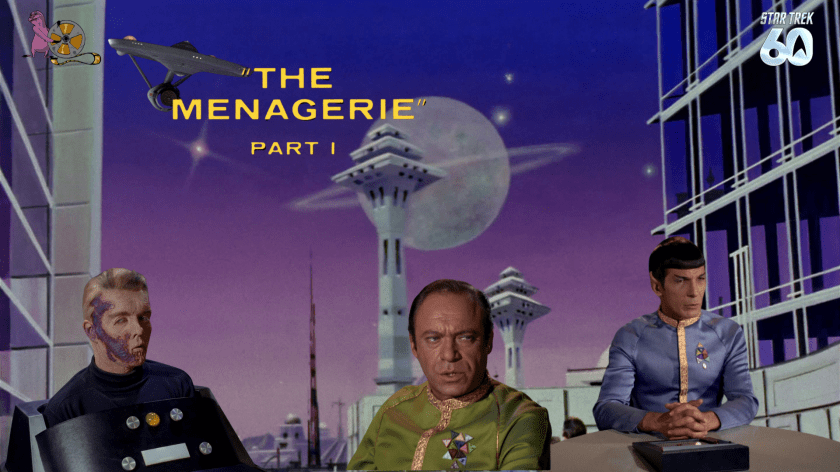
Last night I watched “The Menagerie, Part I” which was cleverly written by Gene Roddenberry to incorporate the original pilot, “The Cage”. By doing this, production got two episodes but only had to shoot footage for one. It caught them up when they were behind on scripts and immortalized the events of “The Cage” as canon. “The Menagerie” is the only two-part episode in TOS. The first episode aired on November 17, 1966. It was the 15th episode produced, but the 11th to air.
Story
Is it a coherent story?
The Enterprise receives a mysterious message ordering them to visit Starbase 11. When they arrive, Kirk and party discover the Enterprise’s former captain, Christopher Pike, has suffered catastrophic injuries and is confined to a wheelchair, unable to speak. It turns out there was no message, but Spock’s loyalty to his old captain has set him on a path to mutiny. 5/5
Is it enjoyable to watch?
General audiences had not seen “The Cage” so it must have seemed like a very prestigious episode with a great deal of production value on screen. We see the Enterprise in its original form, different uniforms, a younger Spock with different crew members, etc. As Scotty might say, it really packs a wallop! It’s one of a handful of episodes across the franchise where our heroes get to watch Star Trek. 5/5
Is the dialogue strong and/or memorable?
I’m going to try to discuss mainly the new material that was shot for this episode since I’ve already reviewed “The Cage”. There are a handful of memorable lines, especially for Spock. At the beginning of the episode, Spock is alone with Pike for a moment and he tells his old captain, “I must do this. I have no choice.” which is a very intriguing way to end the teaser, but not entirely true.
McCoy has this strange line in a scene with Kirk: “Blast medicine, anyway!” He’s frustrated that modern medicine can’t do anything to restore Pike to the man he was. I imagine a disability justice lens would see this differently, but at the time, and in this circumstance, it seems that to our heroes Pike’s life is over.
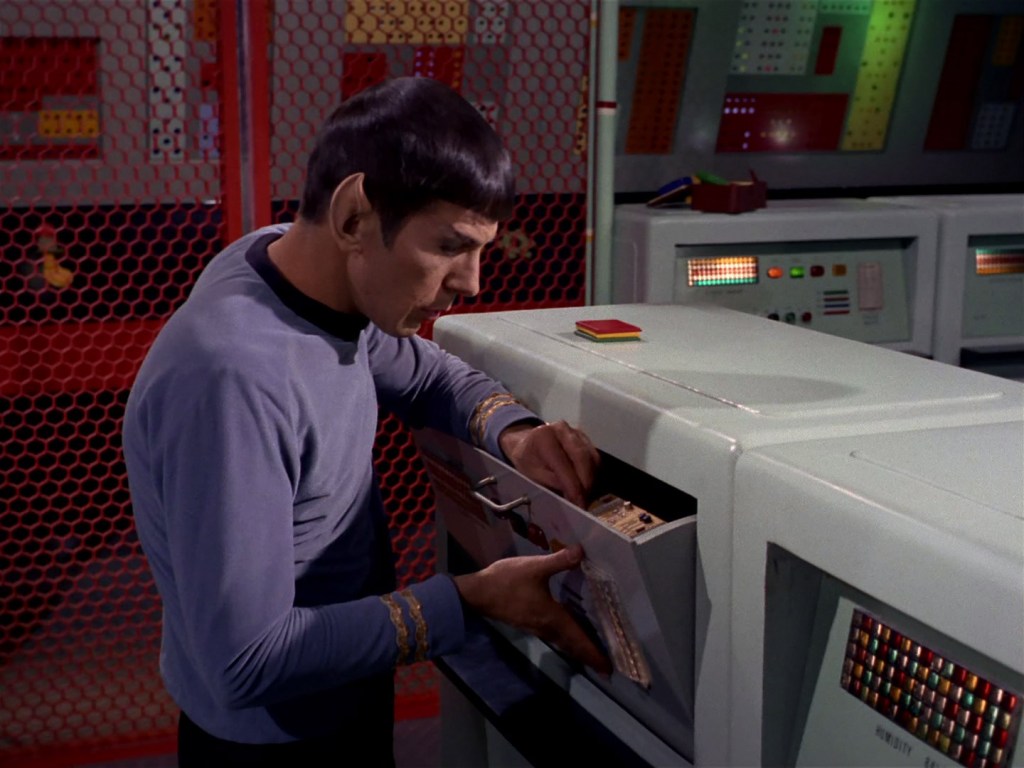
The other line that I always remember from this episode is from when Spock is in the starbase’s computer control room. He’s working on falsifying computer tapes; creating messages in duped voices to fool everyone. There’s a moment when he’s working on the line “Starbase operations” and it’s played several times in slower than normal speed and faster than normal speed. I don’t know why, but it’s stuck permanently in my mind and will sometimes pop up even when I haven’t seen this episode in a long while. 4/5
Does it serve the main cast well?
The character that is most developed in this episode is Spock. What is he doing?! It seems so illogical. How could he betray Kirk and the Enterprise? Why? We learn that Spock served with Pike for over 11 years and developed a strong sense of loyalty, if not friendship for the man. Some of these years are explored in Strange New Worlds, decades later. The whole affair is very mysterious because that’s what the episode needs. There are ways that Spock could have approached this more logically, but it might not have been as entertaining.
When Kirk starts to question whether Spock might be lying, it’s McCoy who comes to the Vulcan’s defense. He becomes very emotional in telling Kirk it’s not possible for Spock to do something like this. We learn from McCoy that Vulcans are incapable of telling lies (something we learn later in the franchise is not true) but Kirk points out that Spock is half-Human. Could he be lying? He is, because he wants to get Pike to Talos IV where he believes Pike will have a more satisfying life, but Talos IV is a forbidden planet so Spock has to do this sneakily.
When Kirk and Commodore Mendez catch up to the Enterprise on its mutinous mission, Spock surrenders himself for arrest but doesn’t give up control of the ship. He forces Kirk into giving him a court martial where Kirk, Mendez, and Pike must serve as the panel. Mendez asks Spock why he’s taken these actions, which opens up the floor for Spock to share evidence in the form of footage from “The Cage”. This is how audiences first learned about Pike, first saw the Talosians, and Vina, etc. Spock is very insistent, stubborn, and stoic. It’s incredibly frustrating for Kirk who tells us in his log that trying Spock is the most painful action he’s had to take in all his years of service.
Spock also gets to do the nerve pinch twice in this episode! 4/5
If there are guest or recurring characters, are they memorable or interesting?
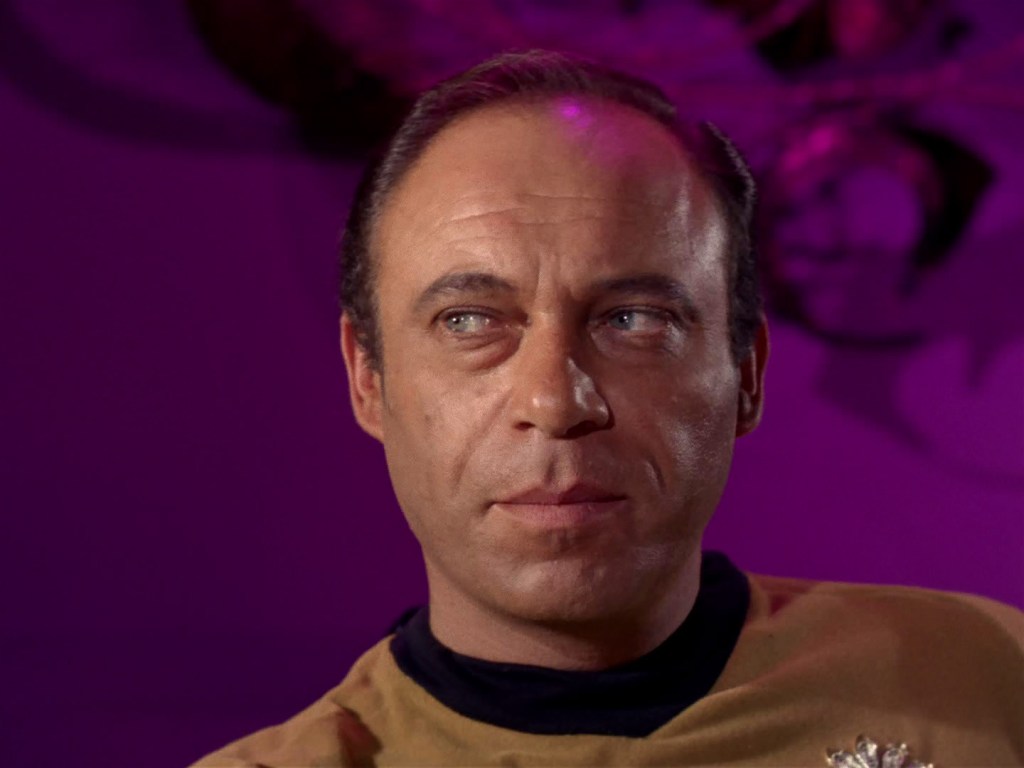
Malachi Throne appears as Commodore Jose Mendez. Throne had previously provided the voice of the Keeper in “The Cage” so it’s kind of appropriate that he would show up again here. Mendez is mostly present for exposition. He explains Pike’s situation and the classified background on Talos IV to Kirk. We learn in the second episode that we’re really only dealing with the real Mendez in the Starbase 11 scenes. When Mendez accompanies Kirk in a shuttlecraft to follow the Enterprise, he’s actually an illusion generated by the Talosians.
We’ve also got Julie Parrish as Miss Piper who is some kind of attaché to Mendez. She has an amusing interaction with Kirk. She tells Mendez that she recognized Kirk right away because he’d been described to her by her friend Helen Johansson. Kirk looks briefly worried and Piper says, “she merely mentioned she knew you.” I wondered whether the original intention was for this to be Helen Noel from “Dagger of the Mind.” That would have been a fun continuation for that character.
Finally, there’s Sean Kenney who plays the injured Pike. He has very little to do but he’s present much of the time and is quite memorable. 4/5
World-building
Does it contribute positively to the Trek Universe?
As I mentioned above, it’s thanks to this episode that the original pilot is considered canon. That significantly enriched the Trek universe, giving it a sense of history that it wouldn’t have had otherwise. Having a Starbase 11 implies at least another 10 which helps give Starfleet some scale. 5/5
Is it consistent with the rest of canon?
Yes, I didn’t catch anything anachronistic. Mendez says that there has been “subspace chatter” about Pike’s condition for months. The continued use of this kind of consistent technobabble really helps build a sense of a cohesive universe. 5/5
Is there something new and unique?
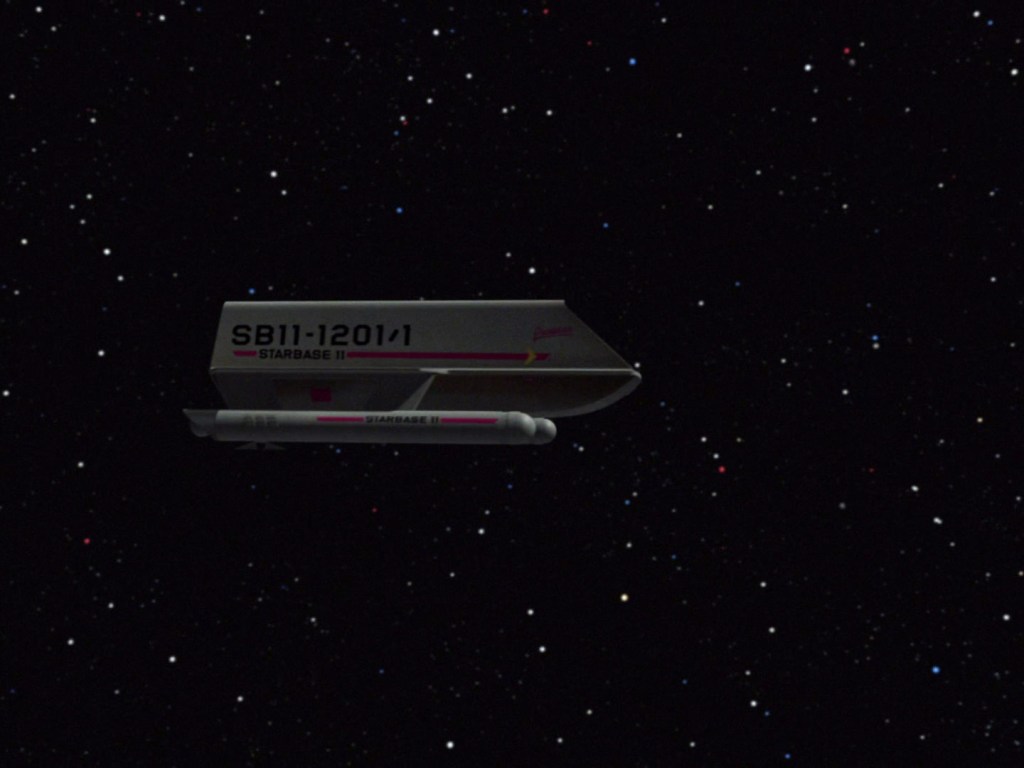
What comes to mind here is the shuttlecraft that Kirk and Mendez take from Starbase 11. This is the first time we see the TOS shuttlecraft. It’s referred to as a “class F” shuttlecraft. This also does a great deal of work to expand and establish the technology of Starfleet and a similar shuttlecraft will be highlighted in an upcoming episode. The remastered edition of this episode features a nice CGI shot of the shuttlecraft which is only barely visible in the original version. 5/5
Does the science seem plausible?
As I mentioned above, it turns out that Mendez was a projection of the Talosians on the shuttlecraft and the Enterprise. Starbase 11 is about two light years from Talos IV which means that the Talosian telepathic abilities are extremely impressive! The Federation’s quarantine of Talos IV really doesn’t mean much if the Talosians can project their thoughts so far out into space. This seems highly unlikely to me, but we’ll see similar feats of telepathic excellence in future episodes so we just have to accept that it is possible in the Trek universe.
Pike’s injury is said to have been caused by delta rays. I’m not an expert, but I believe delta rays don’t generally pose much threat. They must have been concentrated in an extreme way to damage Pike as they do. 3/5
Production
Production design (sets, props)
The Starbase 11 sets are what I’ll focus on here. The computer centre seems to be a re-dress of the Enterprise engineering set. They pack a lot of standing computer consoles into the space and the blocking makes good use of the geography. The medical area in which Pike is living has standard hinged doors – something we rarely see on Star Trek. Interestingly, the doors on the rest of the base are the standard sliding ones we know from the Enterprise. Maybe hinged doors are quieter to keep the medical area calm?
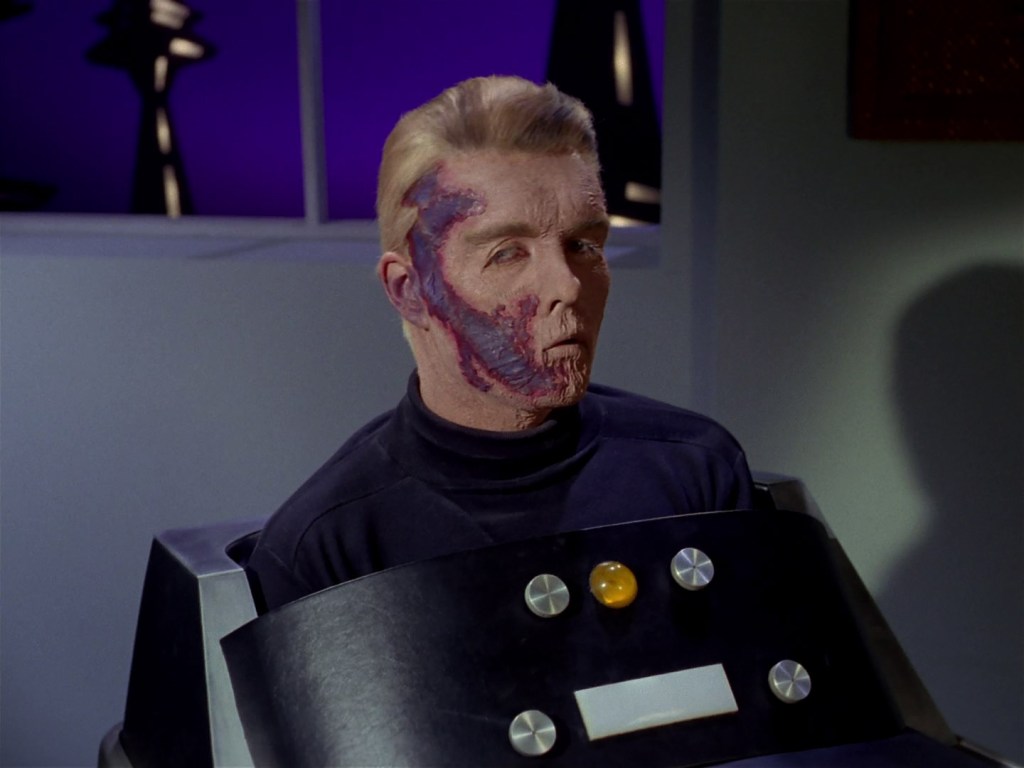
The design of Pike’s wheelchair is quite cool. I believe some kind of plastic cover was designed to fit over an actual electric wheelchair. It’s an extremely memorable image that always evokes memories of this episode and the Pike character. 5/5
Costumes
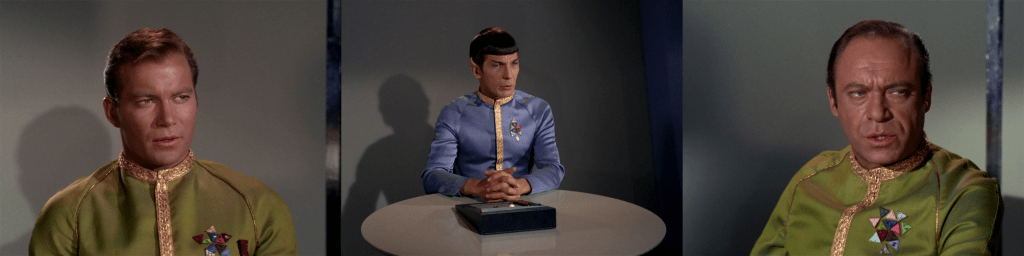
This is the first episode in which we see Starfleet dress uniforms. Theiss did a great job at crafting something that seems very much in the family of the regular uniforms, but elevated for dress occasions. 5/5
Make-up and Hair
The burn/injury make-up for Kenney as Pike is quite good. The purple blotches are reminiscent of the plague we saw in “Miri” but the overall effect is strong. It looks painful and it’s easy to empathize with Pike’s situation. 5/5
Visual Effects
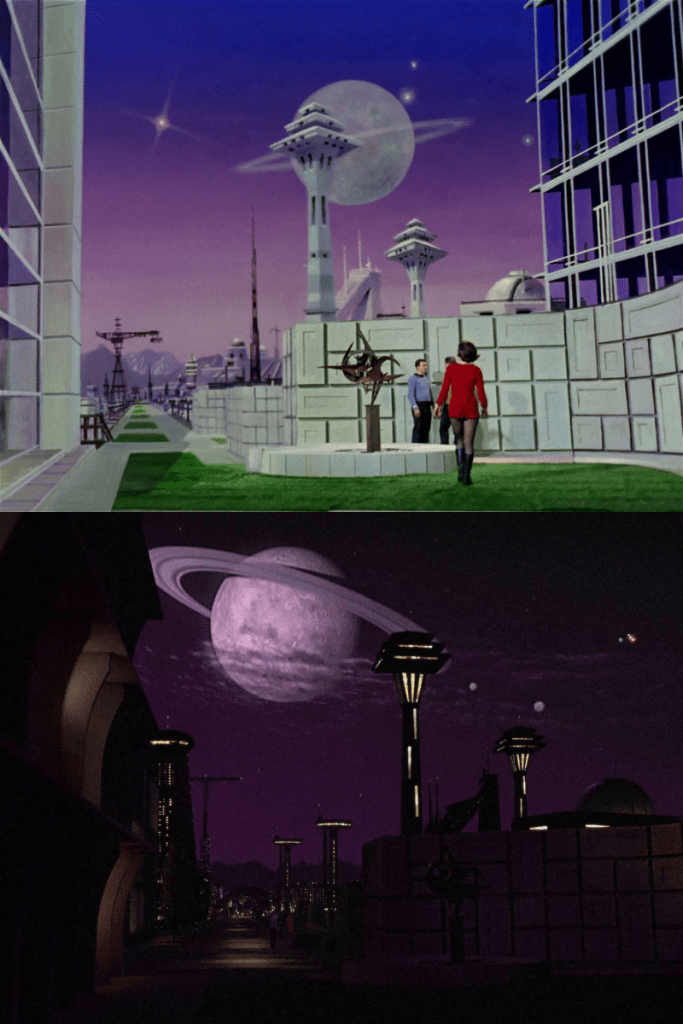
The matte painting for Starbase 11 was created by the great Albert Whitlock. It’s another iconic Star Trek location design and it’s combined really effectively with live action in this episode. The remastered edition includes a night-time shot of Starbase 11 which is also beautiful. There are several burn-in effects in this episode when the panel is watching footage on a large screen. They’re quite successful, too. 5/5
Music
The music for this episode is by Alexander Courage. Much of it is recycled from “The Cage”. It’s good but not particularly memorable. 3/5
Acting (series regulars and guests)
The regulars are all strong in this episode and Malachi Throne does a good job as Mendez. He feels very natural in the role. 5/5
Direction (coherent, memorable)
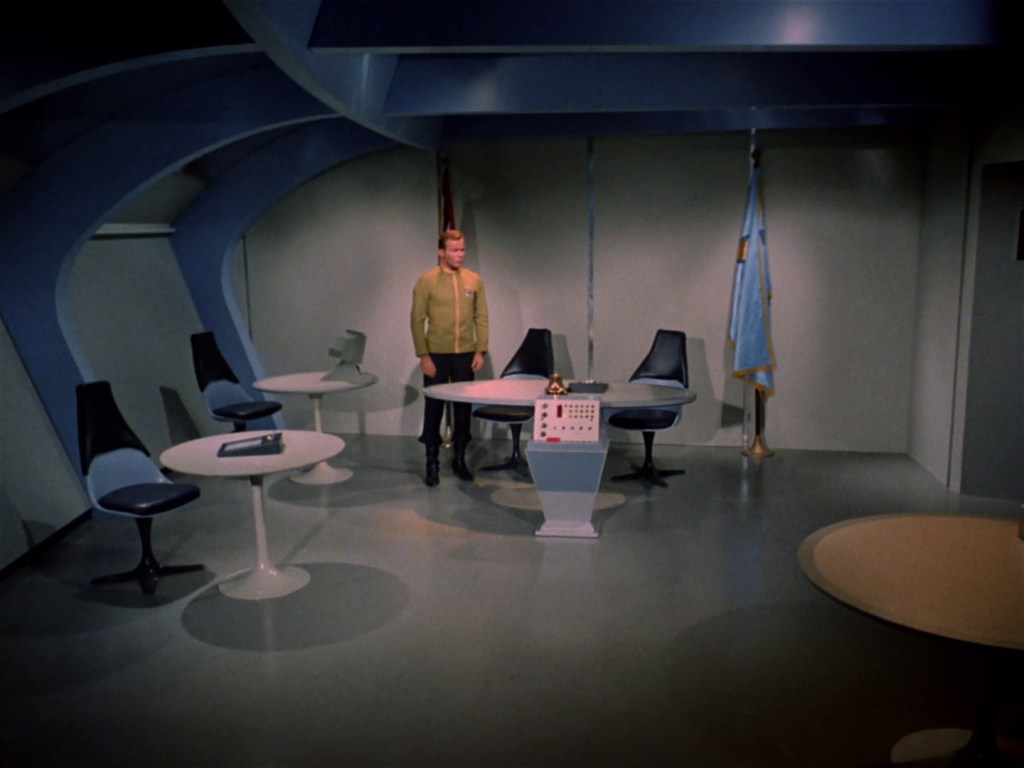
Marc Daniels directed enough new material for this episode that he is credited as director. Robert Butler is uncredited for directing the material from “The Cage”. I already mentioned the good use of the engineering set as computer control at Starbase 11. The scenes in that set probably have the most complex blocking in the episode. The most memorable shot is at the very end of the episode when Kirk stands alone in the empty briefing room, looking small and uncertain. Mendez has just reminded us that a captain is responsible for everything that happens on his ship. Even if Kirk had no knowledge of Spock’s plot, he’s responsible for the actions of his officers. 4/5
Philosophy
Is it thought-provoking?
I admire this episode more for its clever production than anything else. It’s thought-provoking only insofar as the mystery of why Spock is acting as he is – a mystery that won’t be solved until Part II. 3/5
Does it deal with a moral or ethical issue?
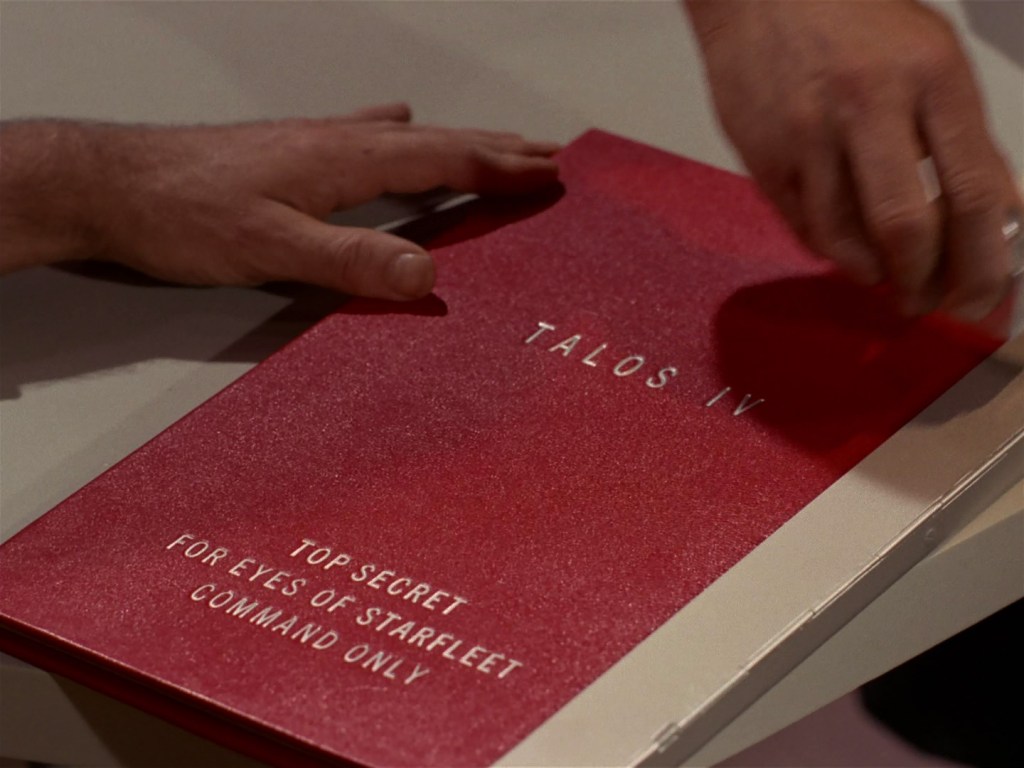
What comes up for me here is that the Federation has one crime for which there is still a death penalty and it is visiting Talos IV. I don’t believe in the death penalty for anything and it’s hard to imagine the enlightened Federation having one for anything, let alone this. I suppose the idea is that the threat of death will keep anyone from going there, and thus keep them safe from capture by the Talosians. I’m not sure why the Talosians’ abilities need to be secret. I would think that making them public would discourage most people from visiting them. 3/5
Is it consistent with Trek’s optimism and Humanism?
I’m struggling here because I don’t think the death penalty is in line with Trek’s optimism. That said, this episode was written by Roddenberry so it should have his philosophical fingerprint on it. I think if you look at both Menagerie episodes we get a bit more, but if we’re just looking at Part I I’m not really finding much of it. Possibly, there is a hint of optimism from Pike at one point. During the court martial, Mendez stops the proceedings at one point because Spock refuses to say where the visual evidence being presented is coming from. When put to a vote about whether to continue, both Kirk and Pike vote in favour of doing so. That suggests Pike has some hope that the affair will lead to something positive. 3/5
IDEA (Inclusion, Diversity, Equity, Accessibility)
Here’s where that disability justice lens I mentioned would come in handy. I’m not an expert in this area. There are definitely some ableist tropes here, and there’s kind of an implicit vibe that people with severe physical disabilities might be “better off dead”. One would hope by the 23rd century that we could do a bit better with assistive technologies that would give Pike more ability to communicate and contribute to decision-making about his future.
My guess is that Roddenberry saw Pike as a resilient character, refusing to give up in the face of severe disability. Maybe that speaks to Roddenberry’s Humanism. 3/5
Conclusion
My ratings for this episode total 84/100, definitely placing it amongst the top five so far.


3 comments