
“A cage is a cage, Jim.”
Last night I watched “Dagger of the Mind” (great title!). This was the 11th TOS episode to be produced, but the 9th to be released. It first aired on November 3, 1966. It was written by S. Bar-David (Shimon Wincelberg).
Story
Is it a coherent story?
While on a routine cargo delivery to the Tantalus Penal Colony for the criminally insane, the Enterprise encounters a mad scientist, Tristan Adams, who has created a disturbing device called a Neural Neutralizer which can re-write the Human mind. 5/5
Is it enjoyable to watch?
Yes, I’ve always enjoyed this one, even though parts of it are difficult to watch. I think my own mental health challenges predispose me to be curious about stories about mental health. I also enjoy the Kirk-Noel relationship. 5/5
Is the dialogue strong and/or memorable?
There are a couple of lines I find particularly memorable in this episode. One is from Spock who says, “Where there is no emotion, there is no motive for violence.” This is a great explainer for why most Vulcans have dedicated themselves to logic. We’ll learn more in future episodes about Vulcan’s violent past. I’d also like to put a pin in this for when we get to the seventh season of Star Trek: Deep Space Nine.
Later, Kirk says to Noel, “One of the advantages of being a captain, Doctor, is being able to ask for advice without necessarily having to take it.” On the page, this seems kind of witty, but in the context of the scene on screen it’s pretty patronizing.
Finally, Dr. Adams also has this memorable dialogue, “May we never find space so vast, planets so cold, heart and mind so empty that, that we cannot fill them with love and warmth.” It’s a lovely sentiment that belies the doctor’s true feelings. 4/5
Does it serve the main cast well?
Kirk seems to have an obsession with penal colonies. He mentions his familiarity with them, at least three times; saying that he’s visited them before, and that they’re more like resorts than prisons. He comes across as a bit arrogant, but I think the point of these lines is to illustrate that in the 23rd century mental health challenges are less stigmatized and we’re more civil about we treat mental illness (this turns out not to be true).
McCoy’s characterization is a bit mixed. At the beginning of the episode, he disagrees with Kirk about the pleasantness of these facilities, saying “A cage is a cage, Jim.” This feels like a reasonable thing for a compassionate country doctor to say. However, when the desperate Simon Van Gelder is discovered about the Enterprise, McCoy tells Kirk “I’d sure like to study this one, Jim.” while smirking. This is very de-Humanizing and makes McCoy much less sympathetic.
I’ll talk more about this later, but this episode gives us our first Vulcan mind meld. Spock is perhaps the member of the triumvirate who is served best by this episode. 3/5
If there are guest or recurring characters, are they memorable or interesting?
Morgan Woodward appears as Simon Van Gelder. This is the first of two TOS roles Woodward plays – both are mentally unstable characters. Van Gelder is fascinating. I wish we got to spend more time with him because I think he would probably be more representative of mental health professionals in the 23rd century.
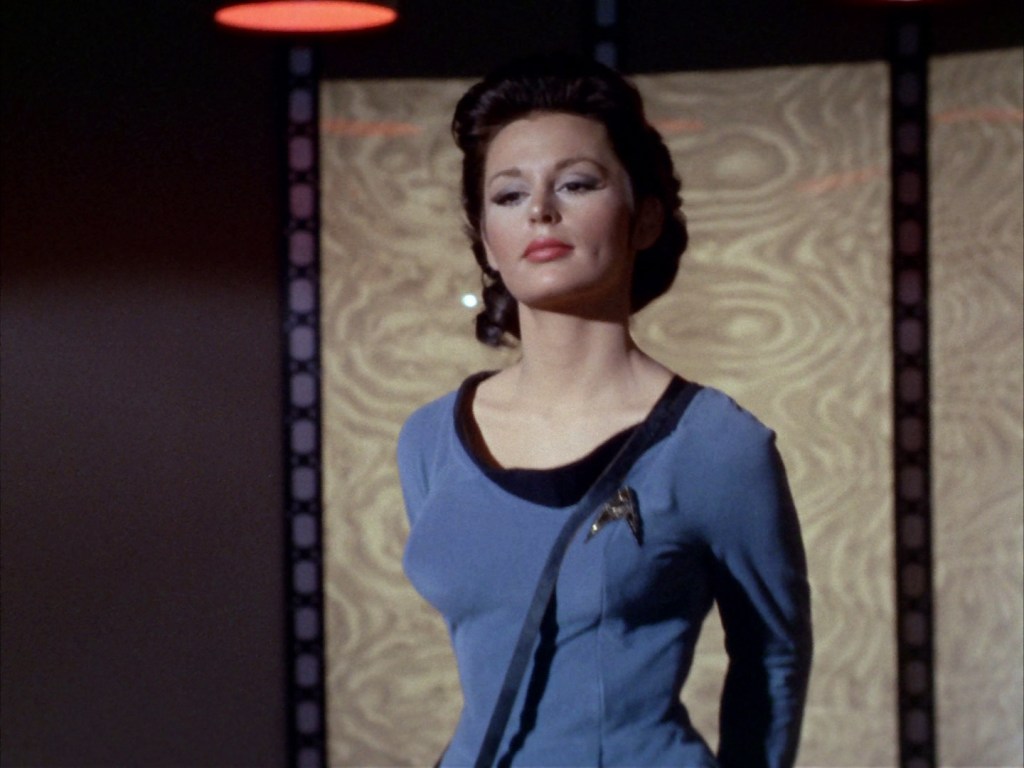
Marianna Hill plays Dr. Helen Noel, an Enterprise psychiatrist. Noel is in an interesting character. She’s a good foil for Kirk. She’s presented as smart, professional, but with a sense of humour, and Hill is one of the most beautiful women in the series.
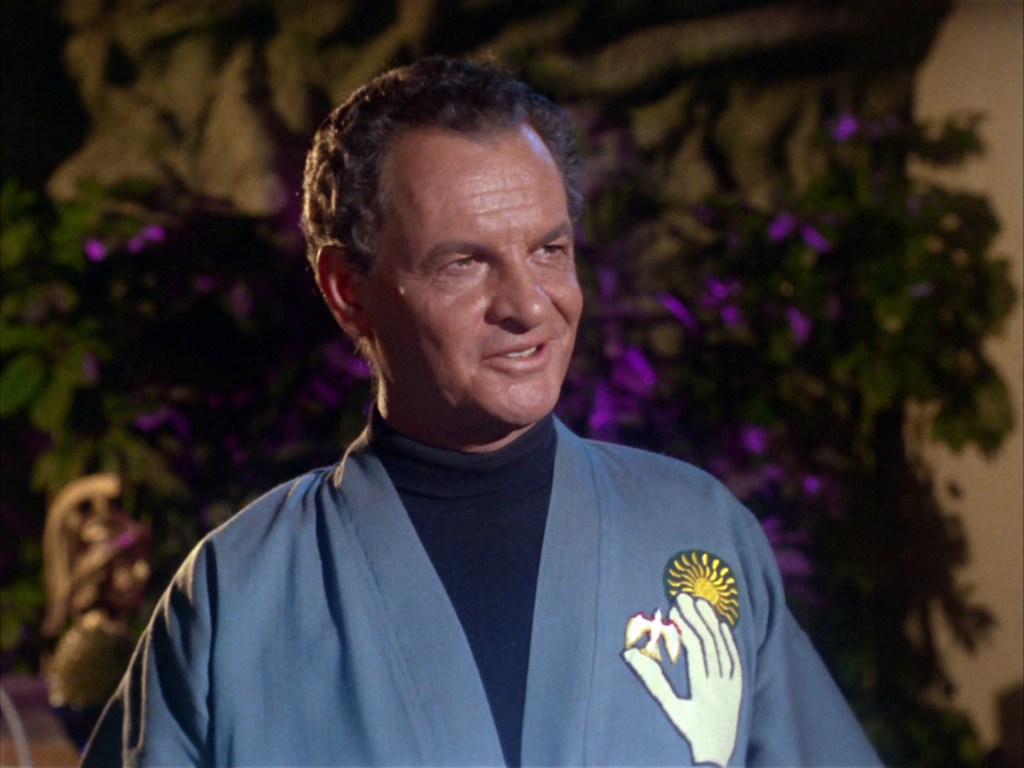
James Gregory plays the “mad scientist”, Tristan Adams. He seems very charming to Kirk and Noel, but I always find him off-putting from the get-go. To me, he comes across as arrogant and kind of sleazy – telegraphing his villainous turn.
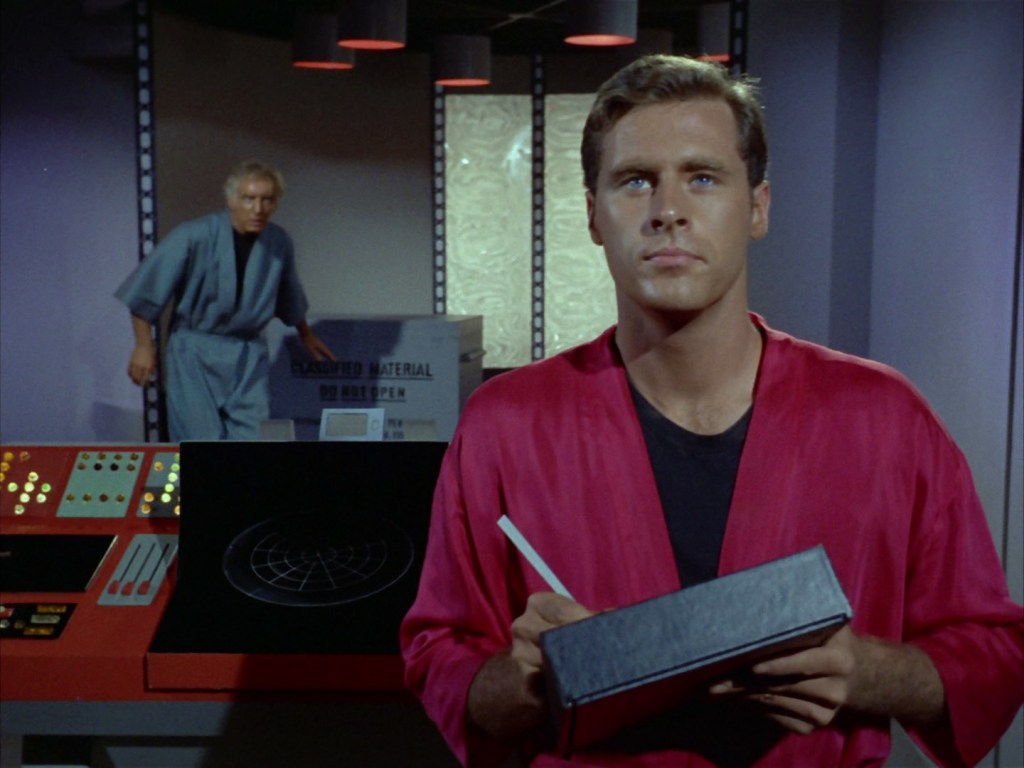
Finally, I note the second of my Trek boyfriends (after Riley in “The Naked Time”). An unknown actor appears as an unnamed, but dreamy, transporter assistant. 5/5
World-building
Does it contribute positively to the Trek Universe?
We are introduced to Tantalus V (a wonderful planet name, though it sort of telegraphs something sinister happening because of the Greek mythological figure of the same name). In the remastered edition of the episode, there’s a new wide shot of the surface of the planet which is quite nice. We learn that there is a Central Bureau of Penology in Stockholm on Earth. “Bureau of Penology” is just a wonderful phrase. We learn, through Kirk as a proxy for the everyman, that the general feeling in the 23rd century is that mental illness is not to be feared and that it’s at least the intention of most to treat those with mental health challenges respectfully. 4/5

Is it consistent with the rest of canon?
I can think of one anachronism which I’ll discuss below. We learned in “Charlie X” that at least some people on the Enterprise are still celebrating the American holiday of Thanksgiving. In this episode we learn that at least some are still celebrating Christmas. I wish that had been left out. I’d love to believe that we’ll have outgrown religion by the 23rd century. 4/5
Is there something new and unique?
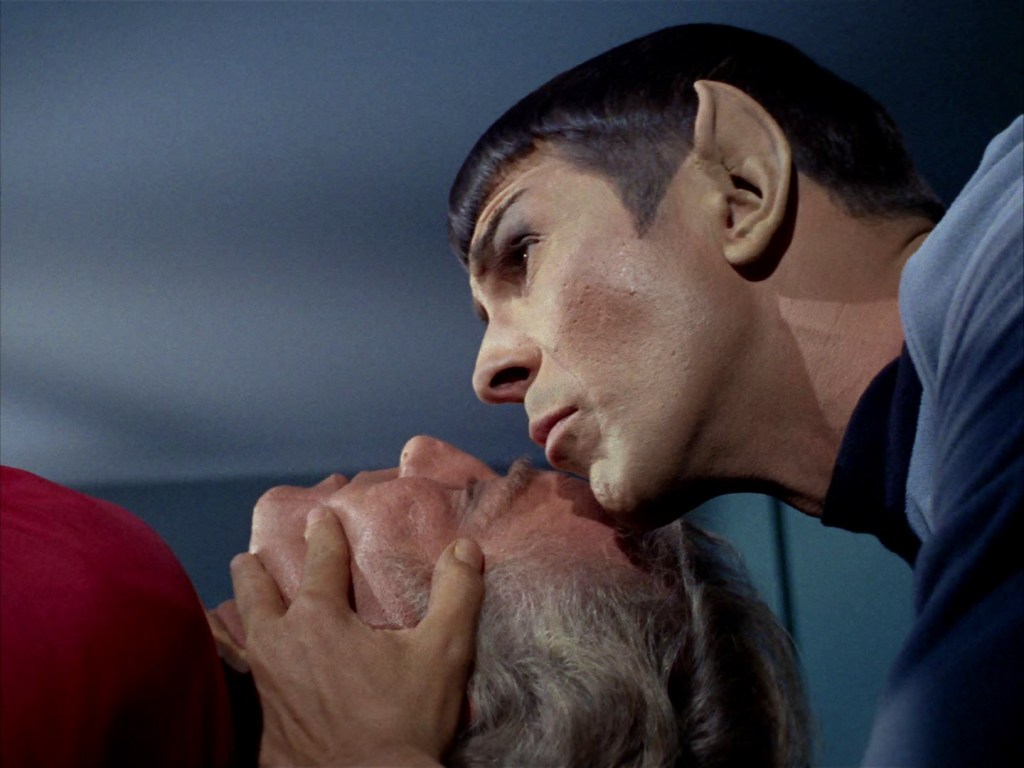
For me, the most exciting new and unique element of this episode is the first Vulcan mind meld. Spock tells McCoy that it’s a deeply personal thing and that he’s never used it on a Human. Here’s another place where Star Trek: Strange New Worlds is inconsistent with TOS. We’ve seen Spock mind meld with both La’an and Kirk in SNW.
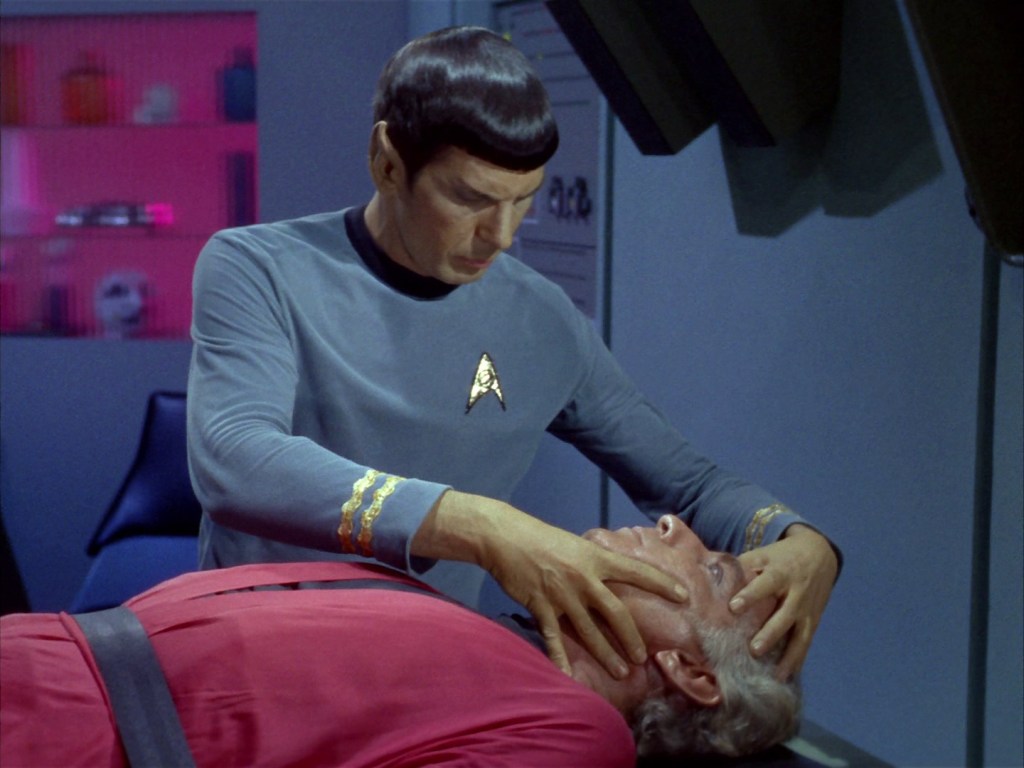
McCoy basically guilts Spock into using it here. Spock tells him it could be dangerous, but because Van Gelder is in such a state that he can’t easily communicate, it seems to be the only way to get essential information about what’s really happening on Tantalus V. There are some wonderful shots of Nimoy’s long, green fingers on Van Gelder’s face and the direction of the mind meld scenes makes it a very memorable experience. The mind meld will, of course, become a staple of Trek for decades to come. 5/5
Does the science seem plausible?
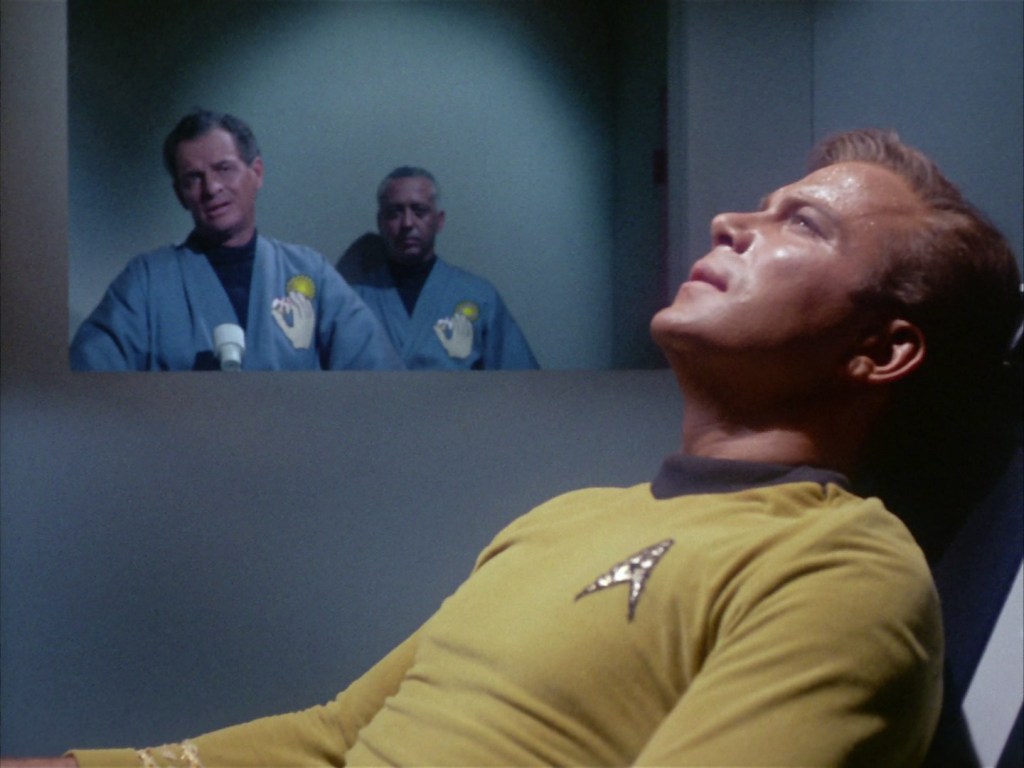
The Neural Neutralizer (another sinister name) apparently neutralizes brain waves and relaxes patients, making them susceptible to suggestion. During Spock’s mind meld with Van Gelder he learns that it “re-shapes minds” and erases memory. Hypnosis is definitely a real science and it is used clinically, but I still have doubts. When Kirk tests the device on himself with Noel at the controls, he asks her to try implanting a harmless suggestion. She suggests that he is hungry and Kirk becomes hungry. She then suggests that their encounter at the science lab Christmas party happened differently than we know it did. She implants the idea that Kirk is madly in love with her and that suggestion also sticks. These seem like stage hypnosis to me. Despite her earlier assertion to Kirk that Dr. Adams has not created a chamber of horrors, the Neural Neutralizer is just that. 3/5
Production
Production design (sets, props)
The phasers in this episode definitely have black handles. The handles weren’t visible in the previous two episodes so it’s hard to say when exactly the change was made, but it was sometime between “Mudd’s Women” and this episode.
In terms of other props, we again see Kirk record his log into a tricorder. Adams serves drinks from a Holmegaard kluk kluk bottle. These are wonderful and I have some in my collection.
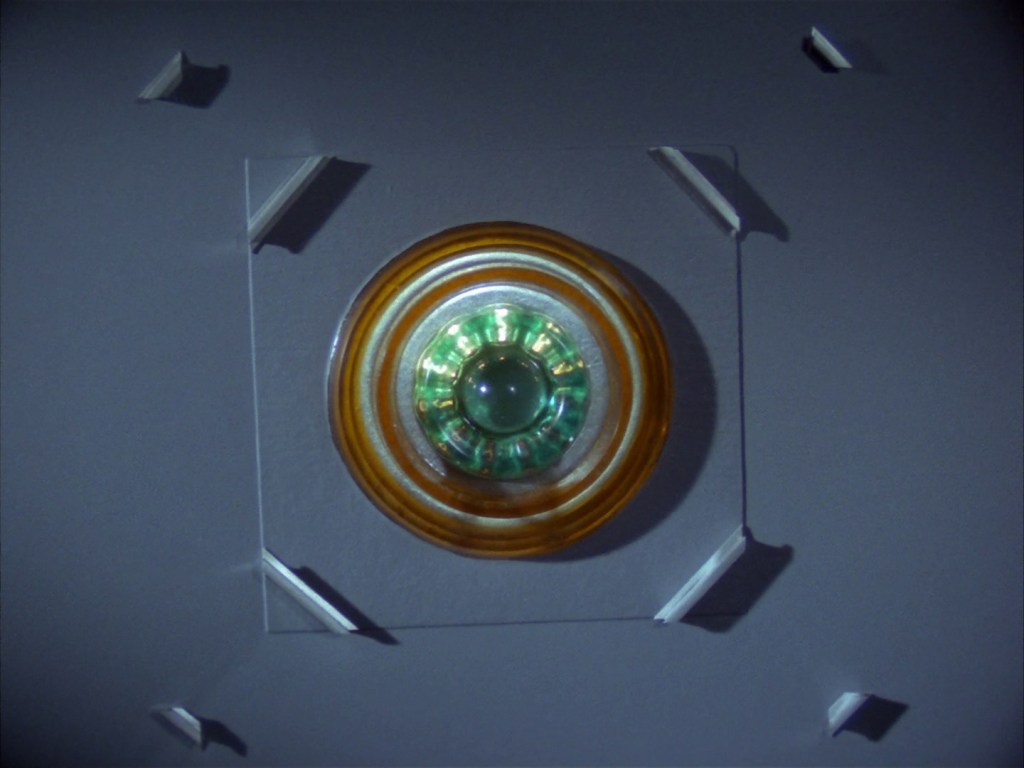
The Neural Neutralizer has a very memorable design. I always remember the various grates and conduits that Noel deals with in this episode. It reminds of crawling through tunnels at Chuck E. Cheese’s when I was a kid. 5/5
Costumes
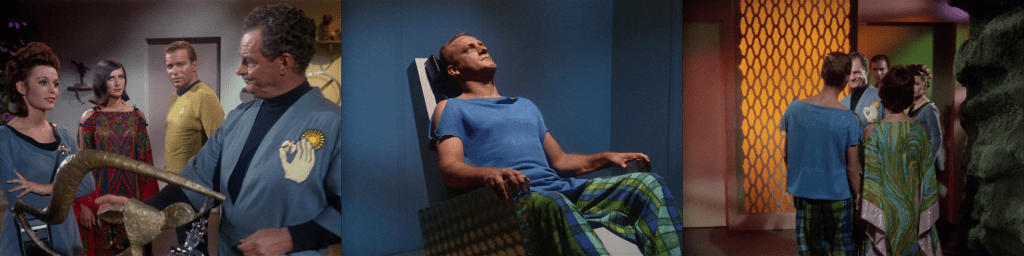
Soon after Kirk and Noel arrive on Tantalus V, Adams introduces them to Lethe (another name that telegraphs danger since it’s the river of forgetfulness in Greek mythology), a woman who apparently arrived as a patient, was cured, and stayed on as a therapist. The person she was no longer exists (thanks to the Neural Neutralizer). She wears a particularly vibrant costume. In fact, William Ware Theiss has found very vibrant, memorable fabrics for all the civilians in this episode. Most of these costumes will be re-used later. The blue-green plaid pants are especially memorable to me. 5/5
Make-up and Hair
Nothing particularly sticks out to me in this area. Marianna Hill is quite beautiful. Her hair seems to be her own, rather than a wig. 4/5
Visual Effects
Nothing stands out to me here. There are some great physical and lighting effects. 4/5
Music
The music for this episode was written by Alexander Courage. The score during the mind meld scenes is very alien and interesting. 4/5
Acting (series regulars and guests)
I want to talk here mostly about Woodward as Van Gelder. Van Gelder sneaks aboard the Enterprise in a cargo container that is beamed aboard. He’s visibly strung out and sweaty from the moment we see him. He neck chops my transporter boyfriend and makes his way to the bridge where he demands asylum. Spock nerve pinches him and his reaction is good. The rest of the time we spend with him, he’s an incredibly tortured man. The Neural Neutralizer has been used to make him forget, or to prevent him from talking about what he remembers. He’s laughing, screaming, struggling to remember and to get words out. The performance is on the verge of being over the top but it’s controlled enough to convey the pain he’s in. I think it’s very strong.
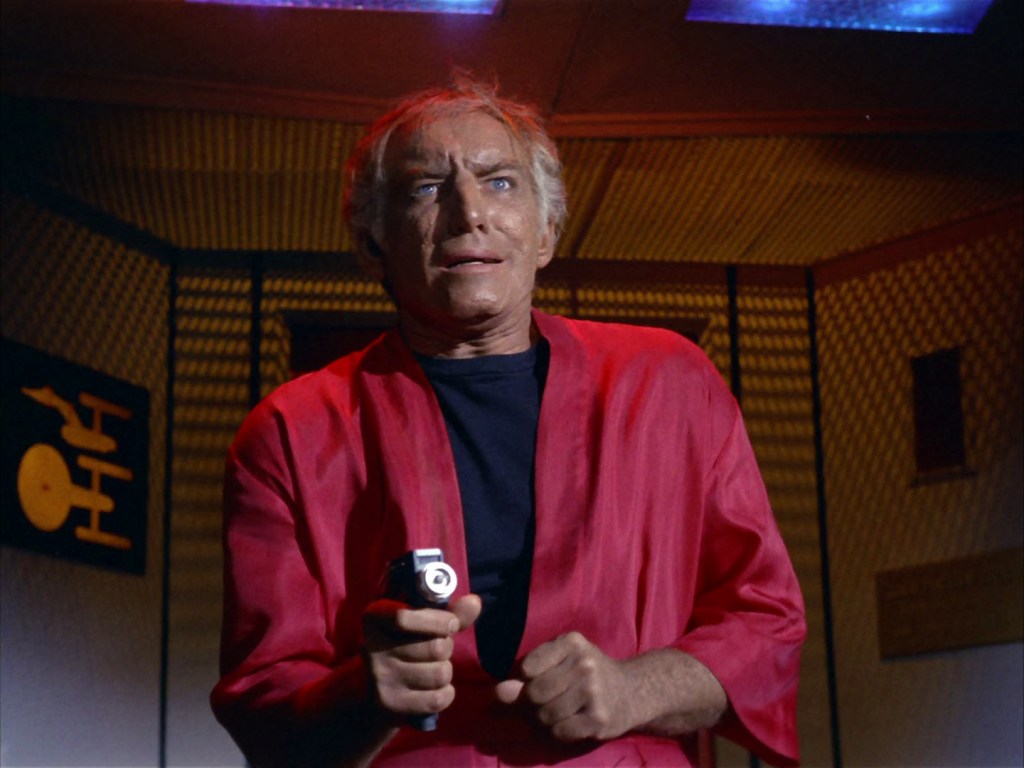
The regulars all do a good job. Despite some of McCoy’s contradictory dialogue, the characterizations are all in place. When Spock beams down to rescue Kirk and Noel and finds them kissing because of Kirk’s Neural Neutralizer-conditioning, he gives a wonderfully sassy look. 5/5
Direction (coherent, memorable)
This episode was directed by Vincent McEveety, who also directed last week’s episode, “Miri”. There are a handful of really memorable moments in his direction. The first is our introduction to Helen Noel. She’s standing on the transporter pad and there’s a great zoom in to her as she says “we’ve met”. The other memorable moments are during the mind meld scenes. There’s some really interesting blocking. I have to think that Nimoy was very influential in how he played the scene and the placement of his hands and face in relation to Van Gelder, but there are some unique camera angles that make this a really alien experience. 5/5
Philosophy
Is it thought-provoking?
It brings up for me, questions about how we as a society treat people who have mental health challenges. I think in the 21st century we’ve become better at talking openly about mental illness and removing some of the stigma around counselling and other supports, but that’s not true everywhere geographically, or with every segment of communities. Though we’ve become better at talking about it, we haven’t done a good job at making mental health supports more accessible. In Canada at least, community counselling agencies have waitlists a mile long, and good luck seeing a psychiatrist in a timely fashion. Most employment benefits cover very little in terms of counselling. If you want to see a psychologist, your benefits will probably get you two sessions. 5/5
Does it deal with a moral or ethical issue?
Though we don’t lock as many people away in institutions as we once did, that still happens more than it should. Some people with developmental delays, for example, are even physically restrained for long periods. I think this episode is asking whether a cage is still a cage. The Neural Neutralizer is like a futuristic lobotomy. Do we have the right to try to correct a perceived mental illness with something like that? Can someone who is “criminally insane” consent to these kinds of practices? 5/5
Is it consistent with Trek’s optimism and Humanism?
When it comes to optimism, I think Kirk gets a bit of a wake-up call in this episode. At the beginning, he’s entirely convinced that penal colonies like Tantalus are like spas where everyone is treated well. By the end, he’s had the experience of being in that room. When Adams dies, the crew imagines what it might be like to have one’s mind “emptied by that thing”. It suggests to me that any time one Human is put in charge of another the tendency is to Other them, and when someone is de-Humanized (as McCoy does by referring to Van Gelder as “this one”) it’s possible for extreme abuses of power to take place. I’m not sure this episode is optimistic, but it does attempt to get at the heart of a very Human problem. 4/5
IDEA (Inclusion, Diversity, Equity, Accessibility)
What comes up for me here is around equity and agency. Our history shows that it’s possible for horrendous abuses of power to take place when one of us accuses another of being mentally ill. There are countless stories of people (especially women and racialized people) being committed to institutions to silence them or disappear them from someone with power’s life. Unfortunately, it is possible for someone to truly not be able to understand their situation and be unable to care for themselves. In that case, we have to trust that the powers that be are going to treat the people under their care with respect and dignity, and we know that doesn’t always happen. We learn that Dr. Adams has forced Neural Neutralizer treatments on people. Did any of his patients choose to go through the process? We don’t see enough to know what else might be happening at Tantalus, but this isn’t the last time we’ll explore a facility like this in TOS. 3/5
Conclusion
My ratings for this episode add up to 87/100 – narrowly beating “What Are Little Girls Made Of?” for highest rating.


4 comments