
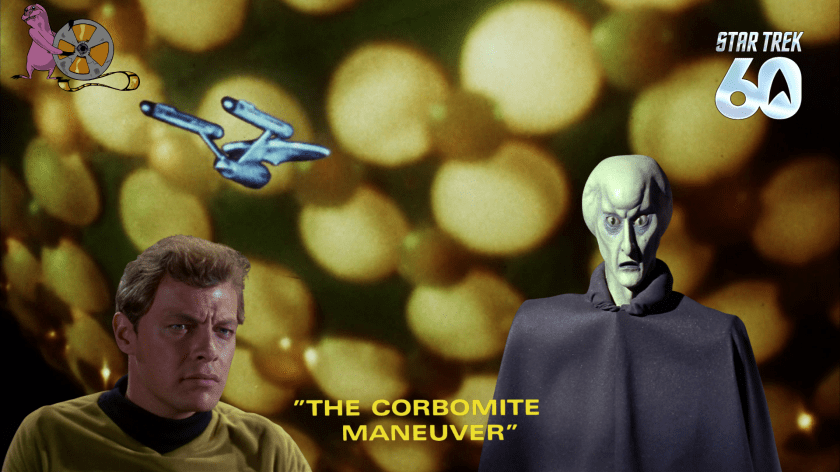
“A very interesting game, this poker.”
Life has thrown me off my re-watch schedule, but last night I watched “The Corbomite Maneuver”. This was the third TOS episode produced, but the 10th to air. It first aired on November 10, 1966. It was written by Jerry Sohl who would go on to write two additional episodes.
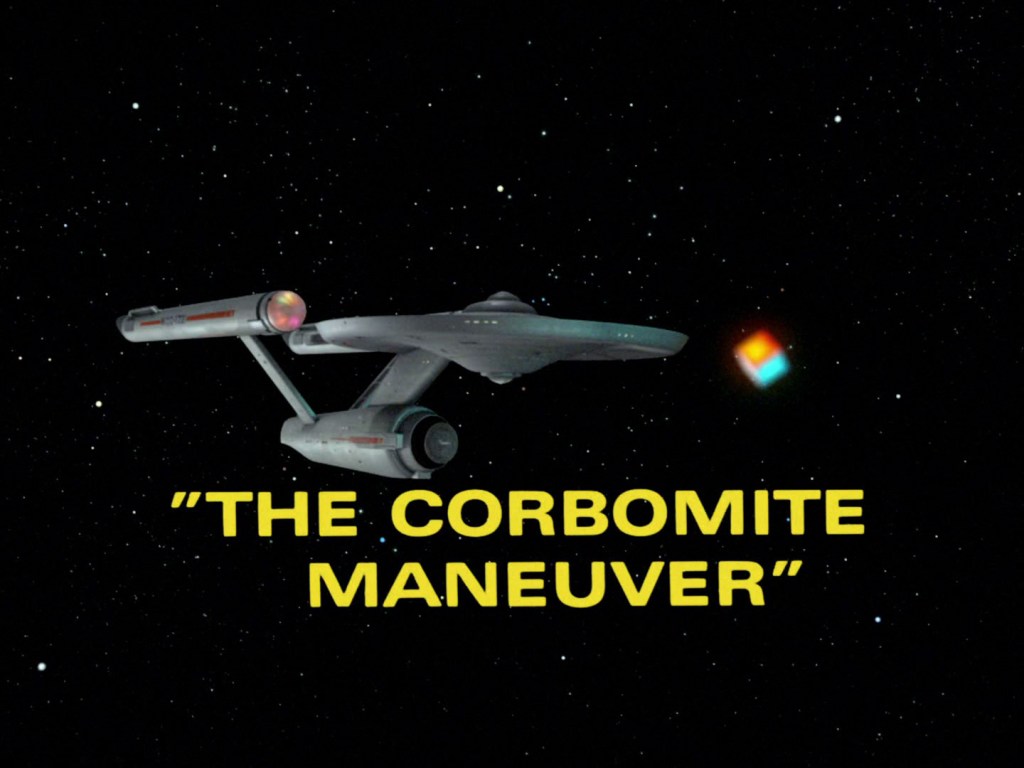
Story
Is it a coherent story?
When the Enterprise is exploring an uncharted region of space, it encounters the First Federation, an advanced alien race. 5/5
Is it enjoyable to watch?
Despite some incongruencies because of its production early in the series, I really enjoy this episode. 5/5
Is the dialogue strong and/or memorable?
From McCoy, we get, “What am I, a doctor or a moon shuttle conductor?”. He goes on to say to himself that if he jumped at every blinking light in sickbay he’d end up talking to himself. This is a great early scene for McCoy that tells us a bit about his crochety personality. It’s also the earliest iteration of the “I’m a doctor, not a…” which is picked up throughout TOS and into several other Trek series.
Kirk and Spock also get some strong dialogue. Kirk says to Balok, “Death has little meaning to us. If it has none to you then attack us now.” It’s delivered really well by Shatner. There’s also Spock’s line about Balok reminding him of his father (clearly written with no expectation that we would later meet Sarek). Spock goes on to say that his mother considered herself a very fortunate Earth woman. It’s a bit goofy, but memorable. There’s also the Spock-Kirk exchange where Spock asks Kirk whether he’s considered there’s a certain inefficiency in questioning him about things when he’s already made up his mind. Kirk replies that it gives him emotional security. 5/5
Does it serve the main cast well?
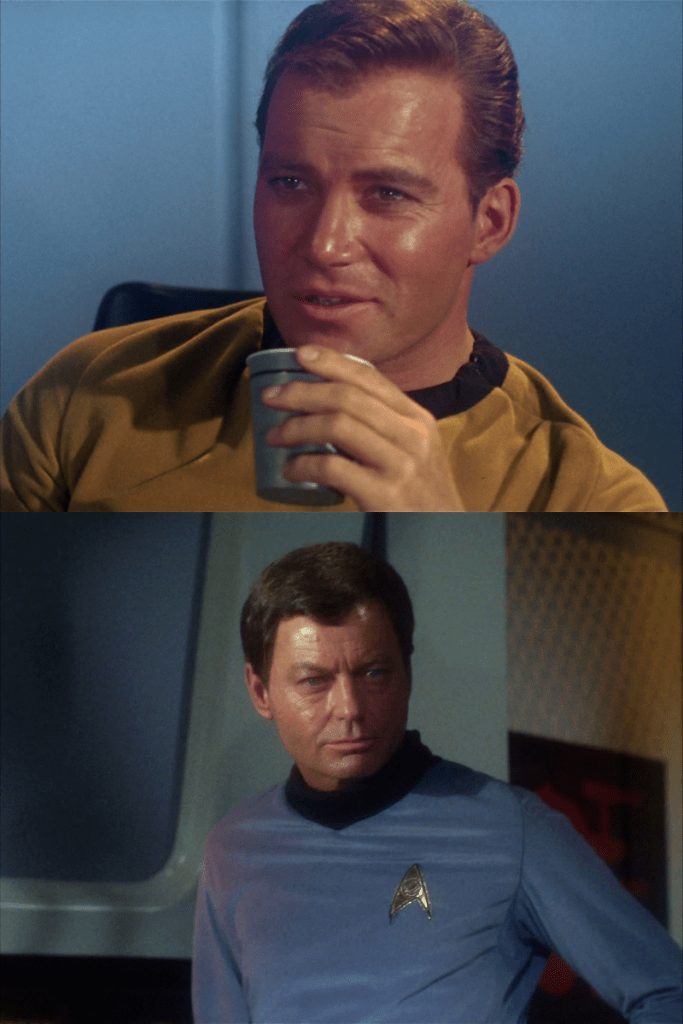
Kirk and McCoy are well served by this episode. We get a real sense that McCoy respects Kirk’s leadership but that he’s willing to go against Kirk when he disagrees. Early in the episode, McCoy is giving Kirk a physical when a red alert light flashes. McCoy notices it but has Kirk continue with an exercise. This is perhaps not the most responsible decision. The ship could be in serious danger. It demonstrates that McCoy must have faith in Spock and the rest of the bridge crew to deal with it until they actually call for Kirk.
We also get a good sense of Kirk’s leadership style. He promotes Bailey, a young officer, to the helm. McCoy thinks this is too stressful a position for Bailey but Kirk seems to have a sense that Bailey can grow into the role. When Bailey is too stressed by the encounter with Balok, Kirk orders him to leave the bridge. Near the end, Kirk assigns Bailey to stay with Balok as part of a cultural exchange. There’s something there about Kirk seeing the potential in a young officer that is very appealing.
There’s also Kirk as the gambler, the risk taker. The titular maneuver, inspired by poker rather than chess, is an interesting idea. 5/5
If there are guest or recurring characters, are they memorable or interesting?
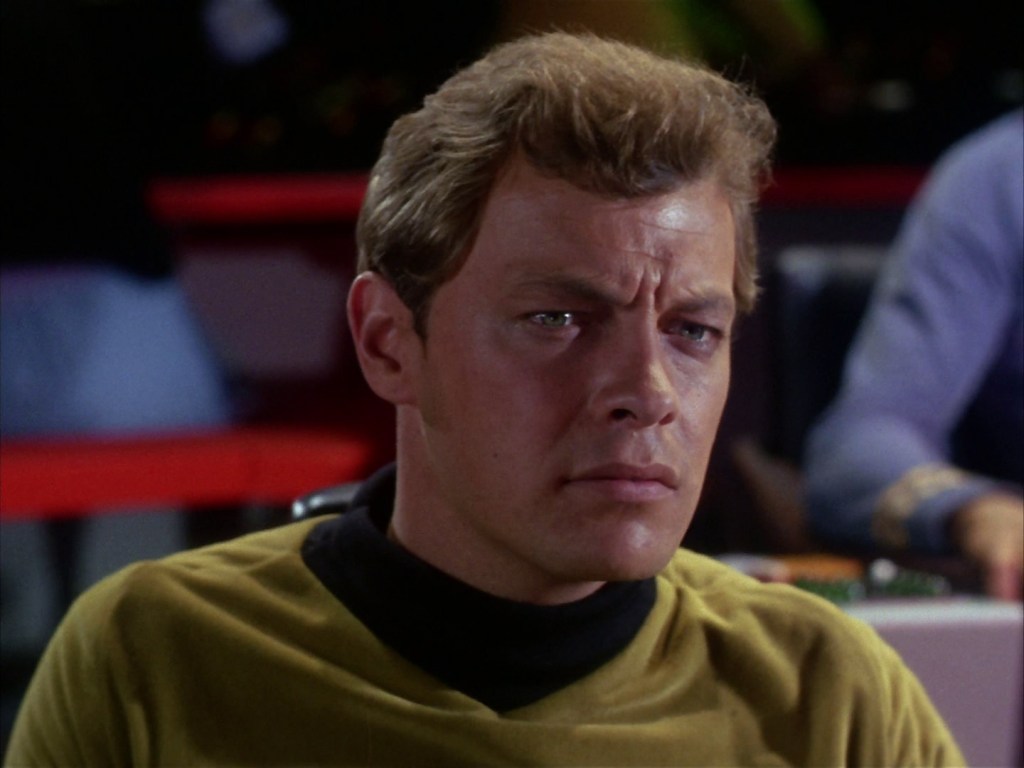
Anthony Call as Dave Bailey: Call would have been familiar to television audiences of the 60s and 70s. He guest starred on a wide variety of series. He’s not really fully developed. He’s sort of a tool to help us better understand Kirk and McCoy. But what Call is given, he does well with.
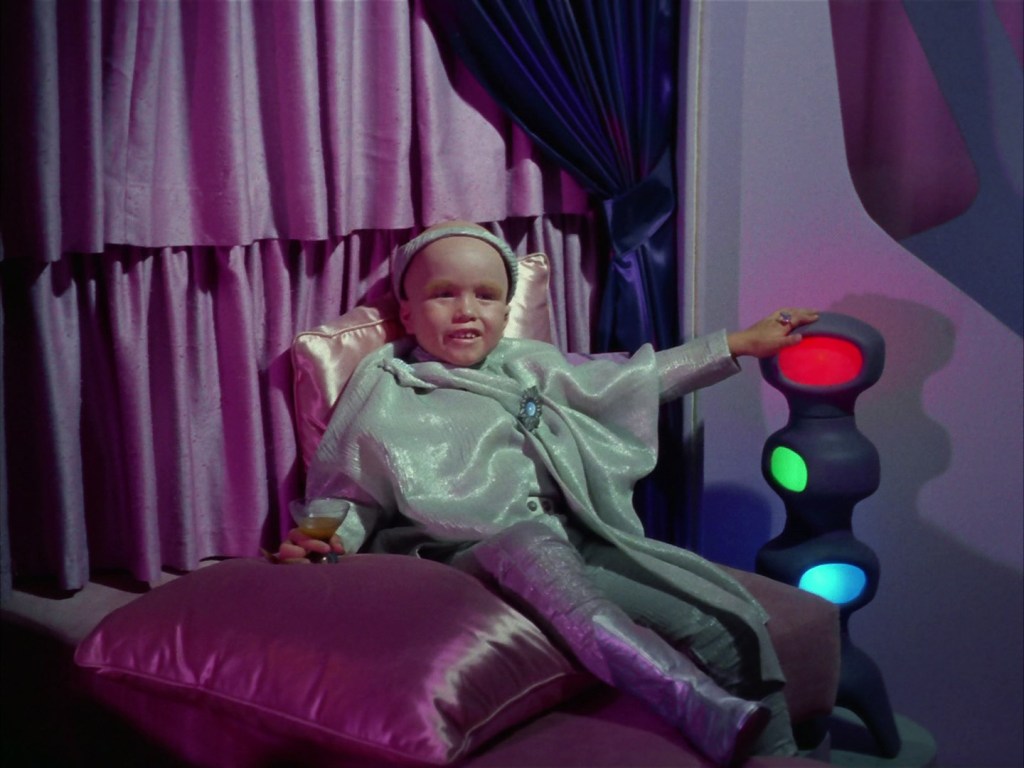
The more memorable guest character is undoubtedly the young Clint Howard as Balok – one of the most memorable TOS aliens. Howard was only six or seven years old at the time but he does a great job at creating an indelible mark on the series. The puppet version of Balok that our crew first sees is voiced by Ted Cassidy, whom we’ve already met as Ruk in “What Are Little Girls Made Of?”. Howard’s voice is dubbed by Walter Edmiston (uncredited). Edmiston provided at least seven voices across TOS. He was sometimes called the man of a thousand voices. 4/5

World-building
Does it contribute positively to the Trek Universe?
This episode provides one of many TOS examples of our crew encountering an alien species that is more advanced than they are. I love this idea because it goes to Gene Roddenberry’s concept that Humanity is a “child race”. That we’re still developing and that there might be other species in the galaxy who have achieved great things we can admire and aspire to. By the end of the series, it’s become a trope that’s used too often, but here it’s still special. 5/5
Is it consistent with the rest of canon?
I believe this is the first episode in which we see the Enterprise firing phasers. The beams are red in the original version. In the remastered edition, they are blue. The colour is inconsistent in TOS but I believe the remastered edition made them consistently blue. The Fesarius uses a tractor beam to hold the Enterprise in place. The idea of tractor or “attractor beams” had been around in sci-fi novels for decades but this is the first use on Trek and they would become very familiar technology going forward.
Scotty refers to a hand phaser as a “phaser weapon” which was probably a smart way to ensure people understood the technobabble. At one point, Rand brings coffee to the bridge. The ship’s power is out but she says she used a hand phaser and “zap, hot coffee”. We’ve already seen that phasers can be used to heat rocks in “The Enemy Within” so this is consistent with that. 5/5
Is there something new and unique?
Kirk reminds us that the mission of the Enterprise is to seek out and contact new life, and Balok and the First Federation are certainly that. The glowing cube and the Fesarius are the first space vessels we’ve seen aside from the Enterprise. The oddness and vast scale of the Fesarius is very unique. It’s very alien. Later, we’ll see Trek’s most powerful villains, the Borg, using ships that are cube and sphere shaped. I think it’s interesting that the designers went back to those when they are the first non-Starfleet ships in the franchise. 5/5
Does the science seem plausible?
There aren’t a lot of big science ideas in this episode but there are a few little things I looked up. At one point, Bailey defends his emotional reactions to Spock as being a natural adrenaline rush. Spock jokes that Bailey should look into having his adrenal gland removed because it’s most inconvenient. It is, apparently, possible to do this. However, one would require hormone replacement therapy because we can’t survive without hormones. Spock must have known this, so it makes it a very obvious joke, letting us know he does have a sense of humour.
Tractor beams are also plausible. Scientists have been able to move microscopic objects with lasers and sound waves. It’s not possible currently to move something as large as a starship but the theoretical science is sound.
The last thing I’ll note here is an inconsistency in using imperial and metric measurement systems. Spock says the Fesarius is a mile in diameter, and Bailey says it is 5000 metres away. Generally, Star Trek will use metric measurements going forward (but not always). 4/5
Production
Production design (sets, props)
I’ve already mentioned the designs of the First Federation cube and the Fesarius. At the end of the episode, when Kirk et al. meet Balok in person, they beam into a space with low ceilings that is defined by some cool arches and lots of pink curtains. It’s a relatively simple set design but it’s very effective. Balok has a Modular Standing Lantern, designed by the American sculptor and ceramicist Malcolm Leland. He uses it as a kind of control mechanism. It looks very alien. I’ve always wanted one but have yet to find one at a reasonable price! 5/5
Costumes
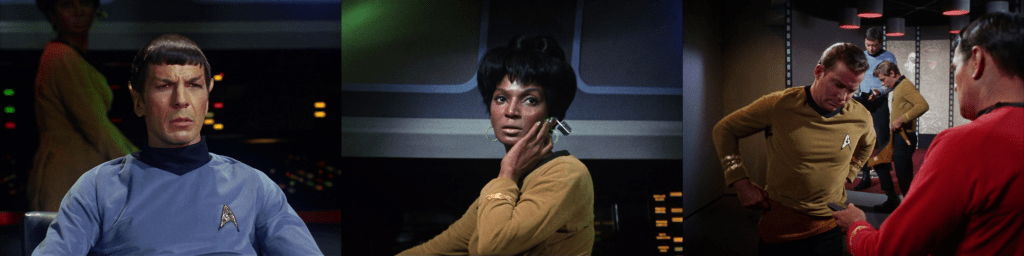
Balok’s costume is the most memorable in this episode. At first glance, the fabric seems to be the same as was used for the Talosian costumes in “The Cage”, but when you look more closely you can see the textures are quite different. The other item I noted here was the use of suede belts by the landing party to hold their phasers and communicators. These are abandoned at some point because they look more western than futuristic. The Starfleet uniforms have wacky high collars – they hadn’t quite perfected them yet. Also, Uhura is wearing a gold uniform rather than her standard red. 4/5
Make-up and Hair
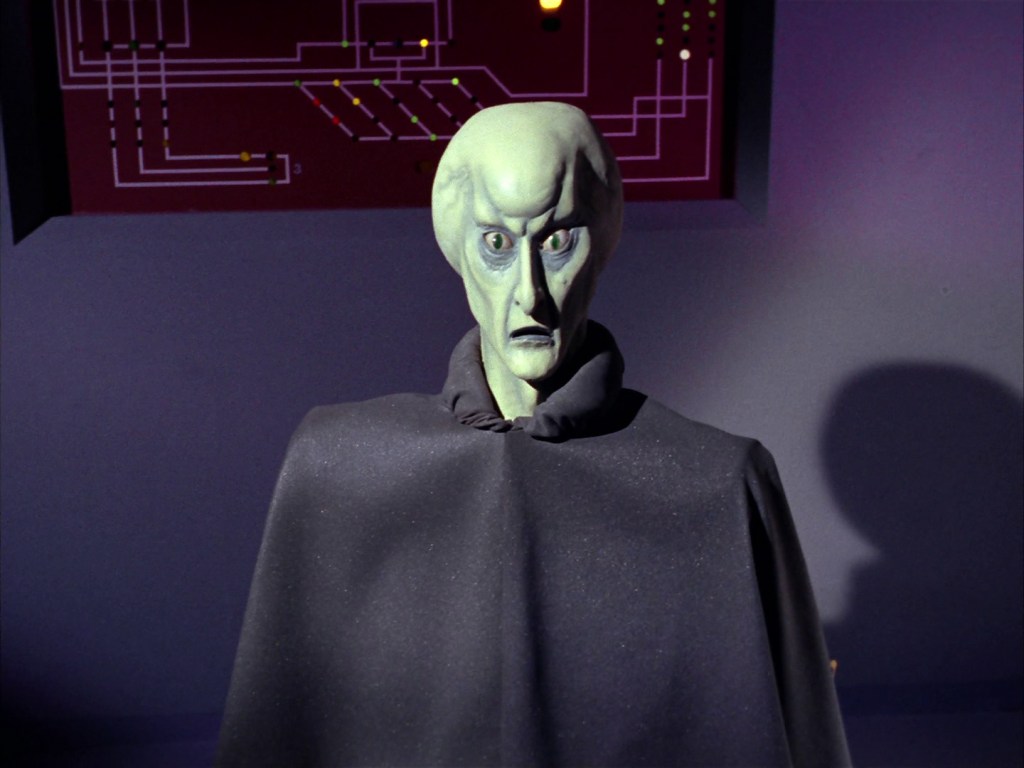
Both versions of Balok stand out in this episode. The puppet version is extremely memorable. Clint Howard as Balok had to wear a bald cap. His unfortunate dentition was all natural. The other thing I noted here is that Rand’s wig looks better than it did in episodes like “Charlie X”. It’s pulled back rather than around her shoulders. 5/5
Visual Effects
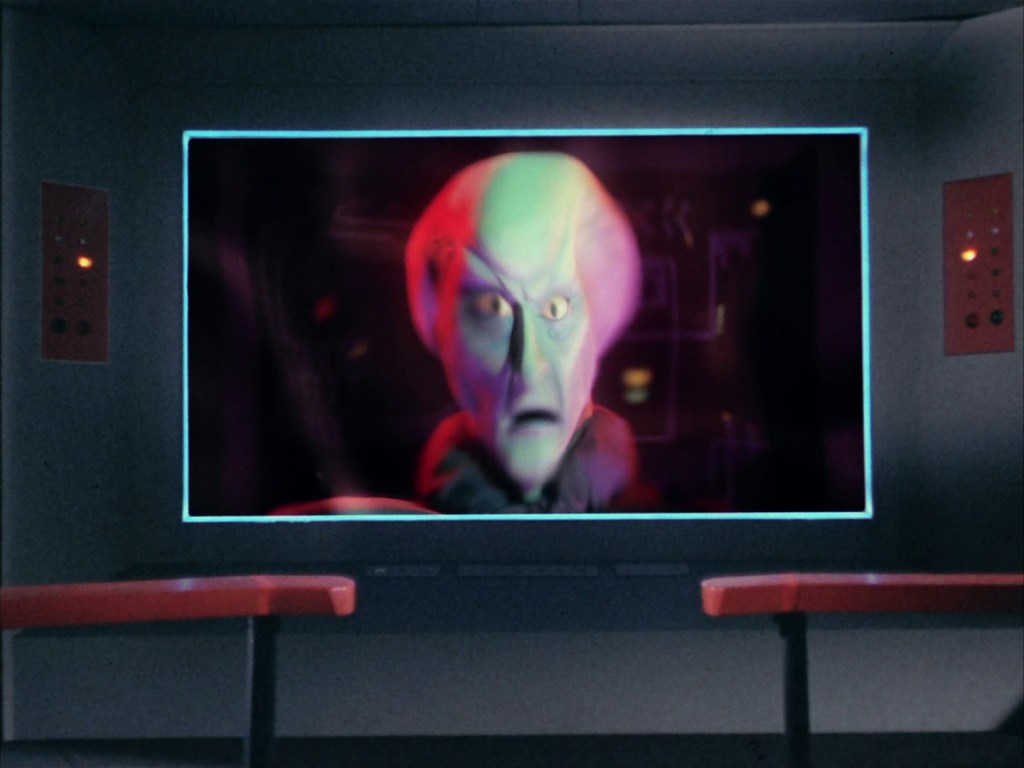
I’ve sort of covered this area already. The animated cube and the Fesarius model are quite effective. We’ve also got the blue phaser beams. While not itself a visual effect, but related to one, when the cube is on the viewscreen there is corresponding strobing light in various colours on the bridge. It really helps to sell the effect. 5/5

Music
Fred Steiner wrote the music for this episode. As usual, he impresses me. The score for this episode is extremely memorable. Parts of it will be re-used in many future episodes. 5/5
Acting (series regulars and guests)
Shatner and Kelley both do a great job in this episode. They’re basically already inhabiting the characters as they would remain for decades. Nimoy is not quite there with Spock, but he’s still good. This episode has a lot of extras in it. They packed people into the corridors in the first season. I really like that because it does make the ship feel more lived in. Also, when Kirk became captain of the Enterprise after Pike left, the crew complement was supposed to have more than doubled to 430. It makes sense that the ship would feel more full.
I’ve sort of already talked about Anthony Call as Bailey and Clint Howard as Balok. 4/5
Direction (coherent, memorable)
This episode was directed by Joseph Sargent. I think this is his only TOS episode but I wish he had come back for more. I think he did a great job. He sort of pioneers the dutch or canted camera angles for when the ship is struck by something. He uses it here both on the bridge and in the corridors. There’s also some great blocking in the bridge scenes. There’s one in particular where he makes really good use of extras moving back and forth and sets up a deep shot with various layers of people. 5/5
Philosophy
Is it thought-provoking?
I’m not sure how thought-provoking this episode is. There is the interesting idea of more advanced alien cultures testing us which leads to an exchange of culture. I think one mostly gets caught up in the suspense of this episode. It’s very engaging but not particularly philosophical. 3/5
Does it deal with a moral or ethical issue?
Kirk’s corbomite maneuver brings up an interesting question of ethics. He does it to save his crew so it’s obviously the right choice, but one wonders how it might colour their ongoing relationship with the First Federation. The first interaction between the two cultures is a lie. We never get to see them again. They’re mentioned a few times in the more recent Trek series. I’d be very interested in a story where we meet Balok’s people again and see how the relationship has evolved. Tranya, the beverage that Balok serves our heroes, appears in a few future episodes of other series. 3/5
Is it consistent with Trek’s optimism and Humanism?
I love the idea that Bailey becomes our cultural ambassador to the First Federation. He admits to Balok that he is far from the most perfect example of Humanity. There’s no better way for them to learn about us than from someone who will make mistakes. We’re still the child race, imperfect and learning, but the fact that Balok thinks we have something to offer – something worth spending his time with us – that’s a really Roddenberry idea. 5/5
IDEA (Inclusion, Diversity, Equity, Accessibility)
I don’t love that Yeoman Rand is delivering Kirk’s lunch to him, and serving coffee on the bridge. I have to wonder whether they would have given those duties to a man in the same role. Aside from that, what comes up for me here is Balok’s appearance. We first believe that Balok looks like a fairly frightening, stereotypical large-headed alien. Later, we learn that he’s actually the size of a Human child. That’s a fun reveal but it’s also telling that Kirk and the landing party don’t start talking down to him. They have respect for Balok as an equal, despite what the audience might think based on his appearance. This leans into the idea that the mission of the Enterprise is to seek out new life and I really enjoy that. 4/5
Conclusion
My ratings add up to 91 out of 100 for this episode. It is definitely a favourite. I hope others relish it as much as I.


One comment